Liew Gerald, Nguyen Helen, Ho I-Van, White Andrew J, Burlutsky George, Gopinath Bamini, Mitchell Paul
Centre for Vision Research, Westmead Institute for Medical Research, University of Sydney, Sydney, Australia.
South West Retina, Retina Associates, Sydney, Australia.
Ophthalmol Sci. 2021 Apr 19;1(2):100019. doi: 10.1016/j.xops.2021.100019. eCollection 2021 Jun.
To describe the prevalence, risk factors, and associations of vitreoretinal interface (VRI) abnormalities in a population-based study of older adults.
Cross-sectional analysis of cohort study participants.
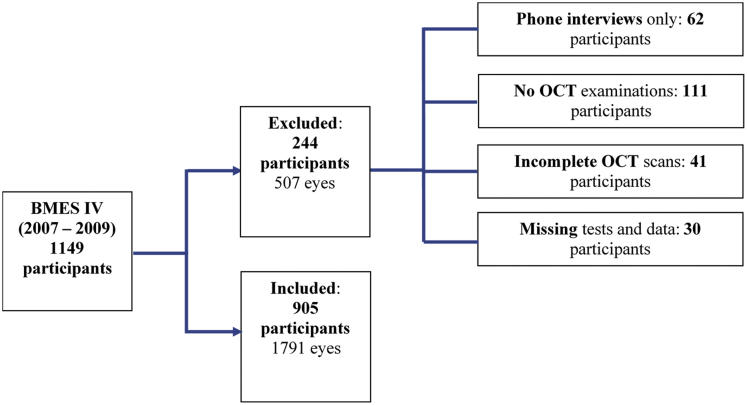
Of the 1149 participants (mean age, 76.1 ± 6.9 years) in the 15-year Blue Mountains Eye Study follow-up examination from 2007 through 2009, 905 (1791 eyes) had gradable time-domain or spectral-domain OCT scans of the macula from at least 1 eye.
OCT scans were graded according to the International Vitreomacular Traction Study Group classification system of VRI abnormalities. Best-corrected visual acuity (BCVA) was recorded.
Prevalence of VRIs.
Overall, 451 participants showed any VRI abnormality (49.8%). Prevalence of VRI abnormality by person was: vitreomacular adhesion (VMA), 33.6%; vitreomacular traction (VMT), 1.6%; epiretinal membrane (ERM), 21.4%; full-thickness macular hole (FTMH), 0.7%; and lamellar macular hole (LMH), 0.7%. Twenty-two percent of VMAs were focal, and 78% were broad based; 76% of VMTs were focal, and 24% were broad based. All FTMHs observed were large (>400 μm), with mean aperture size of 573 μm (range, 459-771 μm). Increased age was associated with higher ERM and lower VMA prevalence ( < 0.001 for both). Pseudophakia and myopia were associated with ERM (age- and sex-adjusted odds ratios [ORs], 1.48 [95% confidence interval (CI), 1.01-2.17] and 1.72 [95% CI, 1.05-2.81], respectively). Moderate or severe ERM and FTMH were associated with worse BCVA of 9.2 Early Treatment Diabetic Retinopathy Study (ETDRS) letters (95% CI, 3.4-15.0 ETDRS letters; = 0.008) and 26.0 ETDRS letters (95% CI, 10.9-41.1 ETDRS letters; = 0.001), respectively.
The prevalence of VRI abnormalities is high in older individuals. Epiretinal membrane was associated with increasing age, pseudophakia, and myopia. Epiretinal membrane and FTMH may account for significant visual loss in the affected eye. This study provided useful population-based data on the prevalence of VRI abnormalities in older individuals.
在一项针对老年人的基于人群的研究中描述玻璃体视网膜界面(VRI)异常的患病率、危险因素及相关性。
队列研究参与者的横断面分析。
在2007年至2009年进行的为期15年的蓝山眼研究随访检查的1149名参与者(平均年龄76.1±6.9岁)中,905名(1791只眼)至少有一只眼进行了可分级的黄斑区时域或频域光学相干断层扫描(OCT)。
根据国际玻璃体黄斑牵拉研究组的VRI异常分类系统对OCT扫描进行分级。记录最佳矫正视力(BCVA)。
VRI的患病率。
总体而言,451名参与者显示出任何VRI异常(49.8%)。按个体计算的VRI异常患病率为:玻璃体黄斑粘连(VMA),33.6%;玻璃体黄斑牵拉(VMT),1.6%;视网膜前膜(ERM),21.4%;全层黄斑裂孔(FTMH),0.7%;以及板层黄斑裂孔(LMH),0.7%。22%的VMA为局限性,78%为广泛型;76%的VMT为局限性,24%为广泛型。观察到的所有FTMH均较大(>400μm),平均孔径大小为573μm(范围459 - 771μm)。年龄增加与ERM患病率升高和VMA患病率降低相关(两者均P<0.001)。人工晶状体眼和近视与ERM相关(年龄和性别调整后的优势比[OR]分别为1.48[95%置信区间(CI),1.01 - 2.17]和1.72[95%CI,1.05 - 2.81])。中度或重度ERM和FTMH分别与较差的BCVA相关,相差9.2个早期糖尿病性视网膜病变研究(ETDRS)视力字母(95%CI,3.4 - 15.0个ETDRS视力字母;P = 0.008)和26.0个ETDRS视力字母(95%CI,10.9 - 41.1个ETDRS视力字母;P = 0.001)。
老年人中VRI异常的患病率较高。视网膜前膜与年龄增加、人工晶状体眼和近视相关。视网膜前膜和FTMH可能导致患眼出现明显视力丧失。本研究提供了关于老年人VRI异常患病率的有用的基于人群的数据。