Turmezei Tom D, Low Samantha B, Rupret Simon, Treece Graham M, Gee Andrew H, MacKay James W, Lynch John A, Poole Kenneth Es, Segal Neil A
Norfolk and Norwich University Hospital NHS Foundation Trust, Colney Lane, Norwich, UK.
University of East Anglia, Norwich Research Park, Norwich, UK.
Osteoarthr Imaging. 2022 Jun;2(2). doi: 10.1016/j.ostima.2022.100069. Epub 2022 Jun 17.
Computed tomography (CT) can deliver multiple parameters relevant to osteoarthritis. In this study we demonstrate that a 3-D multiparametric approach at the weight bearing knee with cone beam CT is feasible, can include multiple parameters from across the joint space, and can reveal stronger relationships with disease status in combination.
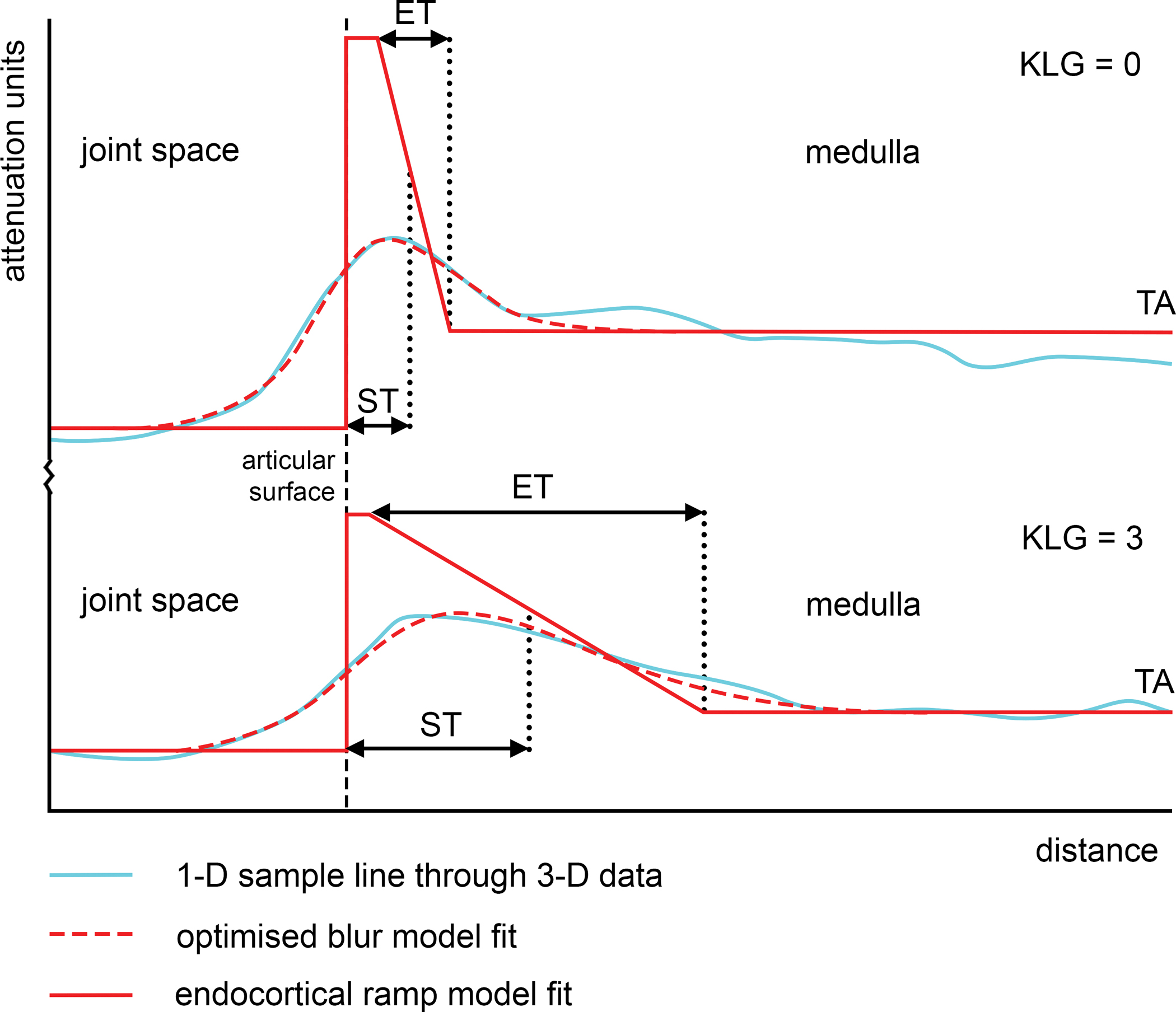
33 participants with knee weight bearing CT (WBCT) were analysed with joint space mapping and cortical bone mapping to deliver joint space width (JSW), subchondral bone plate thickness, endocortical thickness, and trabecular attenuation at both sides of the joint. All data were co-localised to the same canonical surface. Statistical parametric mapping (SPM) was applied in uni- and multivariate models to demonstrate significant dependence of parameters on Kellgren & Lawrence grade (KLG). Correlation between JSW and bony parameters and 2-week test-retest repeatability were also calculated.
SPM revealed that the central-to-posterior medial tibiofemoral joint space was significantly narrowed by up to 0.5 mm with significantly higher tibial trabecular attenuation up to 50 units for each increment in KLG as single features, and in a wider distribution when combined (p<0.05). These were also more strongly correlated with worsening KLG grade category. Test-retest repeatability was subvoxel (0.37 mm) for nearly all thickness parameters.
3-D JSW and tibial trabecular attenuation are repeatable and significantly dependent on radiographic disease severity at the weight bearing knee joint not just alone, but more strongly in combination. A quantitative multiparametric approach with WBCT may have potential for more sensitive investigation of disease progression in osteoarthritis.
计算机断层扫描(CT)能够提供与骨关节炎相关的多个参数。在本研究中,我们证明了采用锥形束CT对负重膝关节进行三维多参数分析方法是可行的,该方法可以纳入整个关节间隙的多个参数,并且联合使用时能揭示与疾病状态更强的相关性。
对33名进行膝关节负重CT(WBCT)检查的参与者进行关节间隙映射和皮质骨映射分析,以得出关节两侧的关节间隙宽度(JSW)、软骨下骨板厚度、皮质内厚度和小梁衰减。所有数据均共定位到同一个标准表面。在单变量和多变量模型中应用统计参数映射(SPM),以证明参数对凯尔格伦&劳伦斯分级(KLG)的显著依赖性。还计算了JSW与骨参数之间的相关性以及两周重测的重复性。
SPM显示,随着KLG每增加一级,作为单一特征,胫股关节中后内侧关节间隙显著变窄达0.5毫米,胫骨小梁衰减显著增加达50个单位,联合使用时分布更广泛(p<0.05)。这些变化也与KLG分级恶化更密切相关。几乎所有厚度参数的重测重复性均为亚体素(0.37毫米)。
三维JSW和胫骨小梁衰减具有可重复性,并且不仅单独显著依赖于负重膝关节的影像学疾病严重程度,联合使用时相关性更强。采用WBCT的定量多参数分析方法可能对骨关节炎疾病进展进行更敏感的研究具有潜力。