École des sciences infirmières, School of Nursing, Faculty of Health Sciences, University of Ottawa, Ottawa, Ontario, Canada.
Managua (CIES UNAN-Managua), National University Autonomous of Nicaragua, Managua, Nicaragua.
PLoS One. 2022 Oct 18;17(10):e0271493. doi: 10.1371/journal.pone.0271493. eCollection 2022.
Limited access to healthcare among children in sub-Saharan Africa (SSA) is a major cause of poor infant health indicators. Although many speculate that the private sector expansion has overwhelmingly reinforced health systems' utilization, little is known as to whether and where children are cared for when they are sick. This study investigated health-seeking behavior (HSB) among children from an urban area of Burkina Faso, with respect to disease severity and the type of provider versus children's characteristics.
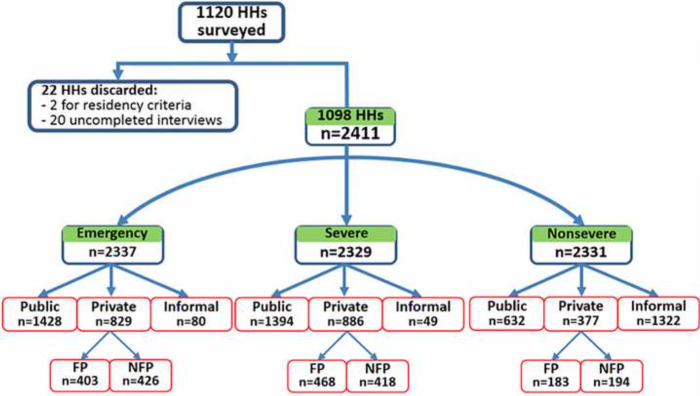
A cross-sectional population-based study was conducted in Ouagadougou, Burkina Faso using a two-stage sampling strategy. 1,098 households (2,411 children) data were collected. Generalized estimating equations (GEE) were used to analyze providers' choice for emergency, severe and non-severe conditions; sex-preference was further assessed with a χ2 test.
Thirty-six percent of children requiring emergency care sought private providers, as did 38% with severe conditions. Fifty-seven percent with non-severe conditions were self-medicated. A multivariable GEE indicated that University-educated household-heads would bring their children to for-profit (instead of public) providers for emergency (OR = 3.51, 95%CI = 1.90; 6.48), severe (OR = 4.05, 95%CI: 2.24; 7.30), and non-severe (OR = 3.25, 95%CI = 1.25; 8.42) conditions. A similar pattern was observed for insured and formal jobholders. Children's sex, age and gender was not associated with neither the type of provider preference nor the assessed health condition.
Private healthcare appeared to be crucial in the provision of care to children. The household head's socioeconomic status and insurance coverage significantly distinguished the choice of care provider. However, the phenomenon of son-preference was not found. These findings spotlighted children's HSB in Burkina Faso.
撒哈拉以南非洲(SSA)的儿童获得医疗保健的机会有限,这是婴儿健康指标较差的主要原因。尽管许多人推测私营部门的扩张在很大程度上加强了卫生系统的利用,但对于儿童患病时在哪里以及由谁照顾的问题知之甚少。本研究调查了布基纳法索城市地区儿童的就医行为(HSB),考虑了疾病严重程度和提供者类型与儿童特征之间的关系。
本研究在布基纳法索瓦加杜古采用两阶段抽样策略进行了一项横断面人群研究。共收集了 1098 户家庭(2411 名儿童)的数据。使用广义估计方程(GEE)分析了紧急、严重和非严重情况下选择提供者的情况;进一步使用 χ2 检验评估了性别偏好。
需要紧急护理的儿童中有 36%选择了私立提供者,严重疾病患儿的这一比例为 38%。57%的非严重疾病患儿自行用药。多变量 GEE 表明,受过大学教育的家庭负责人会带孩子去营利性(而非公立)提供者那里寻求紧急(OR = 3.51,95%CI = 1.90;6.48)、严重(OR = 4.05,95%CI:2.24;7.30)和非严重(OR = 3.25,95%CI = 1.25;8.42)疾病的治疗。对于参保和有正式工作的人也观察到了类似的模式。儿童的性别、年龄和性别与提供者偏好类型或评估的健康状况均无关。
私营医疗保健似乎在儿童护理中至关重要。家庭负责人的社会经济地位和保险覆盖范围显著区分了护理提供者的选择。然而,并未发现儿子偏好的现象。这些发现突显了布基纳法索儿童的 HSB。