• 文献检索
  • 文档翻译
  • 深度研究
  • 学术资讯
  • Suppr Zotero 插件Zotero 插件
  • 邀请有礼
  • 套餐&价格
  • 历史记录
应用&插件
Suppr Zotero 插件Zotero 插件浏览器插件Mac 客户端Windows 客户端微信小程序
定价
高级版会员购买积分包购买API积分包
服务
文献检索文档翻译深度研究API 文档MCP 服务
关于我们
关于 Suppr公司介绍联系我们用户协议隐私条款
关注我们

Suppr 超能文献

核心技术专利:CN118964589B侵权必究
粤ICP备2023148730 号-1Suppr @ 2026

文献检索

告别复杂PubMed语法,用中文像聊天一样搜索,搜遍4000万医学文献。AI智能推荐,让科研检索更轻松。

立即免费搜索

文件翻译

保留排版,准确专业,支持PDF/Word/PPT等文件格式,支持 12+语言互译。

免费翻译文档

深度研究

AI帮你快速写综述,25分钟生成高质量综述,智能提取关键信息,辅助科研写作。

立即免费体验

基于流形正则化的人体运动预测

Physical human locomotion prediction using manifold regularization.

作者信息

Javeed Madiha, Shorfuzzaman Mohammad, Alsufyani Nawal, Chelloug Samia Allaoua, Jalal Ahmad, Park Jeongmin

机构信息

Department of Computer Science, Air University, Islamabad, ICT, Pakistan.

Department of Computer Science, College of Computers and Information Technology, Taif University, Taif, Saudi Arabia.

出版信息

PeerJ Comput Sci. 2022 Oct 12;8:e1105. doi: 10.7717/peerj-cs.1105. eCollection 2022.

DOI:10.7717/peerj-cs.1105
PMID:36262158
原文链接:https://pmc.ncbi.nlm.nih.gov/articles/PMC9575869/
Abstract

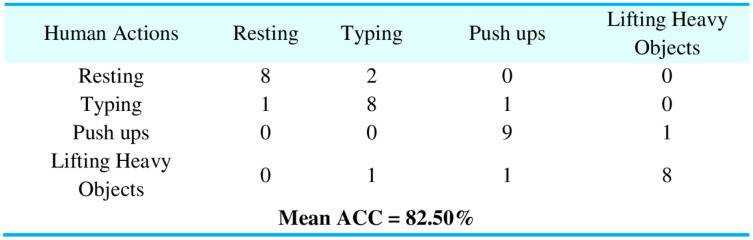
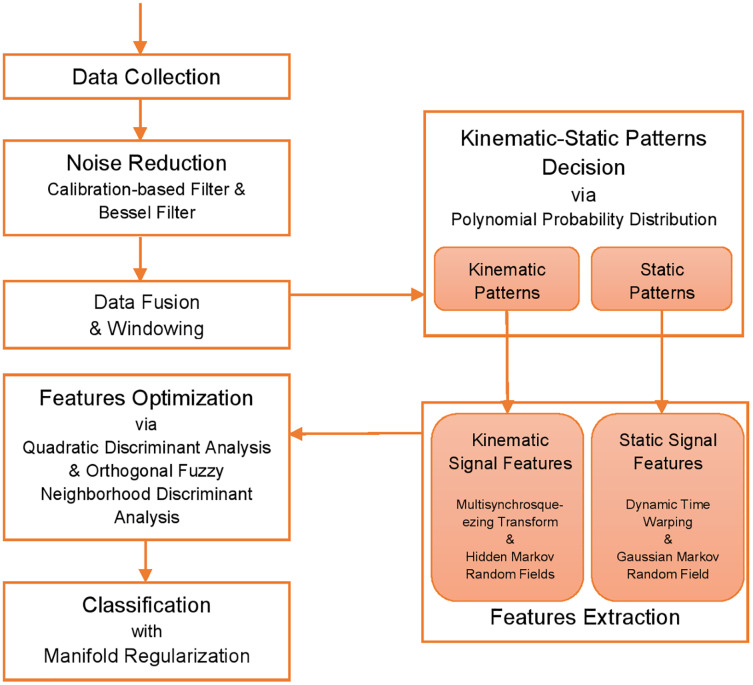
Human locomotion is an imperative topic to be conversed among researchers. Predicting the human motion using multiple techniques and algorithms has always been a motivating subject matter. For this, different methods have shown the ability of recognizing simple motion patterns. However, predicting the dynamics for complex locomotion patterns is still immature. Therefore, this article proposes unique methods including the calibration-based filter algorithm and kinematic-static patterns identification for predicting those complex activities from fused signals. Different types of signals are extracted from benchmarked datasets and pre-processed using a novel calibration-based filter for inertial signals along with a Bessel filter for physiological signals. Next, sliding overlapped windows are utilized to get motion patterns defined over time. Then, polynomial probability distribution is suggested to decide the motion patterns natures. For features extraction based kinematic-static patterns, time and probability domain features are extracted over physical action dataset (PAD) and growing old together validation (GOTOV) dataset. Further, the features are optimized using quadratic discriminant analysis and orthogonal fuzzy neighborhood discriminant analysis techniques. Manifold regularization algorithms have also been applied to assess the performance of proposed prediction system. For the physical action dataset, we achieved an accuracy rate of 82.50% for patterned signals. While, the GOTOV dataset, we achieved an accuracy rate of 81.90%. As a result, the proposed system outdid when compared to the other state-of-the-art models in literature.

摘要

人类运动是研究人员之间必须探讨的一个重要话题。使用多种技术和算法预测人类运动一直是一个备受关注的主题。为此,不同的方法已显示出识别简单运动模式的能力。然而,预测复杂运动模式的动力学仍然不够成熟。因此,本文提出了独特的方法,包括基于校准的滤波算法和运动学 - 静态模式识别,用于从融合信号中预测那些复杂活动。从基准数据集中提取不同类型的信号,并使用一种新颖的基于校准的惯性信号滤波器以及用于生理信号的贝塞尔滤波器进行预处理。接下来,利用滑动重叠窗口来获取随时间定义的运动模式。然后,建议使用多项式概率分布来确定运动模式的性质。对于基于特征提取的运动学 - 静态模式,在物理动作数据集(PAD)和共同老化验证(GOTOV)数据集上提取时间和概率域特征。此外,使用二次判别分析和正交模糊邻域判别分析技术对特征进行优化。还应用了流形正则化算法来评估所提出的预测系统的性能。对于物理动作数据集,我们对模式信号实现了82.50%的准确率。而对于GOTOV数据集,我们实现了81.90%的准确率。结果,与文献中其他现有技术模型相比,所提出的系统表现更优。
https://cdn.ncbi.nlm.nih.gov/pmc/blobs/d09b/9575869/bfbefd8e84dd/peerj-cs-08-1105-g013.jpg
https://cdn.ncbi.nlm.nih.gov/pmc/blobs/d09b/9575869/6cfe0d61aedf/peerj-cs-08-1105-g001.jpg
https://cdn.ncbi.nlm.nih.gov/pmc/blobs/d09b/9575869/dc8fd94b3c1f/peerj-cs-08-1105-g002.jpg
https://cdn.ncbi.nlm.nih.gov/pmc/blobs/d09b/9575869/c20283ac3f59/peerj-cs-08-1105-g003.jpg
https://cdn.ncbi.nlm.nih.gov/pmc/blobs/d09b/9575869/376706a89a20/peerj-cs-08-1105-g004.jpg
https://cdn.ncbi.nlm.nih.gov/pmc/blobs/d09b/9575869/48bb93b5d963/peerj-cs-08-1105-g005.jpg
https://cdn.ncbi.nlm.nih.gov/pmc/blobs/d09b/9575869/7f76bfdd944d/peerj-cs-08-1105-g006.jpg
https://cdn.ncbi.nlm.nih.gov/pmc/blobs/d09b/9575869/8a7bf9ccde3a/peerj-cs-08-1105-g007.jpg
https://cdn.ncbi.nlm.nih.gov/pmc/blobs/d09b/9575869/f3df241268ba/peerj-cs-08-1105-g008.jpg
https://cdn.ncbi.nlm.nih.gov/pmc/blobs/d09b/9575869/eb2dd26daa57/peerj-cs-08-1105-g009.jpg
https://cdn.ncbi.nlm.nih.gov/pmc/blobs/d09b/9575869/36f5b0d8dae8/peerj-cs-08-1105-g010.jpg
https://cdn.ncbi.nlm.nih.gov/pmc/blobs/d09b/9575869/aec01c1f4923/peerj-cs-08-1105-g012.jpg
https://cdn.ncbi.nlm.nih.gov/pmc/blobs/d09b/9575869/bfbefd8e84dd/peerj-cs-08-1105-g013.jpg
https://cdn.ncbi.nlm.nih.gov/pmc/blobs/d09b/9575869/6cfe0d61aedf/peerj-cs-08-1105-g001.jpg
https://cdn.ncbi.nlm.nih.gov/pmc/blobs/d09b/9575869/dc8fd94b3c1f/peerj-cs-08-1105-g002.jpg
https://cdn.ncbi.nlm.nih.gov/pmc/blobs/d09b/9575869/c20283ac3f59/peerj-cs-08-1105-g003.jpg
https://cdn.ncbi.nlm.nih.gov/pmc/blobs/d09b/9575869/376706a89a20/peerj-cs-08-1105-g004.jpg
https://cdn.ncbi.nlm.nih.gov/pmc/blobs/d09b/9575869/48bb93b5d963/peerj-cs-08-1105-g005.jpg
https://cdn.ncbi.nlm.nih.gov/pmc/blobs/d09b/9575869/7f76bfdd944d/peerj-cs-08-1105-g006.jpg
https://cdn.ncbi.nlm.nih.gov/pmc/blobs/d09b/9575869/8a7bf9ccde3a/peerj-cs-08-1105-g007.jpg
https://cdn.ncbi.nlm.nih.gov/pmc/blobs/d09b/9575869/f3df241268ba/peerj-cs-08-1105-g008.jpg
https://cdn.ncbi.nlm.nih.gov/pmc/blobs/d09b/9575869/eb2dd26daa57/peerj-cs-08-1105-g009.jpg
https://cdn.ncbi.nlm.nih.gov/pmc/blobs/d09b/9575869/36f5b0d8dae8/peerj-cs-08-1105-g010.jpg
https://cdn.ncbi.nlm.nih.gov/pmc/blobs/d09b/9575869/aec01c1f4923/peerj-cs-08-1105-g012.jpg
https://cdn.ncbi.nlm.nih.gov/pmc/blobs/d09b/9575869/bfbefd8e84dd/peerj-cs-08-1105-g013.jpg

相似文献

1
Physical human locomotion prediction using manifold regularization.基于流形正则化的人体运动预测
PeerJ Comput Sci. 2022 Oct 12;8:e1105. doi: 10.7717/peerj-cs.1105. eCollection 2022.
2
A Multimodal IoT-Based Locomotion Classification System Using Features Engineering and Recursive Neural Network.基于多模态物联网的运动分类系统,采用特征工程和递归神经网络。
Sensors (Basel). 2023 May 12;23(10):4716. doi: 10.3390/s23104716.
3
An adaptive motion regularization technique to support sliding motion in deformable image registration.一种自适应运动正则化技术,用于支持变形图像配准中的滑动运动。
Med Phys. 2018 Feb;45(2):735-747. doi: 10.1002/mp.12734. Epub 2018 Jan 12.
4
The Role of Surface Electromyography in Data Fusion with Inertial Sensors to Enhance Locomotion Recognition and Prediction.表面肌电图在与惯性传感器的数据融合中的作用,以增强运动识别和预测。
Sensors (Basel). 2021 Sep 19;21(18):6291. doi: 10.3390/s21186291.
5
Elbow Motion Trajectory Prediction Using a Multi-Modal Wearable System: A Comparative Analysis of Machine Learning Techniques.基于多模态可穿戴系统的肘部运动轨迹预测:机器学习技术的比较分析。
Sensors (Basel). 2021 Jan 12;21(2):498. doi: 10.3390/s21020498.
6
A Novel Time-Varying Spectral Filtering Algorithm for Reconstruction of Motion Artifact Corrupted Heart Rate Signals During Intense Physical Activities Using a Wearable Photoplethysmogram Sensor.一种用于使用可穿戴光电容积脉搏波传感器在剧烈体育活动期间重建受运动伪影干扰的心率信号的新型时变频谱滤波算法。
Sensors (Basel). 2015 Dec 23;16(1):10. doi: 10.3390/s16010010.
7
On Inertial Body Tracking in the Presence of Model Calibration Errors.存在模型校准误差时的惯性人体跟踪
Sensors (Basel). 2016 Jul 22;16(7):1132. doi: 10.3390/s16071132.
8
Predicting the outcome of respiratory motion prediction.预测呼吸运动预测的结果。
Med Phys. 2011 Oct;38(10):5569-81. doi: 10.1118/1.3633907.
9
Upper-Limb Motion Recognition Based on Hybrid Feature Selection: Algorithm Development and Validation.基于混合特征选择的上肢运动识别:算法开发与验证。
JMIR Mhealth Uhealth. 2021 Sep 2;9(9):e24402. doi: 10.2196/24402.
10
A New Quaternion-Based Kalman Filter for Human Body Motion Tracking Using the Second Estimator of the Optimal Quaternion Algorithm and the Joint Angle Constraint Method with Inertial and Magnetic Sensors.基于四元数的新卡尔曼滤波器,用于使用最优四元数算法的第二个估计器和惯性与磁传感器的关节角度约束方法进行人体运动跟踪。
Sensors (Basel). 2020 Oct 23;20(21):6018. doi: 10.3390/s20216018.

引用本文的文献

1
IoT powered RNN for improved human activity recognition with enhanced localization and classification.用于通过增强定位和分类改进人类活动识别的物联网驱动循环神经网络。
Sci Rep. 2025 Mar 25;15(1):10328. doi: 10.1038/s41598-025-94689-5.
2
Intelligent ADL Recognition via IoT-Based Multimodal Deep Learning Framework.基于物联网的多模态深度学习框架实现智能日常生活活动识别
Sensors (Basel). 2023 Sep 16;23(18):7927. doi: 10.3390/s23187927.
3
Intelligent Localization and Deep Human Activity Recognition through IoT Devices.通过物联网设备实现智能定位和深度人体活动识别。

本文引用的文献

1
Complex Deep Neural Networks from Large Scale Virtual IMU Data for Effective Human Activity Recognition Using Wearables.利用可穿戴设备,从大规模虚拟 IMU 数据中构建复杂深度神经网络,以实现有效的人体活动识别。
Sensors (Basel). 2021 Dec 13;21(24):8337. doi: 10.3390/s21248337.
2
Syntactic model-based human body 3D reconstruction and event classification via association based features mining and deep learning.基于句法模型的人体三维重建与事件分类:通过关联特征挖掘与深度学习实现
PeerJ Comput Sci. 2021 Nov 19;7:e764. doi: 10.7717/peerj-cs.764. eCollection 2021.
3
sEMG dataset of routine activities.
Sensors (Basel). 2023 Aug 23;23(17):7363. doi: 10.3390/s23177363.
4
A Multimodal IoT-Based Locomotion Classification System Using Features Engineering and Recursive Neural Network.基于多模态物联网的运动分类系统,采用特征工程和递归神经网络。
Sensors (Basel). 2023 May 12;23(10):4716. doi: 10.3390/s23104716.
日常活动的表面肌电图数据集。
Data Brief. 2020 Nov 19;33:106543. doi: 10.1016/j.dib.2020.106543. eCollection 2020 Dec.
4
A Study of Accelerometer and Gyroscope Measurements in Physical Life-Log Activities Detection Systems.在物理生活日志活动检测系统中,对加速度计和陀螺仪测量的研究。
Sensors (Basel). 2020 Nov 21;20(22):6670. doi: 10.3390/s20226670.
5
A Semisupervised Recurrent Convolutional Attention Model for Human Activity Recognition.半监督循环卷积注意模型在人体活动识别中的应用
IEEE Trans Neural Netw Learn Syst. 2020 May;31(5):1747-1756. doi: 10.1109/TNNLS.2019.2927224. Epub 2019 Jul 19.
6
Evaluation of feature extraction techniques and classifiers for finger movement recognition using surface electromyography signal.基于表面肌电信号的手指运动识别的特征提取技术和分类器评估。
Med Biol Eng Comput. 2018 Dec;56(12):2259-2271. doi: 10.1007/s11517-018-1857-5. Epub 2018 Jun 18.
7
Polynomial probability distribution estimation using the method of moments.使用矩量法进行多项式概率分布估计。
PLoS One. 2017 Apr 10;12(4):e0174573. doi: 10.1371/journal.pone.0174573. eCollection 2017.
8
Orthogonal fuzzy neighborhood discriminant analysis for multifunction myoelectric hand control.正交模糊近邻判别分析在多功能肌电手控制中的应用。
IEEE Trans Biomed Eng. 2010 Jun;57(6):1410-9. doi: 10.1109/TBME.2009.2039480. Epub 2010 Feb 17.
9
Gradient descent learning algorithm overview: a general dynamical systems perspective.梯度下降学习算法概述:一个一般动力系统视角。
IEEE Trans Neural Netw. 1995;6(1):182-95. doi: 10.1109/72.363438.