Department of Anesthesiology and Pain Medicine, Seoul National University Bundang Hospital, 82 Gumi-ro 173 Beon-gil, Bundang-gu, Seongnam 13620, Republic of Korea.
Department of Anesthesiology and Pain Medicine, Ajou University, School of Medicine, 164 World Cup-Ro, Yeongtong-Gu, Suwon 16499, Republic of Korea.
Int J Clin Pract. 2022 Sep 19;2022:6343837. doi: 10.1155/2022/6343837. eCollection 2022.
Nonsurgical spinal decompression therapy (NSDT) is a conservative treatment for the lumbosacral herniated intervertebral disc (L-HIVD). This study aimed to evaluate the clinical effectiveness of the NSDT and change in disc volume through magnetic resonance imaging (MRI) in subacute L-HIVD.
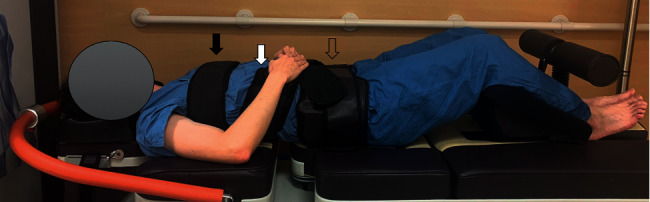
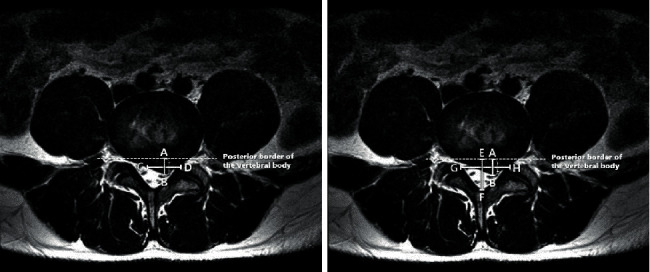
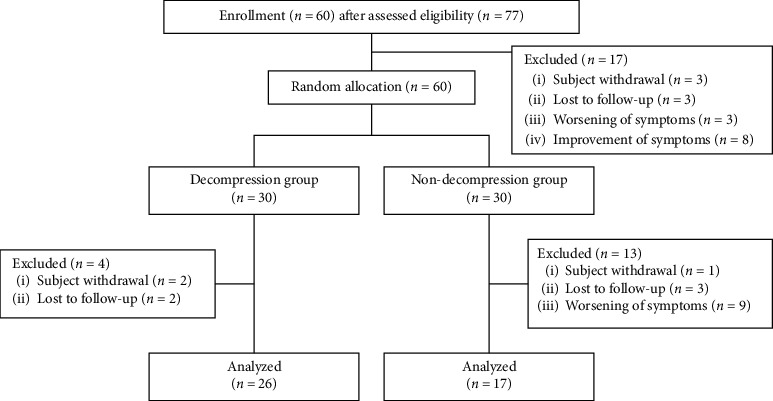
Sixty patients with subacute L-HIVD were randomized into either the decompression group (group D, = 30) or the nondecompression group (group N, = 30). In group D, NSDT was performed ten times in eight weeks. In group N, pseudodecompression therapy (no force) was performed with the same protocol. Lower back and lower leg pain intensities and functional improvements were measured by the visual analog scale and the Korean Oswestry Disability Index (K-ODI). The change in the lumbosacral disc herniation index (HI) was evaluated through a follow-up MRI three months after the therapy.
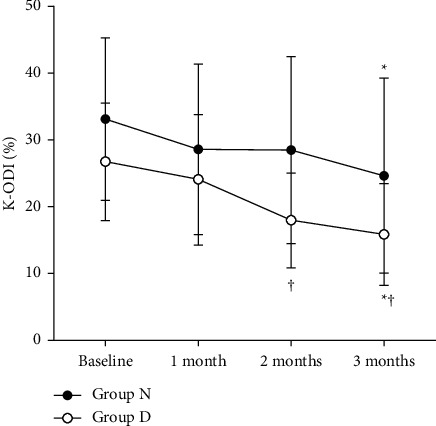
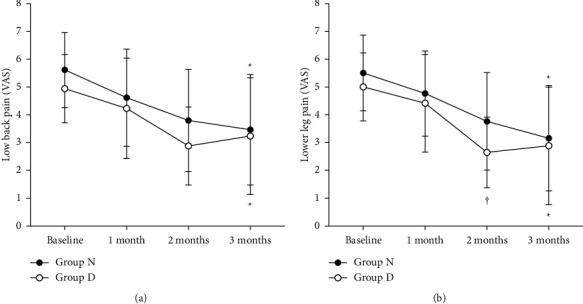
The lower leg pain intensity in group D was lower than that in group N at two months (=0.028). Additionally, there were significantly lower K-ODI scores in group D at two and three months (=0.023, 0.019) than in group N. The change in HI after the therapy was -27.6 ± 27.5 (%) in group D and -7.1 ± 24.9 (%) in group N, with a significant difference (=0.017). Approximately 26.9% of patients in group D and no patients in group N showed over 50% reduction in HI (=0.031).
NSDT may be a suitable treatment option for conservative treatment of subacute L-HIVD.
非手术脊柱减压疗法(NSDT)是治疗腰骶椎间盘突出症(L-HIVD)的保守治疗方法。本研究旨在评估 NSDT 对亚急性 L-HIVD 的临床疗效,并通过磁共振成像(MRI)评估椎间盘容积的变化。
将 60 例亚急性 L-HIVD 患者随机分为减压组(D 组,n=30)和非减压组(N 组,n=30)。D 组在 8 周内进行 10 次 NSDT。N 组采用相同方案进行假性减压治疗(无压力)。通过视觉模拟评分和韩国 Oswestry 残疾指数(K-ODI)测量腰背和下肢疼痛强度和功能改善情况。通过治疗后 3 个月的随访 MRI 评估腰骶椎间盘突出指数(HI)的变化。
D 组的下肢疼痛强度在治疗后 2 个月时低于 N 组(=0.028)。此外,D 组在治疗后 2 个月和 3 个月时的 K-ODI 评分均显著低于 N 组(=0.023,0.019)。治疗后 HI 的变化,D 组为-27.6±27.5(%),N 组为-7.1±24.9(%),差异有统计学意义(=0.017)。D 组约 26.9%的患者 HI 减少超过 50%,而 N 组无患者(=0.031)。
NSDT 可能是治疗亚急性 L-HIVD 的一种合适的保守治疗方法。