Wang Yi, Dai Guogang, Jiang Ling, Liao Shichuan
Cervicodynia/Omalgia/Lumbago/Sciatica Department 2, Sichuan Provincial Orthopedics Hospital, 132 West First Section First Ring Road, Chengdu, 610041, Sichuan Province, China.
College Hospital, Sichuan Agricultural University-Chengdu Campus, 211 Huimin Road, Wenjiang District, Cheng Du, Sichuan Province, China.
BMC Musculoskelet Disord. 2020 Aug 10;21(1):530. doi: 10.1186/s12891-020-03548-z.
Although the regression of symptomatic lumbar disc herniation (SLDH) has been widely reported, little data exist regarding the generalized incidence of regression (IR). We aimed to review the varying IRs and to synthesize the pooled IR of non-surgically-treated SLDH.
Four electronic databases were searched for relevant studies pertaining to the regression of SLDH after non-surgical treatment and for potential studies that may have reported morphological changes in lumbar disc herniation in the follow-up results of SLDH patients treated non-surgically. The main outcome was the regression of SLDH. A random effects model was used to determine the pooled IR of SLDH.
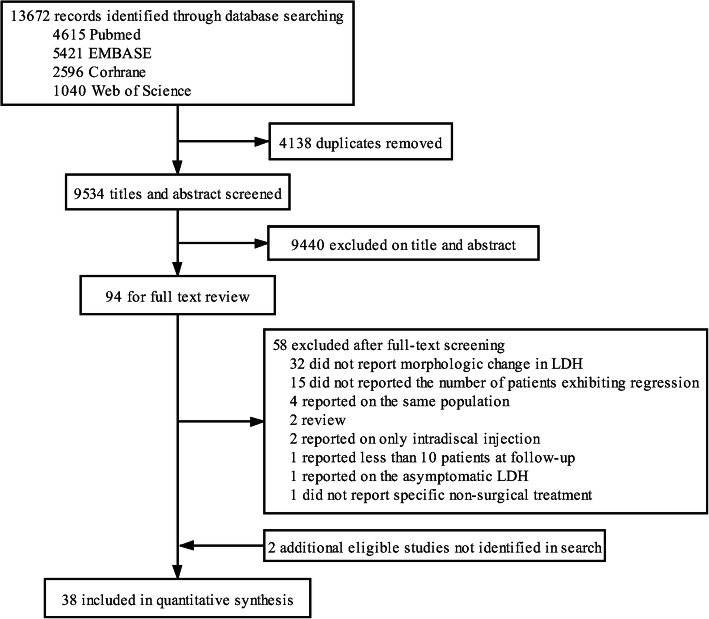
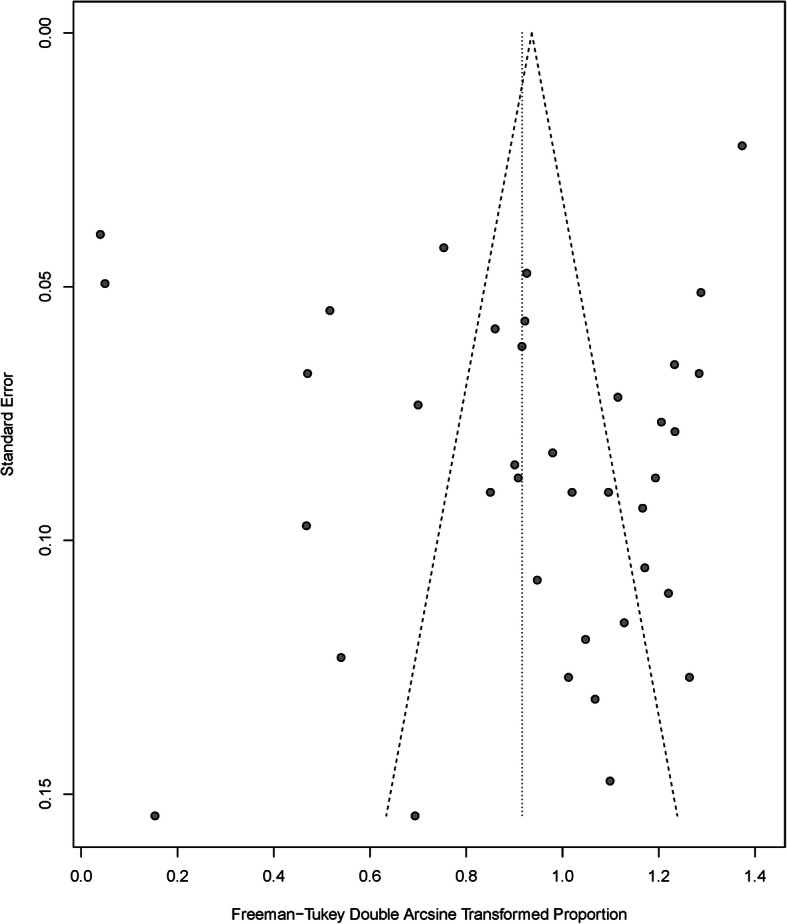
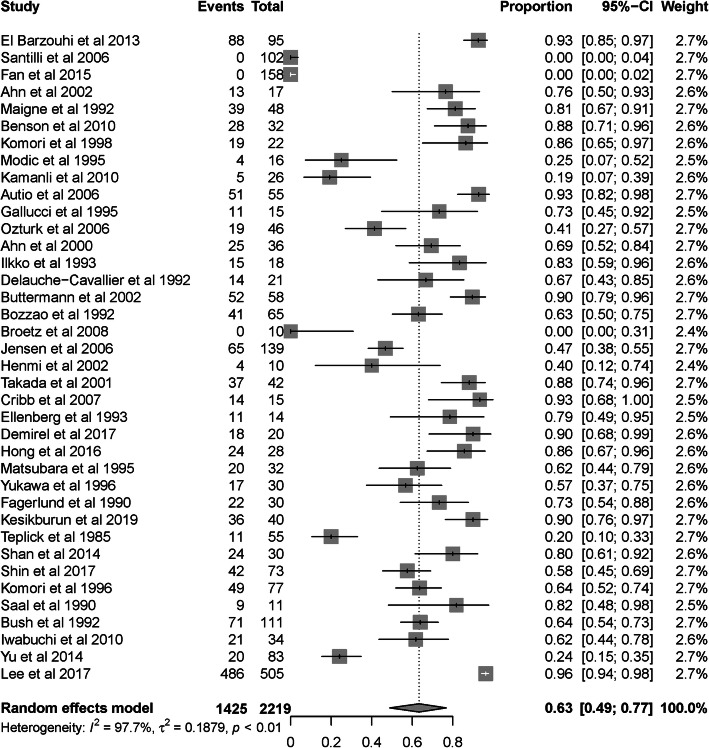
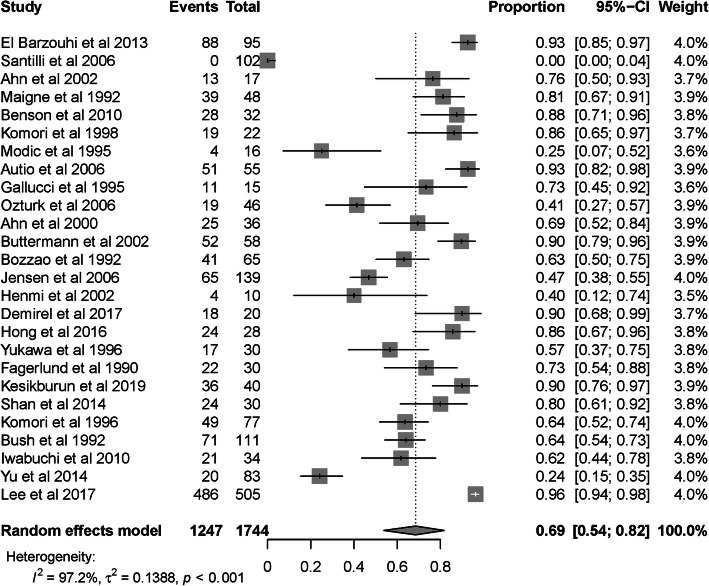
We identified 13,672 articles, 38 of which were eligible for analysis. Our analysis included 2219 non-surgically treated SLDH patients, 1425 of whom presented regression. The pooled IR was 63% (95% CI 0.49-0.77). In subgroup analyses, studies that quantitatively measured the regression of SLDH yielded statistically higher pooled IRs than those that used qualitative methods. The pooled IRs gradually increased in randomized controlled trials and prospective and retrospective studies. The pooled IR varied from 62 to 66% after the sequential omission of any single study. Meta-regression showed that study types, herniation levels and regression measurements caused heterogeneity.
We report an overall IR of 63% among non-surgically treated SLDH patients, thus providing clinical decision makers with quantitative evidence of IR. Based on our systematic review, we suggest a follow-up timeline with time points 4 and 10.5 months after onset when deciding whether to perform surgery for SLDH.
尽管有症状的腰椎间盘突出症(SLDH)的病情缓解已有广泛报道,但关于病情缓解的总体发生率(IR)的数据却很少。我们旨在回顾不同的病情缓解发生率,并综合非手术治疗的SLDH的合并发生率。
检索了四个电子数据库,以查找与非手术治疗后SLDH病情缓解相关的研究,以及可能在非手术治疗的SLDH患者随访结果中报告腰椎间盘突出症形态学变化的潜在研究。主要结局是SLDH的病情缓解。采用随机效应模型确定SLDH的合并发生率。
我们共识别出13672篇文章,其中38篇符合分析条件。我们的分析纳入了2219例非手术治疗的SLDH患者,其中1425例病情出现缓解。合并发生率为63%(95%CI 0.49 - 0.77)。在亚组分析中,定量测量SLDH病情缓解的研究得出的合并发生率在统计学上高于使用定性方法的研究。在随机对照试验以及前瞻性和回顾性研究中,合并发生率逐渐升高。依次剔除任何一项研究后,合并发生率在62%至66%之间变化。Meta回归显示,研究类型、突出节段和病情缓解测量方法导致了异质性。
我们报告非手术治疗的SLDH患者总体病情缓解发生率为63%,从而为临床决策者提供了病情缓解发生率的定量证据。基于我们的系统评价,我们建议在决定是否对SLDH进行手术时,采用发病后4个月和10.5个月的时间点作为随访时间线。