New Mexico Consortium, Los Alamos, NM, USA.
Los Alamos National Laboratory, Los Alamos, NM, USA.
Nat Methods. 2022 Nov;19(11):1376-1382. doi: 10.1038/s41592-022-01645-6. Epub 2022 Oct 20.
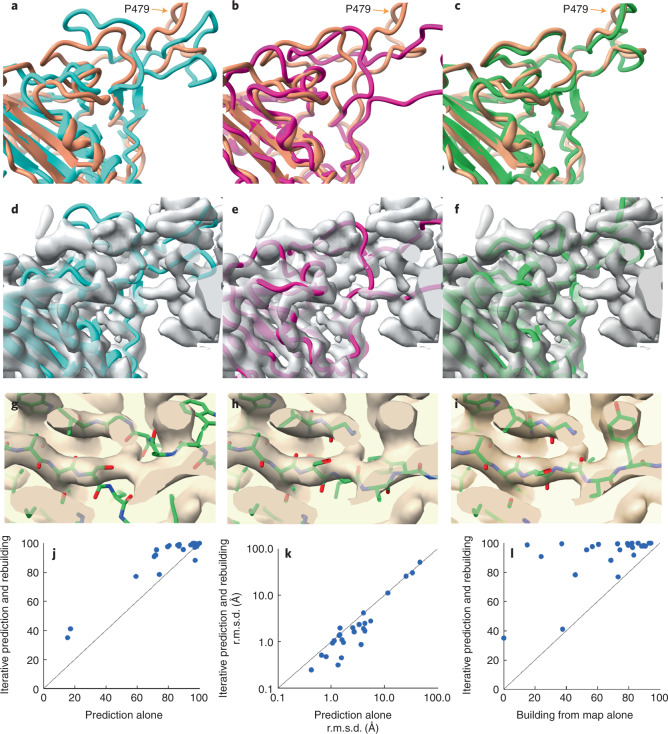
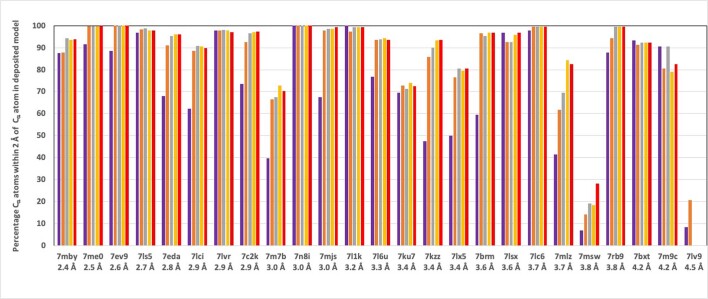
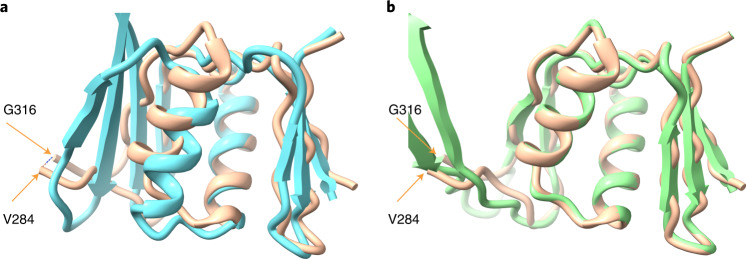
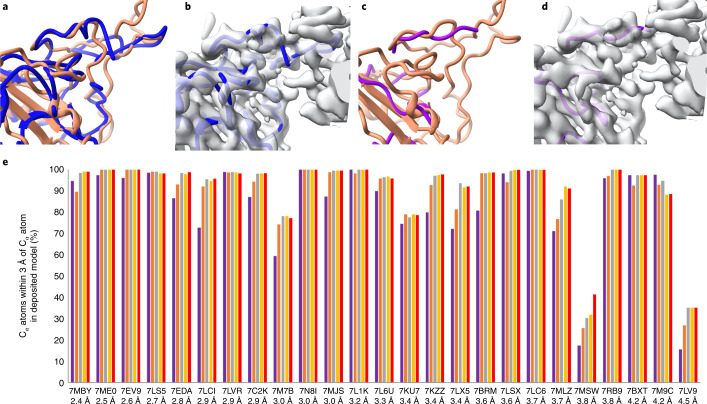
Machine-learning prediction algorithms such as AlphaFold and RoseTTAFold can create remarkably accurate protein models, but these models usually have some regions that are predicted with low confidence or poor accuracy. We hypothesized that by implicitly including new experimental information such as a density map, a greater portion of a model could be predicted accurately, and that this might synergistically improve parts of the model that were not fully addressed by either machine learning or experiment alone. An iterative procedure was developed in which AlphaFold models are automatically rebuilt on the basis of experimental density maps and the rebuilt models are used as templates in new AlphaFold predictions. We show that including experimental information improves prediction beyond the improvement obtained with simple rebuilding guided by the experimental data. This procedure for AlphaFold modeling with density has been incorporated into an automated procedure for interpretation of crystallographic and electron cryo-microscopy maps.
机器学习预测算法,如 AlphaFold 和 RoseTTAFold,可以创建非常准确的蛋白质模型,但这些模型通常有一些区域的预测置信度较低或准确性较差。我们假设,通过隐式地包含新的实验信息,如密度图,可以更准确地预测模型的更大部分,并且这可能会协同提高仅通过机器学习或实验都无法完全解决的模型部分。开发了一种迭代过程,其中根据实验密度图自动重建 AlphaFold 模型,并且将重建的模型用作新的 AlphaFold 预测中的模板。我们表明,包含实验信息可以提高预测精度,超过仅通过实验数据指导的简单重建所获得的精度。这种带有密度的 AlphaFold 建模程序已被纳入用于解释晶体学和电子冷冻显微镜图的自动程序中。