Whitney Jon, Dollinger Liisa, Tamrazi Benita, Hawes Debra, Couce Marta, Marcheque Julia, Judkins Alexander, Margol Ashley, Madabhushi Anant
Department of Biomedical Engineering, Cleveland, OH, USA.
Case Western Reserve University School of Medicine, Cleveland, OH, USA.
J Pathol Inform. 2022 Feb 17;13:100090. doi: 10.1016/j.jpi.2022.100090. eCollection 2022.
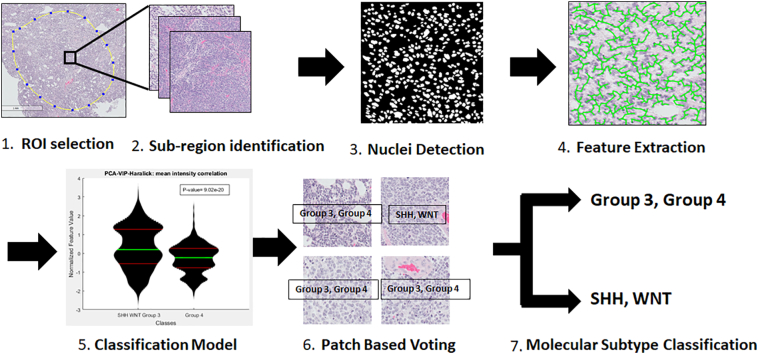
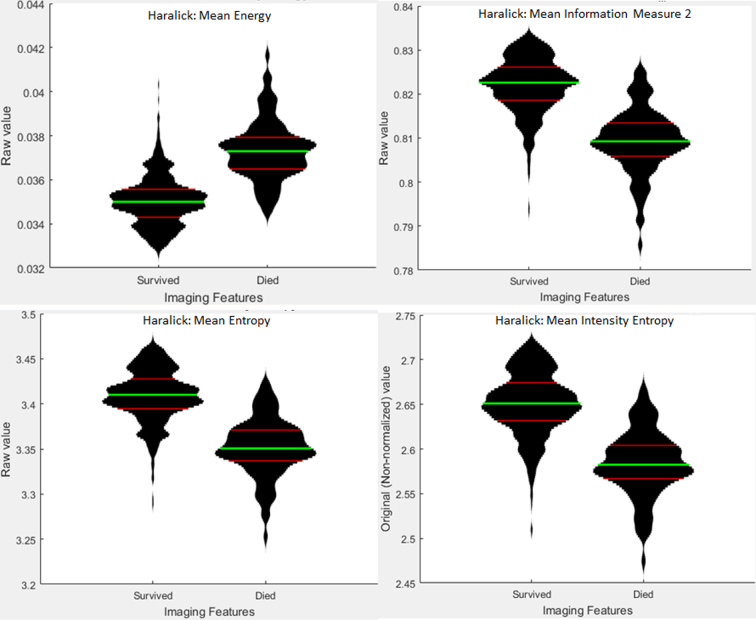
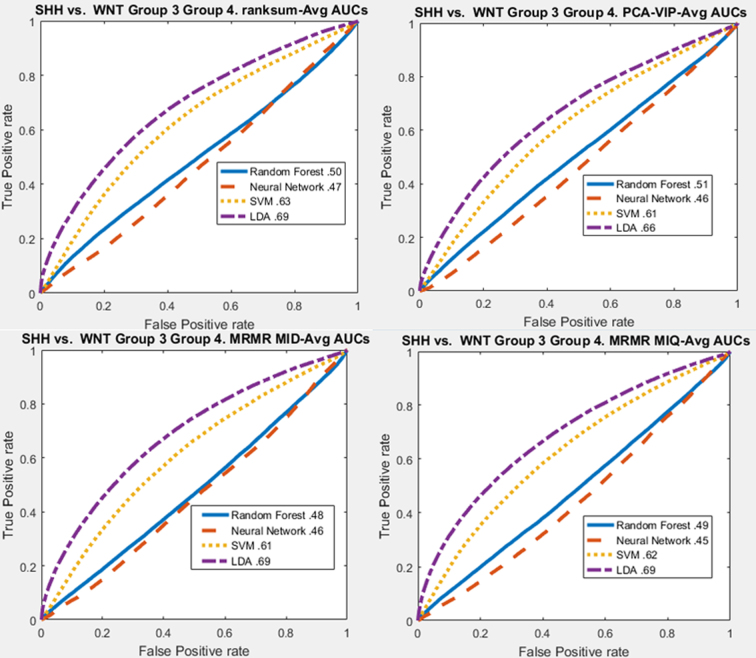
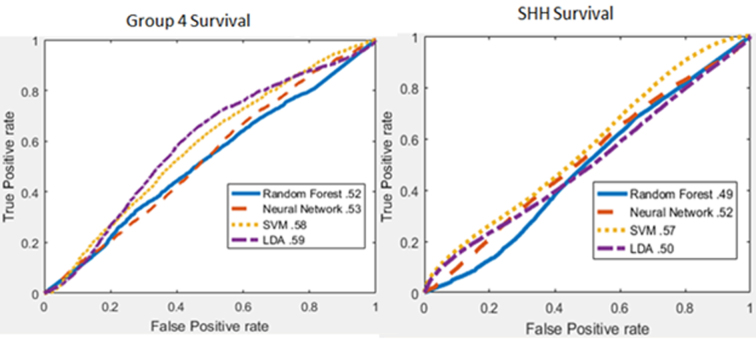
Molecular subtypes of medulloblastoma [Sonic Hedgehog (SHH), Wingless/INT (WNT), Group 3, and Group 4] are defined by common patterns of gene expression. These differential gene expression patterns appear to result in different histomorphology and prognosis. Quantitative histomorphometry is a well-known method of computer-aided pathology image analysis. The hypotheses we sought to examine in this preliminary proof of concept study were whether computer extracted nuclear morphological features of medulloblastomas from digitized tissue slide images could independently: (1) distinguish between molecularly determined subgroups and (2) identify patterns within these subgroups that correspond with clinical outcome. Our dataset was composed of 46 medulloblastoma patients: 16 SHH (5 dead, 11 survived), 3 WNT (0 dead, 3 survived), 12 Group 3 (4 dead, 8 survived), and 15 were Group 4 (5 dead, 10 survived). A watershed-based thresholding scheme was used to automatically identify individual nuclei within digitized whole slide hematoxylin and eosin tissue images. Quantitative histomorphometric features corresponding to the texture (variation in pixel intensity), shape (variations in size, roundness), and architectural rearrangement (distances between, and number of connected neighbors) of nuclei were subsequently extracted. These features were ranked using feature selection schemes and these top-ranked features were then used to train machine-learning classifiers via threefold cross-validation to separate patients based on: (1) molecular subtype and (2) disease-specific outcomes within the individual molecular subtype groups. SHH and WNT tumors were separated from Groups 3 and 4 tumors with a maximum area under the receiver operating characteristic curve (AUC) of 0.7, survival within Group 3 tumors was predicted with an AUC of 0.92, and Group 3 and 4 patients were separated into high- and low-risk groups with = 0.002. Model prediction was quantitatively compared with age, stage, and histological subtype using univariate and multivariate Cox hazard ratio models. Age was the most statistically significant variable for predicting survival in Group 3 and 4 tumors, but model predictions had the highest hazard ratio value. Quantitative nuclear histomorphometry can be used to study medulloblastoma genetic expression phenotypes as it may distinguish meaningful features of disease pathology.
髓母细胞瘤的分子亚型[音猬因子(SHH)、无翅/整合(WNT)、3组和4组]由常见的基因表达模式定义。这些不同的基因表达模式似乎导致了不同的组织形态学和预后。定量组织形态计量学是一种众所周知的计算机辅助病理图像分析方法。在这项初步概念验证研究中,我们试图检验的假设是,从数字化组织切片图像中计算机提取的髓母细胞瘤核形态特征是否能够独立:(1)区分分子确定的亚组;(2)识别这些亚组内与临床结果相关的模式。我们的数据集由46例髓母细胞瘤患者组成:16例SHH型(5例死亡,11例存活),3例WNT型(0例死亡,3例存活),12例3组(4例死亡,8例存活),15例4组(5例死亡,10例存活)。基于分水岭的阈值化方案用于自动识别数字化全切片苏木精和伊红组织图像中的单个细胞核。随后提取与细胞核的纹理(像素强度变化)、形状(大小、圆度变化)和结构重排(相邻细胞核之间的距离和连接邻居的数量)相对应的定量组织形态计量学特征。使用特征选择方案对这些特征进行排序,然后使用这些排名靠前的特征通过三重交叉验证来训练机器学习分类器,以根据以下因素对患者进行分类:(1)分子亚型;(2)各个分子亚型组内的疾病特异性结果。SHH和WNT肿瘤与3组和4组肿瘤分离,受试者操作特征曲线(AUC)下的最大面积为0.7,3组肿瘤内的生存情况预测AUC为0.92,3组和4组患者被分为高风险和低风险组,P = 0.002。使用单变量和多变量Cox风险比模型将模型预测与年龄、分期和组织学亚型进行定量比较。年龄是预测3组和4组肿瘤生存的最具统计学意义的变量,但模型预测的风险比值最高。定量细胞核组织形态计量学可用于研究髓母细胞瘤的基因表达表型,因为它可能区分疾病病理学的有意义特征。