Department of Internal Medicine, Hallym University Dongtan Sacred Heart Hospital, Hallym University College of Medicine, Hwaseong, Korea.
Gut Liver. 2023 Jul 15;17(4):547-557. doi: 10.5009/gnl220226. Epub 2022 Oct 21.
BACKGROUND/AIMS: Various endoscopic submucosal dissection (ESD) methods for gastric tumors have been tried. However, no studies have yet compared results according to the ESD method for gastric body tumors using a dual knife. The objective of this study was to compare outcomes of two ESD methods for gastric body tumors: the pocket-creation method and conventional method.
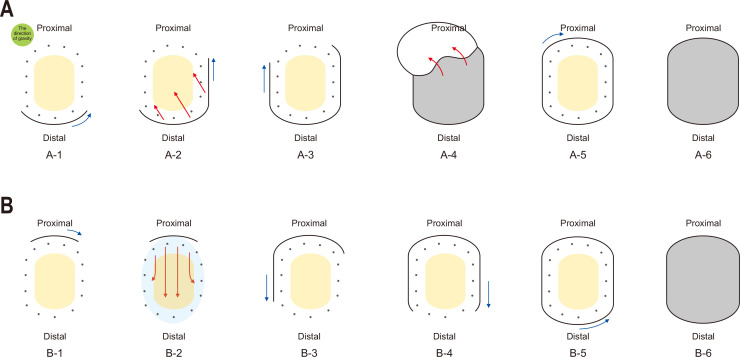
Patients who underwent ESD for a gastric body tumor were retrospectively reviewed. Patients were divided into two groups according to the ESD method: the conventional method (group I) and pocket-creation method (group II). Characteristics of patients and tumors, hospitalization period, incidence of complications, resection margin status, incidence of surgical operation, procedure time, and laboratory findings were investigated.
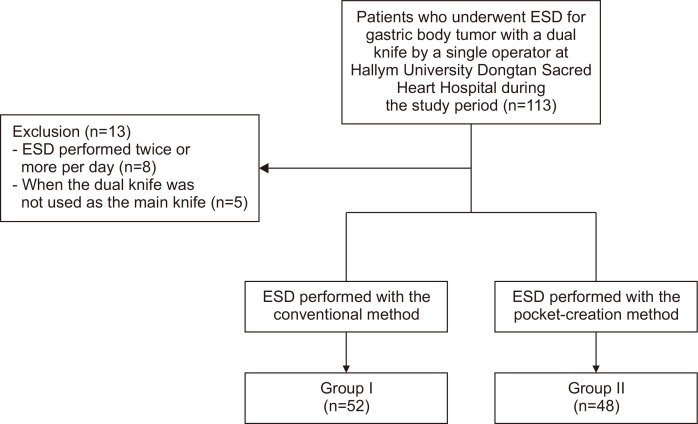
Of the total of 100 patients, 52 belonged to group I and 48 to group II. All tumors were successfully resected . Resection margin involvement was found in six (11.5%) of group I and six (12.5%) of group II. Complications were observed in seven (13.5%; major complication five, minor two) of group I and eight (16.7%; major two, minor six) of group II. There were no significant differences in ESD outcomes such as hospitalization period, incidence of complications, resection margin status, incidence of surgical operation, procedure time, or inflammatory response after ESD between the two groups.
Both methods are suitable for treating gastric body tumors with adequate treatment success rates and comparable complication rates.
背景/目的:已经尝试了各种内镜黏膜下剥离术(ESD)方法来治疗胃肿瘤。然而,目前尚无研究比较过使用双刀的胃体肿瘤的 ESD 方法的结果。本研究的目的是比较两种胃体肿瘤 ESD 方法的结果:创口袋法和传统方法。
回顾性分析了因胃体肿瘤而行 ESD 的患者。根据 ESD 方法将患者分为两组:传统方法组(I 组)和创口袋法组(II 组)。调查了患者和肿瘤的特征、住院时间、并发症发生率、切除边缘状态、手术发生率、手术时间和实验室检查结果。
共 100 例患者中,52 例属于 I 组,48 例属于 II 组。所有肿瘤均成功切除。I 组有 6 例(11.5%)和 II 组有 6 例(12.5%)切除边缘受累。I 组有 7 例(13.5%;主要并发症 5 例,次要并发症 2 例)和 II 组有 8 例(16.7%;主要并发症 2 例,次要并发症 6 例)发生并发症。两组在住院时间、并发症发生率、切除边缘状态、手术发生率、手术时间或 ESD 后炎症反应等 ESD 结果方面无显著差异。
两种方法均适用于治疗胃体肿瘤,具有足够的治疗成功率和相似的并发症发生率。