
主动脉弓变异与异常:胚胎学、影像学表现及临床考量
Aortic Arch Variants and Anomalies: Embryology, Imaging Findings, and Clinical Considerations.
作者信息
Bae Sang Bin, Kang Eun-Ju, Choo Ki Seok, Lee Jongmin, Kim Sang Hyeon, Lim Kyoung Jae, Kwon Heejin
机构信息
Department of Radiology, College of Medicine, Dong-A University, Busan, Korea.
Department of Radiology, Pusan National University School of Medicine, Pusan National University Yangsan Hospital, Yangsan, Korea.
出版信息
J Cardiovasc Imaging. 2022 Oct;30(4):231-262. doi: 10.4250/jcvi.2022.0058.
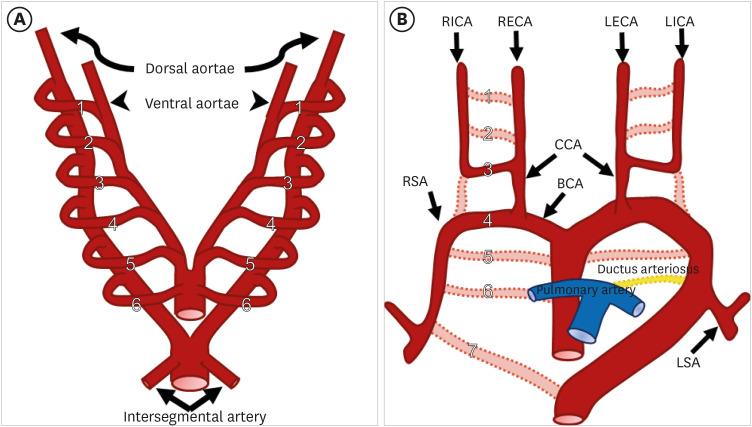
There is a wide spectrum of congenital anomalies or variations of the aortic arch, ranging from non-symptomatic variations that are mostly detected incidentally to clinically symptomatic variations that cause severe respiratory distress or esophageal compression. Some of these may be accompanied by other congenital heart diseases or chromosomal anomalies. The widespread use of multidetector computed tomography (CT) in clinical practice has resulted in incidental detection of several variations of the aortic arch in adults. Thus, radiologists and clinicians should be aware of the classification of aortic arch anomalies and carefully look for imaging features associated with a high risk of clinical symptoms. Understanding the embryological development of the aortic arch aids in the classification of various subtypes of aortic arch anomalies and variants. For accurate diagnosis and precise evaluation of aortic arch anomalies, cross-sectional imaging modalities, such as multidetector CT or magnetic resonance imaging, play an important role by providing three-dimensional reconstructed images. In this review, we describe the embryological development of the thoracic aorta and discuss variations and anomalies of the aortic arch along with their clinical implications.
主动脉弓存在广泛的先天性异常或变异,范围从大多偶然发现的无症状变异到导致严重呼吸窘迫或食管受压的临床症状性变异。其中一些可能伴有其他先天性心脏病或染色体异常。多排计算机断层扫描(CT)在临床实践中的广泛应用导致成人中偶然发现了几种主动脉弓变异。因此,放射科医生和临床医生应了解主动脉弓异常的分类,并仔细寻找与临床症状高风险相关的影像学特征。了解主动脉弓的胚胎发育有助于对主动脉弓异常和变异的各种亚型进行分类。对于主动脉弓异常的准确诊断和精确评估,多排CT或磁共振成像等横断面成像方式通过提供三维重建图像发挥着重要作用。在本综述中,我们描述了胸主动脉的胚胎发育,并讨论了主动脉弓的变异和异常及其临床意义。



 Zotero 插件