Prehal Christian, von Mentlen Jean-Marc, Drvarič Talian Sara, Vizintin Alen, Dominko Robert, Amenitsch Heinz, Porcar Lionel, Freunberger Stefan A, Wood Vanessa
Department of Information Technology and Electrical Engineering, ETH Zürich, Gloriastrasse 35, 8092, Zürich, Switzerland.
Department of Materials Chemistry, National Institute of Chemistry, Hajdrihova 19, 1000, Ljubljana, Slovenia.
Nat Commun. 2022 Oct 24;13(1):6326. doi: 10.1038/s41467-022-33931-4.
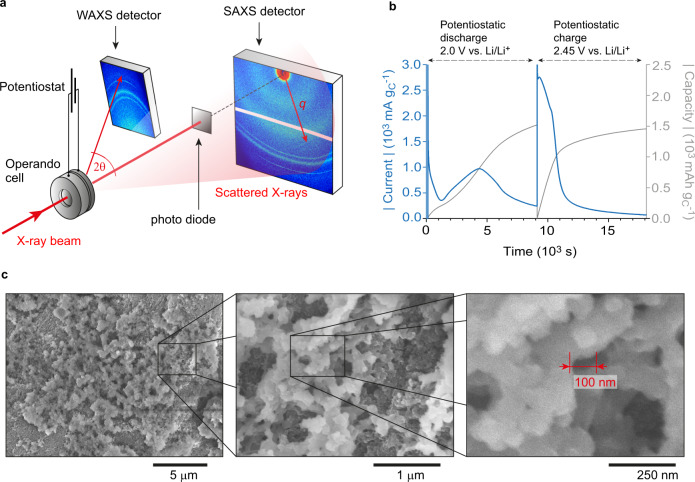
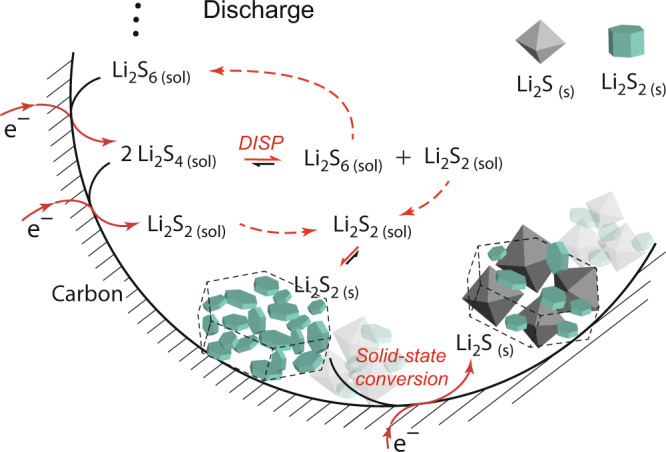
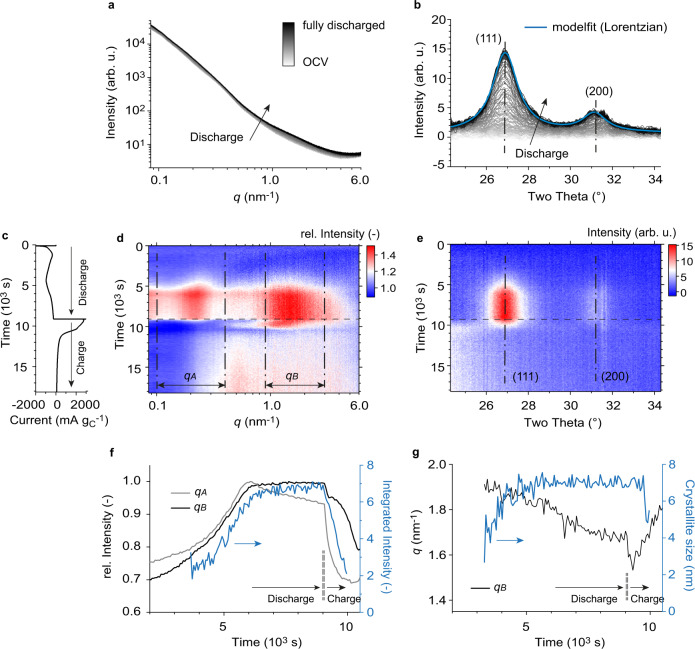
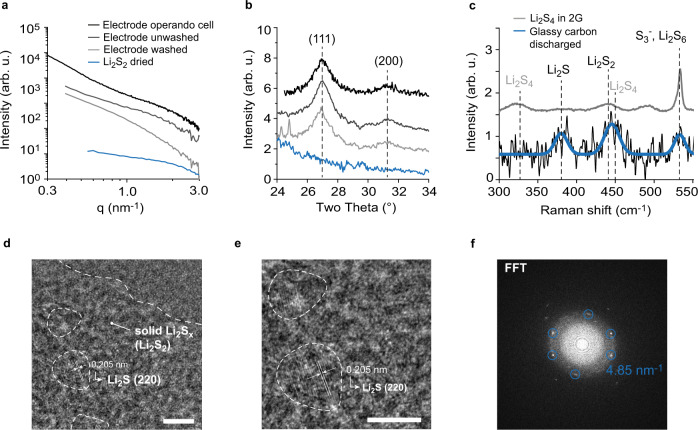
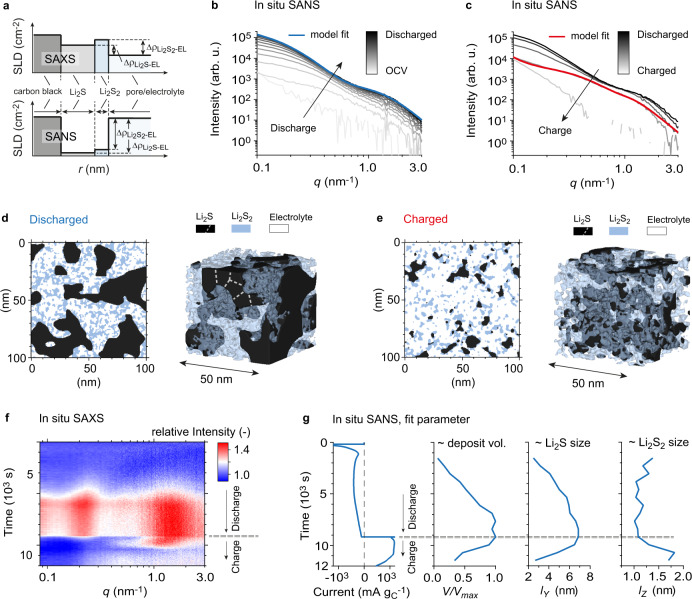
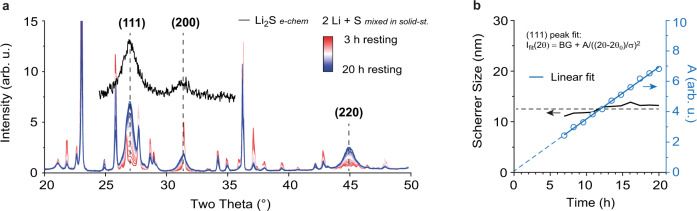
The inadequate understanding of the mechanisms that reversibly convert molecular sulfur (S) into lithium sulfide (LiS) via soluble polysulfides (PSs) formation impedes the development of high-performance lithium-sulfur (Li-S) batteries with non-aqueous electrolyte solutions. Here, we use operando small and wide angle X-ray scattering and operando small angle neutron scattering (SANS) measurements to track the nucleation, growth and dissolution of solid deposits from atomic to sub-micron scales during real-time Li-S cell operation. In particular, stochastic modelling based on the SANS data allows quantifying the nanoscale phase evolution during battery cycling. We show that next to nano-crystalline LiS the deposit comprises solid short-chain PSs particles. The analysis of the experimental data suggests that initially, LiS precipitates from the solution and then is partially converted via solid-state electroreduction to LiS. We further demonstrate that mass transport, rather than electron transport through a thin passivating film, limits the discharge capacity and rate performance in Li-S cells.
对通过可溶性多硫化物(PSs)形成将分子硫(S)可逆转化为硫化锂(LiS)的机制理解不足,阻碍了具有非水电解质溶液的高性能锂硫(Li-S)电池的发展。在此,我们使用原位小角和广角X射线散射以及原位小角中子散射(SANS)测量,以跟踪实时Li-S电池运行过程中从原子尺度到亚微米尺度固体沉积物的成核、生长和溶解。特别是,基于SANS数据的随机建模能够量化电池循环过程中的纳米级相演变。我们表明,除了纳米晶LiS外,沉积物还包含固态短链PSs颗粒。对实验数据的分析表明,最初,LiS从溶液中沉淀出来,然后通过固态电还原部分转化为LiS。我们进一步证明,质量传输而非通过薄钝化膜的电子传输限制了Li-S电池的放电容量和倍率性能。