Department of Microbiology, Immunology, and Parasitology, School of Medicine, Addis Ababa University, Addis Ababa, Ethiopia.
Global Health Working Group, Martin Luther University Halle-Wittenberg, Halle (Saale), Germany.
Breast Cancer Res Treat. 2022 Dec;196(3):495-504. doi: 10.1007/s10549-022-06769-z. Epub 2022 Oct 25.
The recent development of multi-gene assays for gene expression profiling has contributed significantly to the understanding of the clinically and biologically heterogeneous breast cancer (BC) disease. PAM50 is one of these assays used to stratify BC patients and individualize treatment. The present study was conducted to characterize PAM50-based intrinsic subtypes among Ethiopian BC patients.
Formalin-fixed paraffin-embedded tissues were collected from 334 BC patients who attended five different Ethiopian health facilities. All samples were assessed using the PAM50 algorithm for intrinsic subtyping.
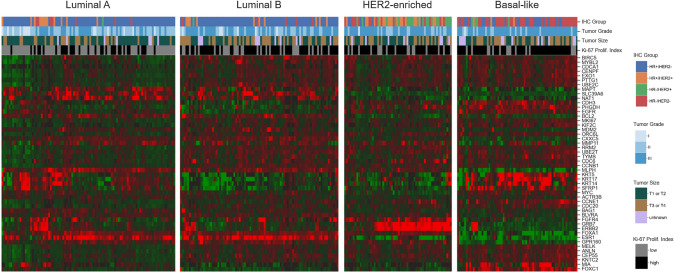
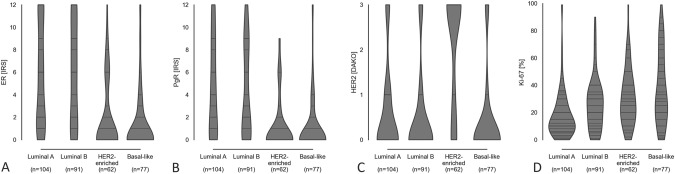
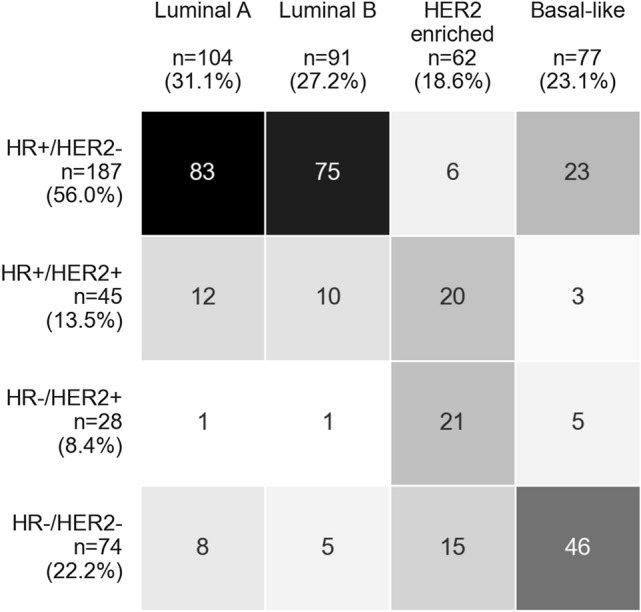
The tumor samples were classified into PAM50 intrinsic subtypes as follows: 104 samples (31.1%) were luminal A, 91 samples (27.2%) were luminal B, 62 samples (18.6%) were HER2-enriched and 77 samples (23.1%) were basal-like. The intrinsic subtypes were found to be associated with clinical and histopathological parameters such as steroid hormone receptor status, HER2 status, Ki-67 proliferation index and tumor differentiation, but not with age, tumor size or histological type. An immunohistochemistry-based classification of tumors (IHC groups) was found to correlate with intrinsic subtypes.
The distribution of the intrinsic subtypes confirms previous immunohistochemistry-based studies from Ethiopia showing potentially endocrine-sensitive tumors in more than half of the patients. Health workers in primary or secondary level health care facilities can be trained to offer endocrine therapy to improve breast cancer care. Additionally, the findings indicate that PAM50-based classification offers a robust method for the molecular classification of tumors in the Ethiopian context.
最近用于基因表达谱分析的多基因检测的发展,大大促进了对临床上和生物学上具有异质性的乳腺癌(BC)疾病的理解。PAM50 就是用于对 BC 患者进行分层和个体化治疗的检测方法之一。本研究旨在对埃塞俄比亚 BC 患者的 PAM50 内在亚型进行特征分析。
从 334 名在五个不同的埃塞俄比亚医疗机构就诊的 BC 患者中收集了福尔马林固定石蜡包埋组织。所有样本均使用 PAM50 算法进行内在亚型评估。
肿瘤样本被分为 PAM50 内在亚型,其中 104 个样本(31.1%)为 luminal A,91 个样本(27.2%)为 luminal B,62 个样本(18.6%)为 HER2 富集型,77 个样本(23.1%)为基底样型。内在亚型与临床和组织病理学参数相关,如甾体激素受体状态、HER2 状态、Ki-67 增殖指数和肿瘤分化,但与年龄、肿瘤大小或组织学类型无关。肿瘤的免疫组织化学分类(IHC 组)与内在亚型相关。
内在亚型的分布证实了以前来自埃塞俄比亚的免疫组织化学研究,表明超过一半的患者存在潜在的内分泌敏感肿瘤。初级或二级保健机构的卫生工作者可以接受培训,提供内分泌治疗,以改善乳腺癌的护理。此外,这些发现表明,基于 PAM50 的分类为埃塞俄比亚的肿瘤分子分类提供了一种稳健的方法。