• 文献检索
  • 文档翻译
  • 深度研究
  • 学术资讯
  • Suppr Zotero 插件Zotero 插件
  • 邀请有礼
  • 套餐&价格
  • 历史记录
应用&插件
Suppr Zotero 插件Zotero 插件浏览器插件Mac 客户端Windows 客户端微信小程序
定价
高级版会员购买积分包购买API积分包
服务
文献检索文档翻译深度研究API 文档MCP 服务
关于我们
关于 Suppr公司介绍联系我们用户协议隐私条款
关注我们

Suppr 超能文献

核心技术专利:CN118964589B侵权必究
粤ICP备2023148730 号-1Suppr @ 2026

文献检索

告别复杂PubMed语法,用中文像聊天一样搜索,搜遍4000万医学文献。AI智能推荐,让科研检索更轻松。

立即免费搜索

文件翻译

保留排版,准确专业,支持PDF/Word/PPT等文件格式,支持 12+语言互译。

免费翻译文档

深度研究

AI帮你快速写综述,25分钟生成高质量综述,智能提取关键信息,辅助科研写作。

立即免费体验

一种基于深度学习的图像内在分子亚型分类器可对乳腺癌肿瘤进行分类,揭示肿瘤异质性,可能影响患者的生存情况。

A deep learning image-based intrinsic molecular subtype classifier of breast tumors reveals tumor heterogeneity that may affect survival.

机构信息

NantOmics LLC, 9920 Jefferson Blvd., Culver City, CA, 90232, USA.

ImmunityBio, 9920 Jefferson Blvd., Culver City, CA, 90232, USA.

出版信息

Breast Cancer Res. 2020 Jan 28;22(1):12. doi: 10.1186/s13058-020-1248-3.

DOI:10.1186/s13058-020-1248-3
PMID:31992350
原文链接:https://pmc.ncbi.nlm.nih.gov/articles/PMC6988279/
Abstract

BACKGROUND

Breast cancer intrinsic molecular subtype (IMS) as classified by the expression-based PAM50 assay is considered a strong prognostic feature, even when controlled for by standard clinicopathological features such as age, grade, and nodal status, yet the molecular testing required to elucidate these subtypes is not routinely performed. Furthermore, when such bulk assays as RNA sequencing are performed, intratumoral heterogeneity that may affect prognosis and therapeutic decision-making can be missed.

METHODS

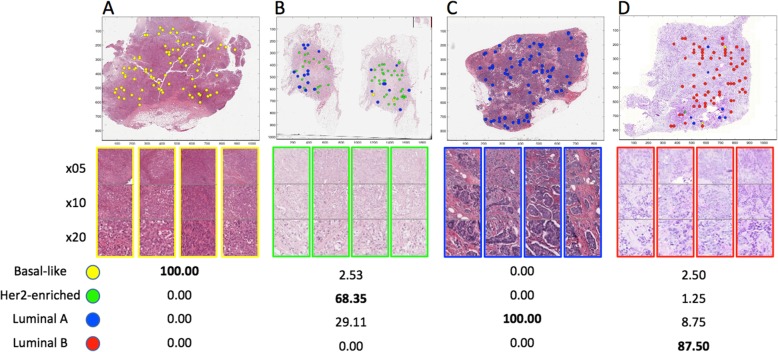
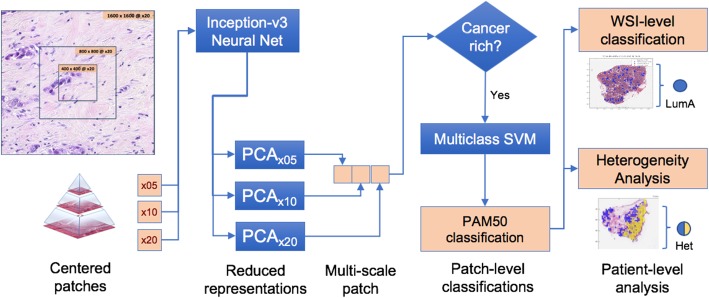
As a more facile and readily available method for determining IMS in breast cancer, we developed a deep learning approach for approximating PAM50 intrinsic subtyping using only whole-slide images of H&E-stained breast biopsy tissue sections. This algorithm was trained on images from 443 tumors that had previously undergone PAM50 subtyping to classify small patches of the images into four major molecular subtypes-Basal-like, HER2-enriched, Luminal A, and Luminal B-as well as Basal vs. non-Basal. The algorithm was subsequently used for subtype classification of a held-out set of 222 tumors.

RESULTS

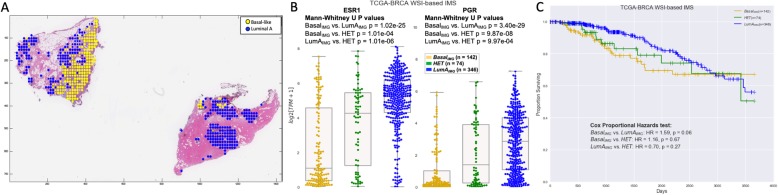
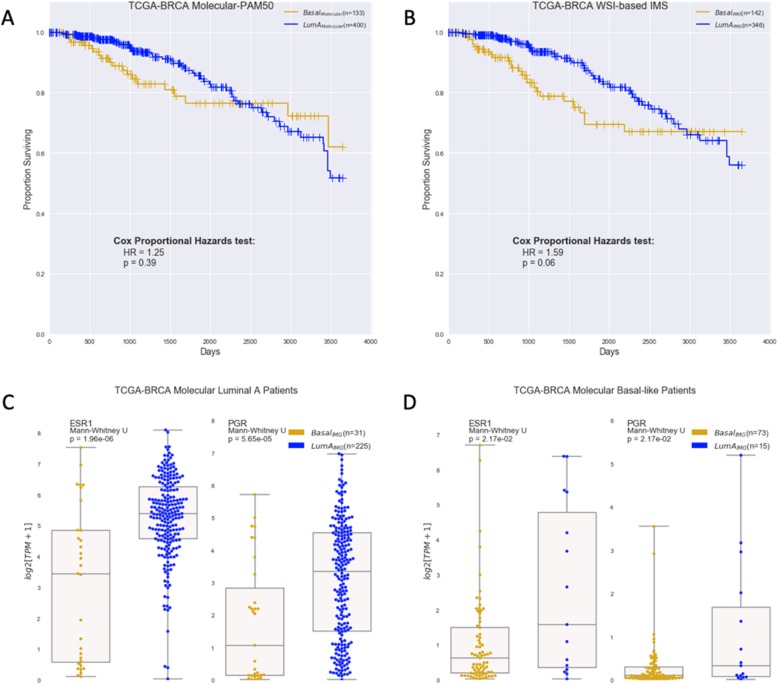
This deep learning image-based classifier correctly subtyped the majority of samples in the held-out set of tumors. However, in many cases, significant heterogeneity was observed in assigned subtypes across patches from within a single whole-slide image. We performed further analysis of heterogeneity, focusing on contrasting Luminal A and Basal-like subtypes because classifications from our deep learning algorithm-similar to PAM50-are associated with significant differences in survival between these two subtypes. Patients with tumors classified as heterogeneous were found to have survival intermediate between Luminal A and Basal patients, as well as more varied levels of hormone receptor expression patterns.

CONCLUSIONS

Here, we present a method for minimizing manual work required to identify cancer-rich patches among all multiscale patches in H&E-stained WSIs that can be generalized to any indication. These results suggest that advanced deep machine learning methods that use only routinely collected whole-slide images can approximate RNA-seq-based molecular tests such as PAM50 and, importantly, may increase detection of heterogeneous tumors that may require more detailed subtype analysis.

摘要

背景

基于表达的 PAM50 检测法对乳腺癌内在分子亚型(IMS)进行分类,被认为是一个强有力的预后特征,即使在控制了年龄、分级和淋巴结状态等标准临床病理特征后也是如此,但阐明这些亚型所需的分子检测并未常规进行。此外,当进行 RNA 测序等批量检测时,可能影响预后和治疗决策的肿瘤内异质性可能会被忽略。

方法

为了更简便、更便捷地确定乳腺癌的 IMS,我们开发了一种深度学习方法,仅使用 H&E 染色的乳腺癌活检组织切片的全切片图像来近似 PAM50 内在分型。该算法是在先前经过 PAM50 分型的 443 个肿瘤的图像上进行训练的,将小的图像块分类为四个主要的分子亚型——基底样、HER2 富集型、Luminal A 型和 Luminal B 型,以及基底样与非基底样。然后,该算法用于 222 个肿瘤的保留集的亚型分类。

结果

该深度学习图像分类器正确地对保留集肿瘤中的大多数样本进行了亚型分类。然而,在许多情况下,在单个全切片图像内的各个斑块中观察到分配的亚型存在显著异质性。我们进一步分析了异质性,重点关注对比的 Luminal A 型和基底样亚型,因为我们的深度学习算法的分类-类似于 PAM50-与这两种亚型之间的生存差异显著相关。发现被归类为异质性的肿瘤患者的生存情况介于 Luminal A 和基底患者之间,并且激素受体表达模式的变化程度也更大。

结论

在这里,我们提出了一种方法,可以最大限度地减少在 H&E 染色的 WSIs 中识别所有多尺度斑块中富含癌症的斑块所需的人工工作,该方法可以推广到任何适应症。这些结果表明,仅使用常规采集的全切片图像的先进深度学习方法可以近似基于 RNA-seq 的分子检测,如 PAM50,并且重要的是,可能会增加对可能需要更详细亚型分析的异质性肿瘤的检测。
https://cdn.ncbi.nlm.nih.gov/pmc/blobs/bf2e/6988279/477daaf22c2b/13058_2020_1248_Fig4_HTML.jpg
https://cdn.ncbi.nlm.nih.gov/pmc/blobs/bf2e/6988279/d88a4fcfedcf/13058_2020_1248_Fig1_HTML.jpg
https://cdn.ncbi.nlm.nih.gov/pmc/blobs/bf2e/6988279/8a4b176b6d11/13058_2020_1248_Fig2_HTML.jpg
https://cdn.ncbi.nlm.nih.gov/pmc/blobs/bf2e/6988279/e8665aebca90/13058_2020_1248_Fig3_HTML.jpg
https://cdn.ncbi.nlm.nih.gov/pmc/blobs/bf2e/6988279/477daaf22c2b/13058_2020_1248_Fig4_HTML.jpg
https://cdn.ncbi.nlm.nih.gov/pmc/blobs/bf2e/6988279/d88a4fcfedcf/13058_2020_1248_Fig1_HTML.jpg
https://cdn.ncbi.nlm.nih.gov/pmc/blobs/bf2e/6988279/8a4b176b6d11/13058_2020_1248_Fig2_HTML.jpg
https://cdn.ncbi.nlm.nih.gov/pmc/blobs/bf2e/6988279/e8665aebca90/13058_2020_1248_Fig3_HTML.jpg
https://cdn.ncbi.nlm.nih.gov/pmc/blobs/bf2e/6988279/477daaf22c2b/13058_2020_1248_Fig4_HTML.jpg

相似文献

1
A deep learning image-based intrinsic molecular subtype classifier of breast tumors reveals tumor heterogeneity that may affect survival.一种基于深度学习的图像内在分子亚型分类器可对乳腺癌肿瘤进行分类,揭示肿瘤异质性,可能影响患者的生存情况。
Breast Cancer Res. 2020 Jan 28;22(1):12. doi: 10.1186/s13058-020-1248-3.
2
PAM50 breast cancer subtyping by RT-qPCR and concordance with standard clinical molecular markers.基于 RT-qPCR 的 PAM50 乳腺癌分型与标准临床分子标志物的一致性。
BMC Med Genomics. 2012 Oct 4;5:44. doi: 10.1186/1755-8794-5-44.
3
Intrinsic subtypes from PAM50 gene expression assay in a population-based breast cancer cohort: differences by age, race, and tumor characteristics.基于人群的乳腺癌队列中PAM50基因表达检测的内在亚型:年龄、种族和肿瘤特征的差异
Cancer Epidemiol Biomarkers Prev. 2014 May;23(5):714-24. doi: 10.1158/1055-9965.EPI-13-1023. Epub 2014 Feb 12.
4
Intrinsic subtypes from the PAM50 gene expression assay in a population-based breast cancer survivor cohort: prognostication of short- and long-term outcomes.基于人群的乳腺癌幸存者队列中PAM50基因表达检测的内在亚型:短期和长期预后分析
Cancer Epidemiol Biomarkers Prev. 2014 May;23(5):725-34. doi: 10.1158/1055-9965.EPI-13-1017. Epub 2014 Feb 12.
5
Prognostic significance of different molecular typing methods and immune status based on RNA sequencing in HR-positive and HER2-negative early-stage breast cancer.基于 RNA 测序的 HR 阳性、HER2 阴性早期乳腺癌不同分子分型方法及免疫状态的预后意义。
BMC Cancer. 2022 May 14;22(1):548. doi: 10.1186/s12885-022-09656-4.
6
Human basal-like breast cancer is represented by one of the two mammary tumor subtypes in dogs.人类基底样乳腺癌表现为犬乳腺肿瘤的两种亚型之一。
Breast Cancer Res. 2023 Oct 3;25(1):114. doi: 10.1186/s13058-023-01705-5.
7
PCA-PAM50 improves consistency between breast cancer intrinsic and clinical subtyping reclassifying a subset of luminal A tumors as luminal B.PCA-PAM50 提高了乳腺癌内在和临床亚型之间的一致性,将一部分 luminal A 肿瘤重新分类为 luminal B。
Sci Rep. 2019 May 28;9(1):7956. doi: 10.1038/s41598-019-44339-4.
8
Frequency of breast cancer subtypes among African American women in the AMBER consortium.AMBER 联盟中非洲裔美国女性乳腺癌亚型的频率。
Breast Cancer Res. 2018 Feb 6;20(1):12. doi: 10.1186/s13058-018-0939-5.
9
PAM50- and immunohistochemistry-based subtypes of breast cancer and their relationship with breast cancer mortality in a population-based study.基于 PAM50 和免疫组织化学的乳腺癌亚型及其与基于人群研究的乳腺癌死亡率的关系。
Breast Cancer. 2021 Nov;28(6):1235-1242. doi: 10.1007/s12282-021-01261-w. Epub 2021 May 18.
10
Everolimus plus Exemestane for Hormone Receptor-Positive Advanced Breast Cancer: A PAM50 Intrinsic Subtype Analysis of BOLERO-2.依维莫司联合依西美坦治疗激素受体阳性晚期乳腺癌:BOLERO-2 研究的 PAM50 内在亚型分析。
Oncologist. 2019 Jul;24(7):893-900. doi: 10.1634/theoncologist.2018-0407. Epub 2019 Jan 24.

引用本文的文献

1
Integrating Artificial Intelligence in Next-Generation Sequencing: Advances, Challenges, and Future Directions.将人工智能整合到下一代测序中:进展、挑战与未来方向。
Curr Issues Mol Biol. 2025 Jun 19;47(6):470. doi: 10.3390/cimb47060470.
2
WMRCA + : a weighted majority rule-based clustering method for cancer subtype prediction using metabolic gene sets.WMRCA + :一种基于加权多数规则的聚类方法,用于使用代谢基因集进行癌症亚型预测。
Hereditas. 2025 Jul 7;162(1):121. doi: 10.1186/s41065-025-00487-4.
3
SGA-Driven feature selection and random forest classification for enhanced breast cancer diagnosis: A comparative study.

本文引用的文献

1
Breast cancer histopathological image classification using convolutional neural networks with small SE-ResNet module.基于小 SE-ResNet 模块的卷积神经网络在乳腺癌病理图像分类中的应用。
PLoS One. 2019 Mar 29;14(3):e0214587. doi: 10.1371/journal.pone.0214587. eCollection 2019.
2
Deep Learning Based Analysis of Histopathological Images of Breast Cancer.基于深度学习的乳腺癌组织病理学图像分析
Front Genet. 2019 Feb 19;10:80. doi: 10.3389/fgene.2019.00080. eCollection 2019.
3
Recent advances in breast cancer research impacting clinical diagnostic practice.
基于小基因组区域(SGA)驱动的特征选择和随机森林分类用于增强乳腺癌诊断:一项对比研究。
Sci Rep. 2025 Mar 30;15(1):10944. doi: 10.1038/s41598-025-95786-1.
4
Deep learning-based multi-task prediction of response to neoadjuvant chemotherapy using multiscale whole slide images in breast cancer: A multicenter study.基于深度学习的乳腺癌多尺度全切片图像对新辅助化疗反应的多任务预测:一项多中心研究
Chin J Cancer Res. 2025 Jan 30;37(1):28-47. doi: 10.21147/j.issn.1000-9604.2025.01.03.
5
Enhancing HER2 testing in breast cancer: predicting fluorescence in situ hybridization (FISH) scores from immunohistochemistry images via deep learning.加强乳腺癌中的人表皮生长因子受体2(HER2)检测:通过深度学习从免疫组化图像预测荧光原位杂交(FISH)评分
J Pathol Clin Res. 2025 Mar;11(2):e70024. doi: 10.1002/2056-4538.70024.
6
assessment of HER2 status in circulating tumor cells of breast cancer patients: Methods of detection and clinical implications.乳腺癌患者循环肿瘤细胞中HER2状态的评估:检测方法及临床意义
J Liq Biopsy. 2023 Oct 8;2:100117. doi: 10.1016/j.jlb.2023.100117. eCollection 2023 Dec.
7
SHP2 promotes the epithelial-mesenchymal transition in triple negative breast cancer cells by regulating β-catenin.SHP2通过调节β-连环蛋白促进三阴性乳腺癌细胞的上皮-间质转化。
J Cancer Res Clin Oncol. 2025 Jan 29;151(2):55. doi: 10.1007/s00432-025-06097-x.
8
Deep Learning Predicts Subtype Heterogeneity and Outcomes in Luminal A Breast Cancer Using Routinely Stained Whole-Slide Images.深度学习利用常规染色的全切片图像预测管腔A型乳腺癌的亚型异质性和预后。
Cancer Res Commun. 2025 Jan 1;5(1):157-166. doi: 10.1158/2767-9764.CRC-24-0397.
9
Deep learning-based classification of breast cancer molecular subtypes from H&E whole-slide images.基于深度学习从苏木精和伊红全切片图像对乳腺癌分子亚型进行分类
J Pathol Inform. 2024 Nov 17;16:100410. doi: 10.1016/j.jpi.2024.100410. eCollection 2025 Jan.
10
Innovations in Artificial Intelligence-Driven Breast Cancer Survival Prediction: A Narrative Review.人工智能驱动的乳腺癌生存预测创新:一项叙述性综述。
Cancer Inform. 2024 Sep 29;23:11769351241272389. doi: 10.1177/11769351241272389. eCollection 2024.
乳腺癌研究的最新进展对临床诊断实践产生影响。
J Pathol. 2019 Apr;247(5):552-562. doi: 10.1002/path.5199. Epub 2019 Jan 16.
4
Image analysis with deep learning to predict breast cancer grade, ER status, histologic subtype, and intrinsic subtype.使用深度学习进行图像分析以预测乳腺癌分级、雌激素受体状态、组织学亚型和内在亚型。
NPJ Breast Cancer. 2018 Sep 3;4:30. doi: 10.1038/s41523-018-0079-1. eCollection 2018.
5
Unravelling subclonal heterogeneity and aggressive disease states in TNBC through single-cell RNA-seq.通过单细胞 RNA 测序揭示三阴性乳腺癌中的亚克隆异质性和侵袭性疾病状态。
Nat Commun. 2018 Sep 4;9(1):3588. doi: 10.1038/s41467-018-06052-0.
6
Precision histology: how deep learning is poised to revitalize histomorphology for personalized cancer care.精准组织学:深度学习如何为个性化癌症治疗重振组织形态学。
NPJ Precis Oncol. 2017 Jun 19;1(1):22. doi: 10.1038/s41698-017-0022-1. eCollection 2017.
7
Deep Convolutional Neural Networks Enable Discrimination of Heterogeneous Digital Pathology Images.深度卷积神经网络能够区分异质数字病理学图像。
EBioMedicine. 2018 Jan;27:317-328. doi: 10.1016/j.ebiom.2017.12.026. Epub 2017 Dec 28.
8
Context-aware stacked convolutional neural networks for classification of breast carcinomas in whole-slide histopathology images.用于全切片组织病理学图像中乳腺癌分类的上下文感知堆叠卷积神经网络。
J Med Imaging (Bellingham). 2017 Oct;4(4):044504. doi: 10.1117/1.JMI.4.4.044504. Epub 2017 Dec 14.
9
Cancer stem cells revisited.癌症干细胞再探。
Nat Med. 2017 Oct 6;23(10):1124-1134. doi: 10.1038/nm.4409.
10
Accurate and reproducible invasive breast cancer detection in whole-slide images: A Deep Learning approach for quantifying tumor extent.全切片图像中精确且可重复的浸润性乳腺癌检测:一种用于量化肿瘤范围的深度学习方法。
Sci Rep. 2017 Apr 18;7:46450. doi: 10.1038/srep46450.