Reference Center for Rare Diseases Idiopathic Nephrotic Syndrome, Nice University Hospital, Nice, France.
Clinical Research Unit Côte d'Azur, University Côte d'Azur, Nice, France.
Clin J Am Soc Nephrol. 2022 Nov;17(11):1609-1619. doi: 10.2215/CJN.02930322. Epub 2022 Oct 25.
Membranous nephropathy is a rare autoimmune kidney disease whose increasing prevalence in industrialized countries pleads for the involvement of an environmental factor in the development of the disease. In addition, the predominance of men in membranous nephropathy, classically attributed to biologic or genetic differences between men and women, could also be due to different occupational exposures. To support this hypothesis, we sought to describe the toxic occupational exposures of patients with membranous nephropathy.
DESIGN, SETTING, PARTICIPANTS, & MEASUREMENTS: In this observational epidemiologic study, we compared the occupations and toxic occupational exposures of 100 patients with membranous nephropathy with those of the general population, consisting of two cohorts of 26,734,000 and 26,500 French workers. We then compared the characteristics of patients exposed to an occupational toxic substance with those of unexposed patients.
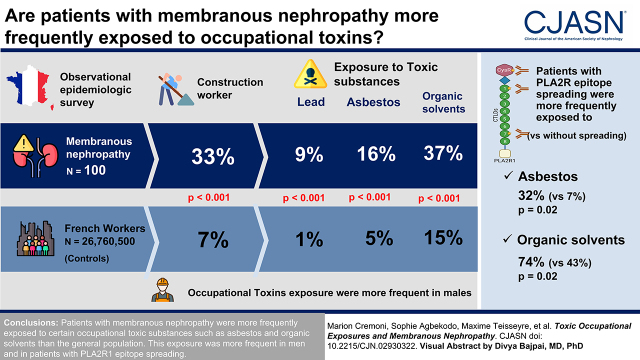
Patients with membranous nephropathy worked more frequently in the construction sector than the general population (33% versus 7%, <0.001). This difference remained significant by age and sex. They were also more frequently exposed to toxic substances, such as asbestos (16% versus 5%, <0.001), lead (9% versus 1%, <0.001), or organic solvents (37% versus 15%, <0.001), than the general population. The predominance of men in the subgroup of patients occupationally exposed to toxic substances was not observed in unexposed individuals (organic solvents: 80% men versus 41%, <0.001; asbestos: 90% men versus 55%, =0.004). In addition, patients with phospholipase A2 receptor 1 (PLA2R1) epitope spreading were more frequently exposed to asbestos and organic solvents than patients without epitope spreading (32% versus 7%, =0.02 and 74% versus 43%, =0.02, respectively), with a dose-dependent effect.
Patients with membranous nephropathy were more frequently exposed to certain occupational toxic substances, such as asbestos and organic solvents, than the general population. This occupational exposure was more frequent in men and in patients with PLA2R1 epitope spreading.
Immunopathological Analysis in a French National Cohort of Membranous Nephropathy (IHMN), NCT04326218.
This article contains a podcast at https://www.asn-online.org/media/podcast/CJASN/2022_10_25_CJN02930322.mp3.
膜性肾病是一种罕见的自身免疫性肾脏疾病,其在工业化国家的发病率不断上升,表明环境因素在疾病的发生发展中发挥了作用。此外,膜性肾病中男性的患病率较高,这一现象通常归因于男性和女性之间的生物学或遗传差异,但也可能与不同的职业暴露有关。为了支持这一假设,我们试图描述膜性肾病患者的有毒职业暴露情况。
在这项观察性的流行病学研究中,我们将 100 名膜性肾病患者的职业和有毒职业暴露情况与普通人群进行了比较,普通人群由两个队列组成,分别包含 26734000 名和 26500 名法国工人。然后,我们比较了暴露于职业性有毒物质的患者和未暴露于有毒物质的患者的特征。
膜性肾病患者比普通人群更频繁地从事建筑行业(33%比 7%,<0.001)。这种差异在年龄和性别上均有显著性。他们也更频繁地接触有毒物质,如石棉(16%比 5%,<0.001)、铅(9%比 1%,<0.001)或有机溶剂(37%比 15%,<0.001)。与普通人群相比,在暴露于有毒物质的患者亚组中,男性的比例较高,但在未暴露于有毒物质的个体中,这种情况并未观察到(有机溶剂:80%男性比 41%,<0.001;石棉:90%男性比 55%,=0.004)。此外,与无表位扩展的患者相比,磷脂酶 A2 受体 1(PLA2R1)表位扩展的患者更频繁地接触到石棉和有机溶剂(32%比 7%,=0.02;74%比 43%,=0.02),且具有剂量依赖性效应。
与普通人群相比,膜性肾病患者更频繁地接触某些职业性有毒物质,如石棉和有机溶剂。这种职业暴露在男性和 PLA2R1 表位扩展的患者中更为常见。