Departmentof Pharmacy, The First Hospital of China Medical University, Shenyang, China.
Key Laboratory of Diagnostic Imaging and Interventional Radiology of Liaoning Province, The First Hospital of China Medical University, Shenyang, People's Republic of China.
BMC Cancer. 2022 Oct 25;22(1):1091. doi: 10.1186/s12885-022-10164-8.
Neuro-oncological ventral antigen 1 (NOVA1) is a neuron-specific RNA-binding protein which regulates alternative splicing in the developing nervous system. Recent research has found that NOVA1 plays a significant role in carcinogenesis. In this paper, we examine the role of NOVA1 in non-small cell lung cancer (NSCLC) and its underlying molecular mechanisms.
The expression of NOVA1 in NSCLC was detected by immunohistochemistry and correlations between NOVA1 expression and clinicopathological factors were analyzed by chi-square tests. Kaplan-Meier survival analysis and the Cox regression model were used to evaluate the predictive effect of prognostic factors. Western blotting, Cell Counting Kit-8, colony formation, apoptosis, migration and invasion assays were used to detect the effects of silencing (si)NOVA1 RNA on Wnt/β-catenin signaling and biological behavior in NSCLC cell lines.
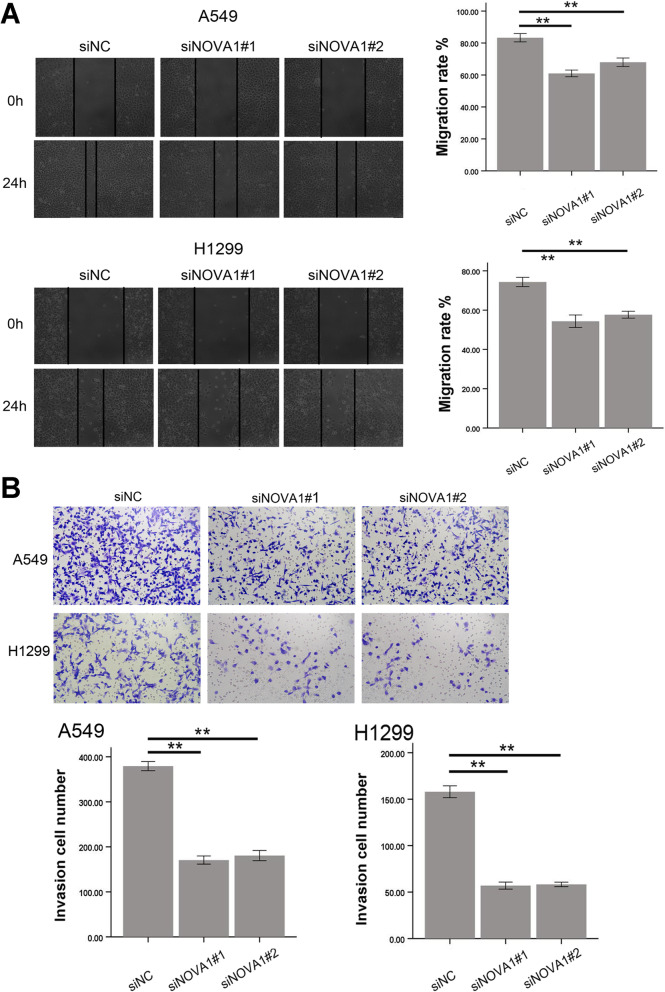
Our study showed that expression of NOVA1 was up-regulated and significantly correlated with poor differentiation (p = 0.020), advanced TNM stage (P = 0.001), T stage (P = 0.001) and lymph node metastasis (P = 0.000) as well as the expression of β-catenin (P = 0.012) in NSCLC. The down-regulation of NSCLC by siRNA significantly inhibited proliferation, migration and invasion and promoted apoptosis in NSCLC cells. Expression of Wnt signaling molecules, including β-catenin, activated β-catenin, cyclin D1, matrix metalloproteinase (MMP)-2 and MMP-7, was also significantly reduced by siNOVA1. The inhibition of Wnt/β-catenin signaling in A549 and H1299 cells by siNOVA1 was reversed after treatment with a β-catenin expression plasmid.
The present study suggests that NOVA1 may serve as a potential prognosis biomarker in NSCLC. High NOVA1 expression was associated with poor survival rate. Finally, in vitro experiments verified that NOVA1 promotes NSCLC cell proliferation and invasion by regulating Wnt/β-catenin signaling.
神经肿瘤学腹侧抗原 1(NOVA1)是一种神经元特异性 RNA 结合蛋白,可调节发育中的神经系统中的选择性剪接。最近的研究发现,NOVA1 在致癌作用中起重要作用。在本文中,我们研究了 NOVA1 在非小细胞肺癌(NSCLC)中的作用及其潜在的分子机制。
通过免疫组织化学检测 NSCLC 中 NOVA1 的表达,并通过卡方检验分析 NOVA1 表达与临床病理因素之间的相关性。Kaplan-Meier 生存分析和 Cox 回归模型用于评估预后因素的预测效果。Western blot、细胞计数试剂盒-8(CCK-8)、集落形成、凋亡、迁移和侵袭实验用于检测沉默(si)NOVA1 RNA 对 NSCLC 细胞系中 Wnt/β-catenin 信号和生物学行为的影响。
我们的研究表明,NOVA1 的表达上调,与低分化(p=0.020)、晚期 TNM 分期(P=0.001)、T 分期(P=0.001)和淋巴结转移(P=0.000)以及β-catenin 的表达显著相关(P=0.012)。siRNA 下调 NSCLC 后,明显抑制 NSCLC 细胞的增殖、迁移和侵袭,并促进凋亡。Wnt 信号分子,包括β-catenin、活化β-catenin、cyclin D1、基质金属蛋白酶(MMP)-2 和 MMP-7 的表达也明显被 siNOVA1 降低。在 A549 和 H1299 细胞中,siNOVA1 抑制 Wnt/β-catenin 信号被β-catenin 表达质粒处理后逆转。
本研究表明,NOVA1 可能是 NSCLC 的潜在预后生物标志物。NOVA1 高表达与生存率降低有关。最后,体外实验验证了 NOVA1 通过调节 Wnt/β-catenin 信号促进 NSCLC 细胞增殖和侵袭。