Department of Applied Health Sciences, Division of Physiotherapy, Hochschule Für Gesundheit (University of Applied Sciences), Gesundheitscampus 6-8, 44801, Bochum, Germany.
HSD Hochschule Döpfer GmbH (University of Applied Sciences), Waidmarkt 3 & 9, 50676, Cologne, Germany.
BMC Health Serv Res. 2022 Oct 25;22(1):1285. doi: 10.1186/s12913-022-08682-z.
Adherence to evidence-based practice (EBP) is considered a key competence to improve healthcare quality. In this study, we aimed to describe the EBP adherence of healthcare professionals working in Germany and to explore barriers and facilitators regarding the implementation of EBP in clinical practice.
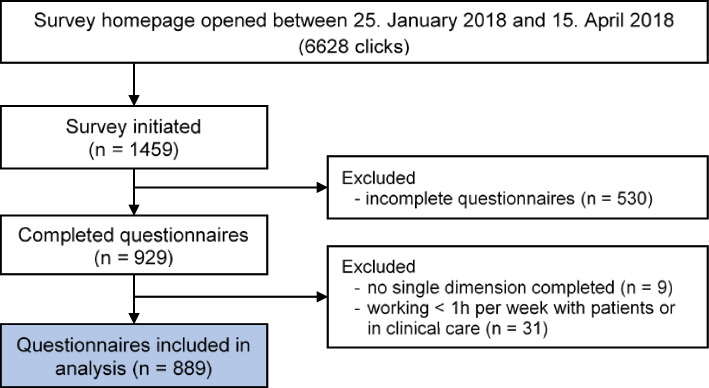
A nationwide online survey was performed among healthcare professionals in Germany from January to April 2018 using the German version of the Evidence-based Practice Inventory (EBPI) questionnaire for a comprehensive assessment of adherence to EBP. Univariate logistic regression analyses were performed to explore the association between demographic and professional determinants and each EBPI dimension.
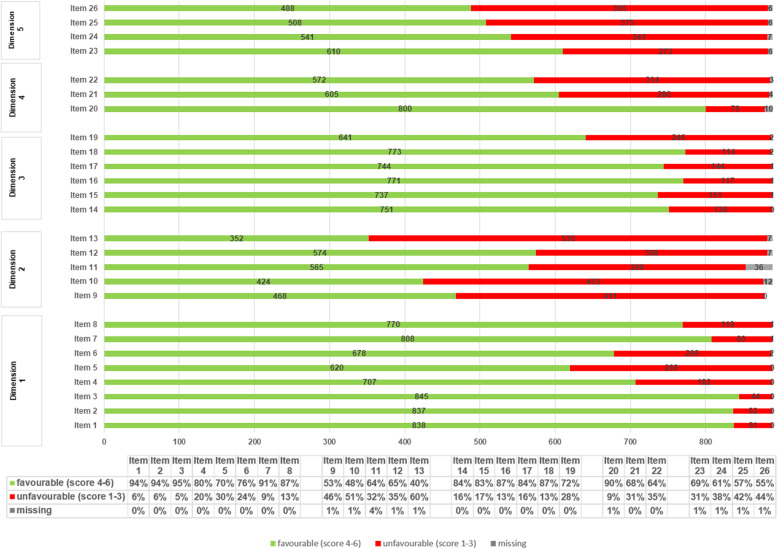
We analysed data of 889 participants, including 318 physical therapists, 154 occupational therapists, 137 midwifes and 280 participants of six other healthcare professions. Approximately 70% of the participants generally demonstrated a positive attitude towards EBP and believed that EBP was useful in clinical practice. Broadly, 80% of the respondents evaluated themselves as being able to enact EBP behaviour in clinical practice. In contrast, less than 70% preferred to use quantitative information instead of their intuition to inform their habitual clinical behaviour. Still, 20 to 30% reported that EBP did not sufficiently account for their clinical experience and differences between patients. The strongest facilitators to EBP adherence across at least three dimensions of the EBPI were the availability of ≥ 60 min for scientific literature at work (OR: 9.67; 95% CI: 5.86; 16.30), followed by a master or higher academic degree (OR: 9.09, 95% CI: 5.86; 14.28) and the involvement in ≥ 1 scientific publication (OR: 7.06, 95% CI: 5.10; 9.85).
This study showed that healthcare professionals in Germany in general had a positive attitude towards EBP although they currently do not consider EBP principles in its entirety. The most important determinant positively influencing a healthcare professional's decision to perform EBP was the time available for scientific literature at work. German healthcare professionals experience similar barriers towards the implementation of EBP in clinical practice compared to other international healthcare settings. These barriers should be targeted by future research.
German Clinical Trials Register (DRKS00013792). Registered 19 January 2018.
循证实践(EBP)的依从性被认为是提高医疗质量的关键能力。在这项研究中,我们旨在描述在德国工作的医疗保健专业人员的 EBP 依从性,并探讨在临床实践中实施 EBP 的障碍和促进因素。
2018 年 1 月至 4 月,使用德国版循证实践库存(EBPI)问卷对德国的医疗保健专业人员进行了一项全国性在线调查,以全面评估 EBP 的依从性。进行单变量逻辑回归分析,以探讨人口统计学和专业决定因素与每个 EBPI 维度之间的关联。
我们分析了 889 名参与者的数据,包括 318 名物理治疗师、154 名职业治疗师、137 名助产士和 280 名来自其他六个医疗保健专业的参与者。大约 70%的参与者对 EBP 普遍持积极态度,并认为 EBP 在临床实践中有用。总体而言,80%的受访者认为自己能够在临床实践中实施 EBP 行为。相比之下,不到 70%的人更喜欢使用定量信息而不是直觉来告知他们的习惯性临床行为。尽管如此,仍有 20%至 30%的人报告说 EBP 没有充分考虑到他们的临床经验和患者之间的差异。对 EBP 依从性的最强促进因素是在工作中至少有 60 分钟的时间用于科学文献(OR:9.67;95%CI:5.86;16.30),其次是硕士或更高的学术学位(OR:9.09,95%CI:5.86;14.28)和参与至少 1 次科学出版物(OR:7.06,95%CI:5.10;9.85)。
这项研究表明,德国的医疗保健专业人员普遍对 EBP 持积极态度,尽管他们目前并未完全考虑 EBP 原则。对医疗保健专业人员执行 EBP 的决定产生积极影响的最重要决定因素是工作中用于科学文献的时间。德国医疗保健专业人员在临床实践中实施 EBP 时面临与其他国际医疗保健环境相似的障碍。这些障碍应该成为未来研究的目标。
德国临床试验注册处(DRKS00013792)。2018 年 1 月 19 日注册。