Jin Qi-Qi, Zheng Cheng, Wang Yao-Ji, Lin Jia-Xuan, Wu Dao-Zhu, Lin Jia-Feng, Guan Xue-Qiang
Department of Cardiology, The Second Affiliated Hospital and Yuying Children's Hospital of Wenzhou Medical University, Xueyuan Road No. 109, Wenzhou 325027, China.
J Cardiovasc Dev Dis. 2022 Oct 5;9(10):338. doi: 10.3390/jcdd9100338.
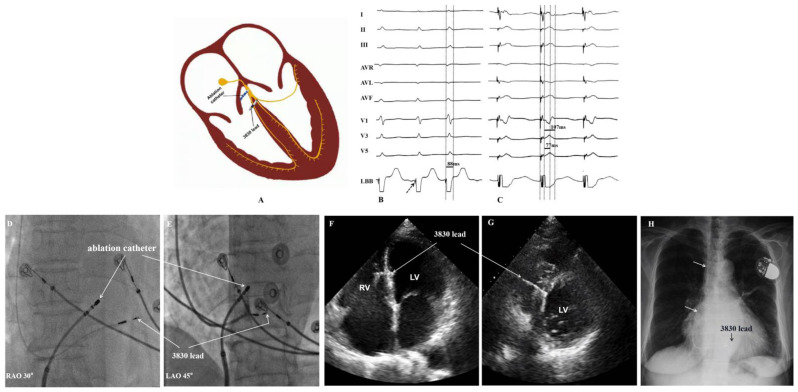
Pacemaker implantation combined with atrioventricular node ablation (AVNA) could be a practical choice for atrial fibrillation (AF) patients with heart failure (HF). Left bundle branch area pacing (LBBaP) has been widely reported.
To explore the safety and efficacy of LBBaP combined with AVNA in AF patients with HF.
Fifty-six AF patients with HF attempted LBBaP and AVNA from January 2019 to December 2020. Standard LBBaP was achieved in forty-six patients, and another ten received left ventricular septal pacing (LVSP). The cardiac function indexes and pacemaker parameters were evaluated at baseline, and we conducted a 1-month and 1-year follow-up.
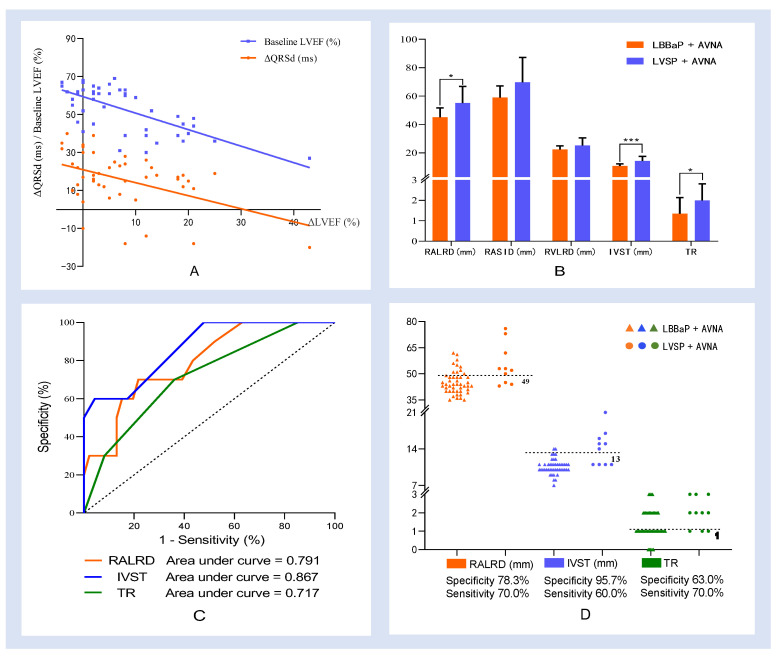
At the time of implantation and 1-month and 1-year follow-up, QRS duration of LVSP group was longer than that of LBBaP group. The pacemaker parameters remained stable in both the LBBaP and LVSP groups. At 1-month and 1-year follow-up after LBBaP and AVNA, left ventricular ejection fraction, left ventricular end-diastolic diameter, and NYHA classification continued to improve. Baseline left ventricular ejection fraction and QRS duration change at implantation can predict the magnitude of improvement of left ventricular ejection fraction at 1-year after LBBaP. Baseline right atrial left-right diameter, the degree of tricuspid regurgitation, and interventricular septum thickness may be the factors affecting the success of LBBaP.
LBBaP combined with AVNA is safe and effective for patients with AF and HF. Baseline right atrial left-right diameter, the degree of tricuspid regurgitation, and interventricular septum thickness may be the factors affecting the success of LBBaP.
起搏器植入联合房室结消融(AVNA)可能是心力衰竭(HF)合并心房颤动(AF)患者的一种实用选择。左束支区域起搏(LBBaP)已有广泛报道。
探讨LBBaP联合AVNA治疗HF合并AF患者的安全性和有效性。
2019年1月至2020年12月,56例HF合并AF患者尝试进行LBBaP和AVNA。46例患者成功实现标准LBBaP,另外10例接受左心室间隔起搏(LVSP)。在基线时评估心功能指标和起搏器参数,并进行1个月和1年的随访。
在植入时以及1个月和1年随访时,LVSP组的QRS时限长于LBBaP组。LBBaP组和LVSP组的起搏器参数均保持稳定。LBBaP和AVNA术后1个月和1年随访时,左心室射血分数、左心室舒张末期内径和纽约心脏协会(NYHA)分级持续改善。植入时的基线左心室射血分数和QRS时限变化可预测LBBaP术后1年左心室射血分数的改善程度。基线右心房左右径、三尖瓣反流程度和室间隔厚度可能是影响LBBaP成功的因素。
LBBaP联合AVNA治疗AF合并HF患者安全有效。基线右心房左右径、三尖瓣反流程度和室间隔厚度可能是影响LBBaP成功的因素。