Vijayaraman Pugazhendhi, Cano Oscar, Ponnusamy Shunmuga Sundaram, Molina-Lerma Manuel, Chan Joseph Y S, Padala Santosh K, Sharma Parikshit S, Whinnett Zachary I, Herweg Bengt, Upadhyay Gaurav A, Subzposh Faiz A, Patel Neil R, Beer Dominik A, Bednarek Agnieszka, Kielbasa Grzegorz, Tung Roderick, Ellenbogen Kenneth A, Jastrzebski Marek
Geisinger Heart Institute, Wilkes-Barre, Pennsylvania.
Hospital Universitari i Politècnic La Fe, Valencia, Spain, and Centro de Investigaciones Biomédicas en RED en Enfermedades Cardiovasculares (CIBERCV), Spain.
Heart Rhythm O2. 2022 May 14;3(4):358-367. doi: 10.1016/j.hroo.2022.05.004. eCollection 2022 Aug.
Cardiac resynchronization therapy (CRT) using biventricular pacing has limited efficacy in patients with heart failure (HF) and right bundle branch block (RBBB). Left bundle branch area pacing (LBBAP) is a novel physiologic pacing option.
The aim of the study was to assess the feasibility and outcomes of LBBAP in HF patients with RBBB and reduced left ventricular systolic function, and indication for CRT or ventricular pacing.
LBBAP was attempted in patients with left ventricular ejection fraction (LVEF) <50%, RBBB, HF, and indications for CRT or ventricular pacing. Procedural, pacing, and electrocardiographic parameters; clinical response (no HF hospitalization and improvement in NYHA class); and echocardiographic response (≥5% increase in ejection fraction) to LBBAP were assessed.
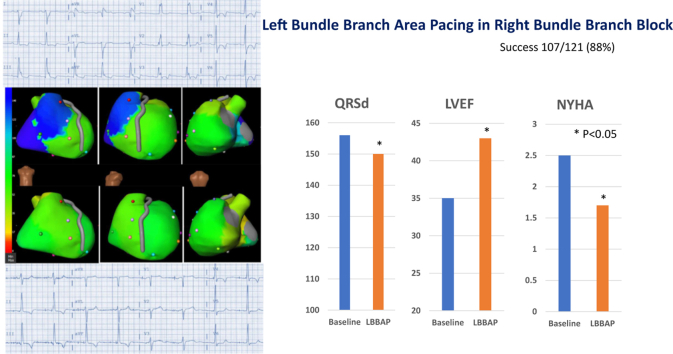
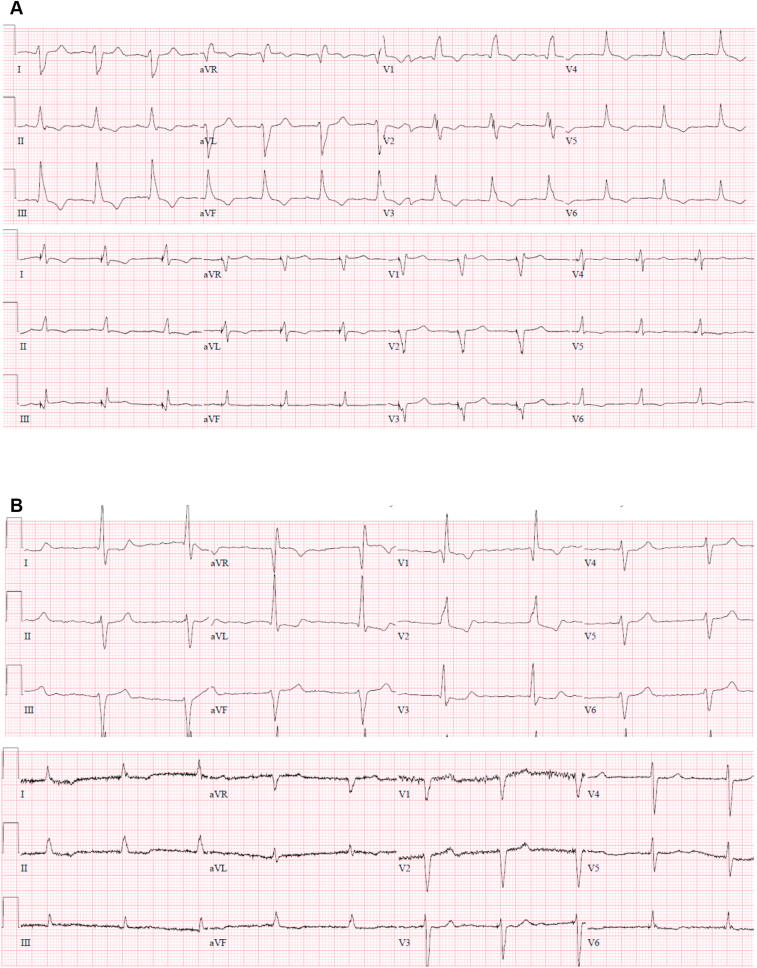
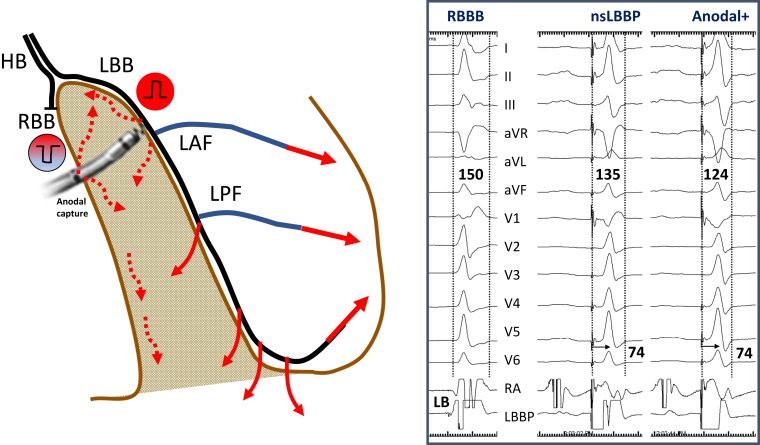
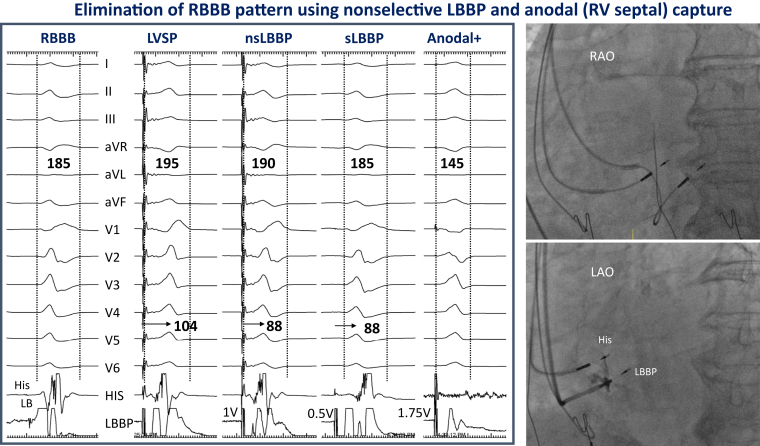
LBBAP was attempted in 121 patients and successful in 107 (88%). Patient characteristics included age 74 ± 12 years, female 25%, ischemic cardiomyopathy 49%, and ejection fraction 35% ± 9%. QRS axis at baseline was normal in 24%, left axis 63%, right axis 13%. LBBAP threshold and R-wave amplitudes were 0.8 ± 0.3 V @ 0.5 ms and 10 ± 9 mV at implant and remained stable during mean follow-up of 13 ± 8 months. LBBAP resulted in narrowing of QRS duration (156 ± 20 ms to 150 ± 24 ms ( = .01) with R-wave peak times in V of 85 ± 16 ms. LVEF improved from 35% ± 9% to 43% ± 12% ( < .01). Clinical and echocardiographic response was observed in 60% and 61% of patients, respectively. Female sex and reduction in QRS duration with LBBAP were predictive of echocardiographic response and super-response.
LBBAP is a feasible alternative to deliver CRT or physiologic ventricular pacing in patients with RBBB, HF, and LV dysfunction.
使用双心室起搏的心脏再同步治疗(CRT)在心力衰竭(HF)合并右束支传导阻滞(RBBB)患者中的疗效有限。左束支区域起搏(LBBAP)是一种新型的生理性起搏选择。
本研究旨在评估LBBAP在RBBB合并左心室收缩功能降低的HF患者中的可行性和疗效,以及CRT或心室起搏的指征。
对左心室射血分数(LVEF)<50%、RBBB、HF且有CRT或心室起搏指征的患者尝试进行LBBAP。评估手术、起搏和心电图参数;临床反应(无HF住院且纽约心脏协会(NYHA)心功能分级改善);以及LBBAP的超声心动图反应(射血分数增加≥5%)。
121例患者尝试进行LBBAP,107例(88%)成功。患者特征包括年龄74±12岁,女性占25%,缺血性心肌病占49%,射血分数35%±9%。基线时QRS电轴正常者占24%,左偏者占63%,右偏者占13%。植入时LBBAP阈值和R波振幅分别为0.8±0.3V@0.5ms和10±9mV,并在平均13±8个月的随访期间保持稳定。LBBAP导致QRS时限变窄(从156±20ms至150±24ms(P=.01),V导联R波峰值时间为85±16ms。LVEF从35%±9%提高到43%±(P<.01)。分别有60%和61%的患者观察到临床和超声心动图反应。女性以及LBBAP使QRS时限缩短是超声心动图反应和超反应的预测因素。
LBBAP是为RBBB、HF和左心室功能障碍患者提供CRT或生理性心室起搏的一种可行替代方法。