Freitas Aaronson Ramathan, Delai Ruana Renostro, Kmetiuk Louise Bach, da Silva Evelyn Cristine, Martini Rafaella, Brandão Ana Pérola Drulla, Giuffrida Rogério, de Barros-Filho Ivan Roque, Costa da Silva Rodrigo, Langoni Hélio, Figueiredo Fabiano Borges, Pimpão Cláudia Turra, Dos Santos Andrea Pires, Santarém Vamilton Alvares, Biondo Alexander Welker
Department of Veterinary Medicine, Federal University of Paraná State, Curitiba 80035-050, PR, Brazil.
Laboratory of Cell Biology, Carlos Chagas Institute, Oswaldo Cruz Foundation, Curitiba 81310-020, PR, Brazil.
Trop Med Infect Dis. 2022 Sep 20;7(10):252. doi: 10.3390/tropicalmed7100252.
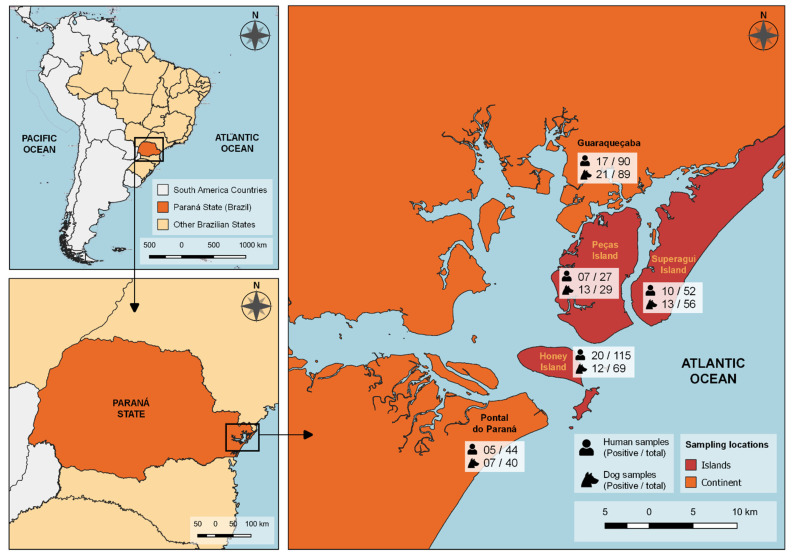
Although toxoplasmosis has been considered among the most neglected zoonoses worldwide, no study has focused on the frequency and associated risk factors of owners and their dogs living on an island and mainland seashore areas. Accordingly, anti- IgG antibodies were screened by indirect fluorescent antibody test (IFAT) in owners and dogs from three oceanic islands and two nearby mainland harbor areas, with associated risk factors for toxoplasmosis assessed by univariable and multivariable logistic regression models. Overall, anti- seropositivity was observed in 59/328 (18.0%) owners and 66/283 (23.3%) dogs, with no statistical difference between owners ( = 0.360) and dogs ( = 0.655) from islands and mainland areas. Consumption of local water springs ( = 0.016; OR = 2.11) was an associated risk factor for seropositivity, and owners with the habit of spring water intake were twice more likely seropositive ( = 0.014; OR = 2.14). Presence of anti- antibodies in dogs was associated with seropositive owners ( = 0.008; OR = 2.81), household consumption of beef meat ( = 0.042; OR = 1.7) and chicken ( = 0.026; OR = 2.9). Despite being lower than the worldwide prevalence, toxoplasmosis seropositivity in owners and their dogs in southern Brazil was influenced by the positive owner, water source, and meat consumption, and not by inhabiting islands or seashore mainland areas, presence of dogs, cats, or both. In addition, drinking water quality should always be considered a critical risk factor for toxoplasmosis on islands.
尽管弓形虫病被认为是全球最被忽视的人畜共患病之一,但尚无研究关注生活在岛屿和大陆海岸地区的宠物主人及其犬只感染弓形虫的频率及相关风险因素。因此,采用间接荧光抗体试验(IFAT)对来自三个海洋岛屿和两个附近大陆港口地区的宠物主人及其犬只进行抗IgG抗体筛查,并通过单变量和多变量逻辑回归模型评估弓形虫病的相关风险因素。总体而言,在59/328(18.0%)的宠物主人和66/283(23.3%)的犬只中观察到抗血清阳性,岛屿和大陆地区的宠物主人(P = 0.360)和犬只(P = 0.655)之间无统计学差异。饮用当地泉水(P = 0.016;OR = 2.11)是抗血清阳性的相关风险因素,有饮用泉水习惯的宠物主人血清阳性的可能性高出两倍(P = 0.014;OR = 2.14)。犬只中抗抗体的存在与血清阳性的宠物主人相关(P = 0.008;OR = 2.81)、家庭食用牛肉(P = 0.042;OR = 1.7)和鸡肉(P = 0.026;OR = 2.9)。尽管低于全球患病率,但巴西南部宠物主人及其犬只的弓形虫病血清阳性受阳性宠物主人、水源和肉类消费的影响,而非居住在岛屿或大陆海岸地区、犬只或猫的存在与否。此外,饮用水质量应始终被视为岛屿上弓形虫病的关键风险因素。