Lima-Noronha Marco A, Fonseca Douglas L H, Oliveira Renatta S, Freitas Rúbia R, Park Jung H, Galhardo Rodrigo S
Universidade de São Paulo, Instituto de Ciências Biomédicas, Departamento de Microbiologia, São Paulo, SP, Brazil.
Genet Mol Biol. 2022 Oct 10;45(3 Suppl 1):e20220107. doi: 10.1590/1678-4685-GMB-2022-0107. eCollection 2022.
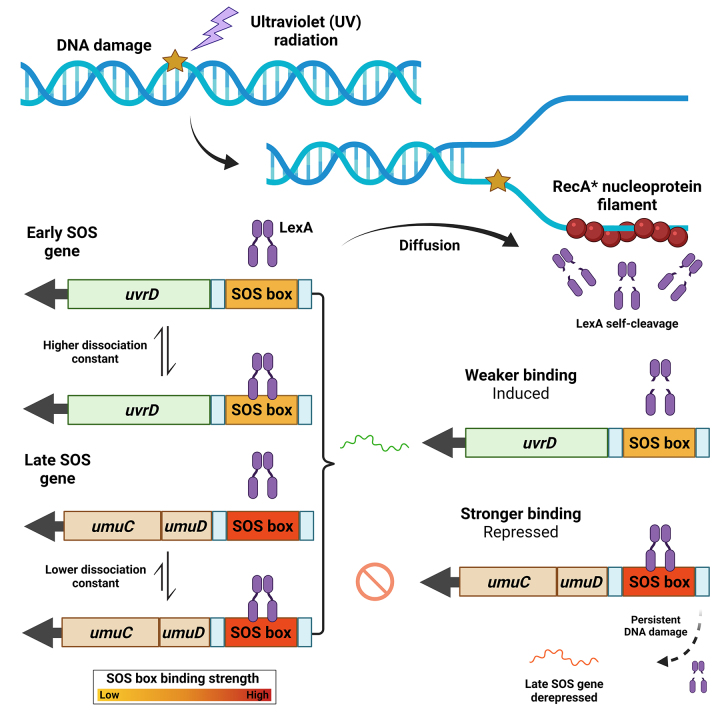
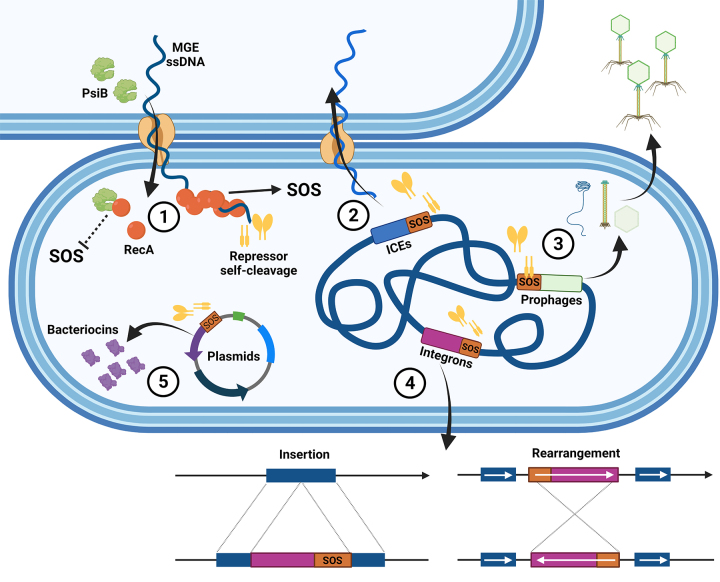
The term "SOS response" was first coined by Radman in 1974, in an intellectual effort to put together the data suggestive of a concerted gene expression program in cells undergoing DNA damage. A large amount of information about this cellular response has been collected over the following decades. In this review, we will focus on a few of the relevant aspects about the SOS response: its mechanism of control and the stressors which activate it, the diversity of regulated genes in different species, its role in mutagenesis and evolution including the development of antimicrobial resistance, and its relationship with mobile genetic elements.
“SOS 反应”这一术语最早由拉德曼于 1974 年提出,旨在整合表明遭受 DNA 损伤的细胞中存在协同基因表达程序的数据。在接下来的几十年里,人们收集了大量关于这种细胞反应的信息。在本综述中,我们将聚焦于 SOS 反应的几个相关方面:其控制机制和激活它的应激源、不同物种中受调控基因的多样性、其在诱变和进化(包括抗菌抗性的发展)中的作用,以及它与移动遗传元件的关系。