
实验性睡眠剥夺导致感知稳定性下降,且与精神病易感性无关。
Experimental Sleep Deprivation Results in Diminished Perceptual Stability Independently of Psychosis Proneness.
作者信息
Balter Leonie J T, Matheson Granville J, Sundelin Tina, Sterzer Philipp, Petrovic Predrag, Axelsson John
机构信息
Department of Clinical Neuroscience, Karolinska Institutet, 171 77 Stockholm, Sweden.
Stress Research Institute, Department of Psychology, Stockholm University, 106 91 Stockholm, Sweden.
出版信息
Brain Sci. 2022 Oct 3;12(10):1338. doi: 10.3390/brainsci12101338.
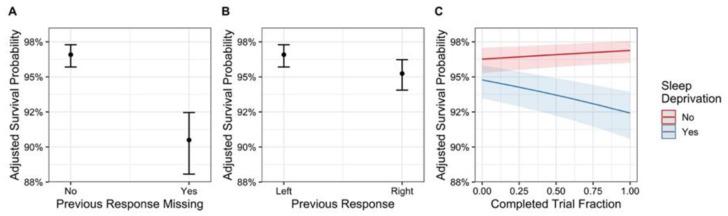
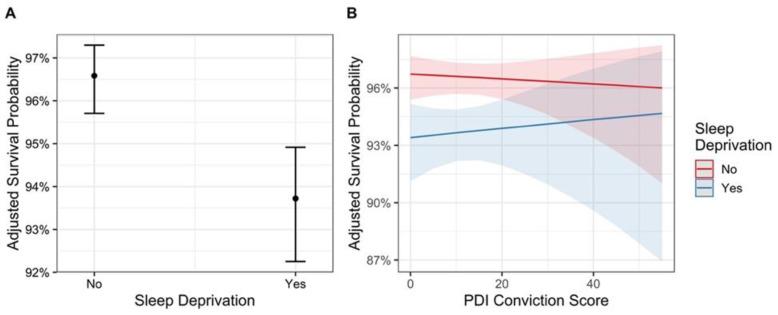
Psychotic disorders as well as psychosis proneness in the general population have been associated with perceptual instability, suggesting weakened predictive processing. Sleep disturbances play a prominent role in psychosis and schizophrenia, but it is unclear whether perceptual stability diminishes with sleep deprivation, and whether the effects of sleep deprivation differ as a function of psychosis proneness. In the current study, we aimed to clarify this matter. In this preregistered study, 146 participants successfully completed an intermittent version of the random dot kinematogram (RDK) task and the 21-item Peters Delusion Inventory (PDI-21) to assess perceptual stability and psychosis proneness, respectively. Participants were randomized to sleep either as normal (8 to 9 h in bed) ( = 72; = 24.7, = 6.2, 41 women) or to stay awake through the night ( = 74; = 24.8, = 5.1, 44 women). Sleep deprivation resulted in diminished perceptual stability, as well as in decreases in perceptual stability over the course of the task. However, we did not observe any association between perceptual stability and PDI-21 scores, nor a tendency for individuals with higher PDI-21 scores to be more vulnerable to sleep-deprivation-induced decreases in perceptual stability. The present study suggests a compromised predictive processing system in the brain after sleep deprivation, but variation in psychosis trait is not related to greater vulnerability to sleep deprivation in our dataset. Further studies in risk groups and patients with psychosis are needed to evaluate whether sleep loss plays a role in the occurrence of objectively measured perceptual-related clinical symptoms.
精神病性障碍以及普通人群中的精神病易感性都与感知稳定性有关,这表明预测性加工能力减弱。睡眠障碍在精神病和精神分裂症中起着重要作用,但尚不清楚睡眠剥夺是否会降低感知稳定性,以及睡眠剥夺的影响是否因精神病易感性而异。在本研究中,我们旨在阐明这一问题。在这项预先注册的研究中,146名参与者成功完成了随机点运动图(RDK)任务的间歇版本和21项彼得斯妄想量表(PDI-21),分别用于评估感知稳定性和精神病易感性。参与者被随机分为正常睡眠组(卧床8至9小时)(n = 72;平均年龄 = 24.7岁,标准差 = 6.2岁,41名女性)或通宵保持清醒组(n = 74;平均年龄 = 24.8岁,标准差 = 5.1岁,44名女性)。睡眠剥夺导致感知稳定性下降,以及在任务过程中感知稳定性降低。然而,我们没有观察到感知稳定性与PDI-21得分之间的任何关联,也没有发现PDI-21得分较高的个体更容易受到睡眠剥夺引起的感知稳定性下降影响的趋势。本研究表明,睡眠剥夺后大脑中的预测性加工系统受损,但在我们的数据集中,精神病特质的差异与对睡眠剥夺的更大易感性无关。需要对风险组和精神病患者进行进一步研究,以评估睡眠不足是否在客观测量的与感知相关的临床症状的发生中起作用。

 Zotero 插件