Louzolo Anaïs, Almeida Rita, Guitart-Masip Marc, Björnsdotter Malin, Lebedev Alexander, Ingvar Martin, Olsson Andreas, Petrovic Predrag
Department of Clinical Neuroscience, Karolinska Institutet, Stockholm, Sweden.
Department of Neuroscience, Karolinska Institutet, Stockholm, Sweden.
Front Psychol. 2022 Apr 13;13:786778. doi: 10.3389/fpsyg.2022.786778. eCollection 2022.
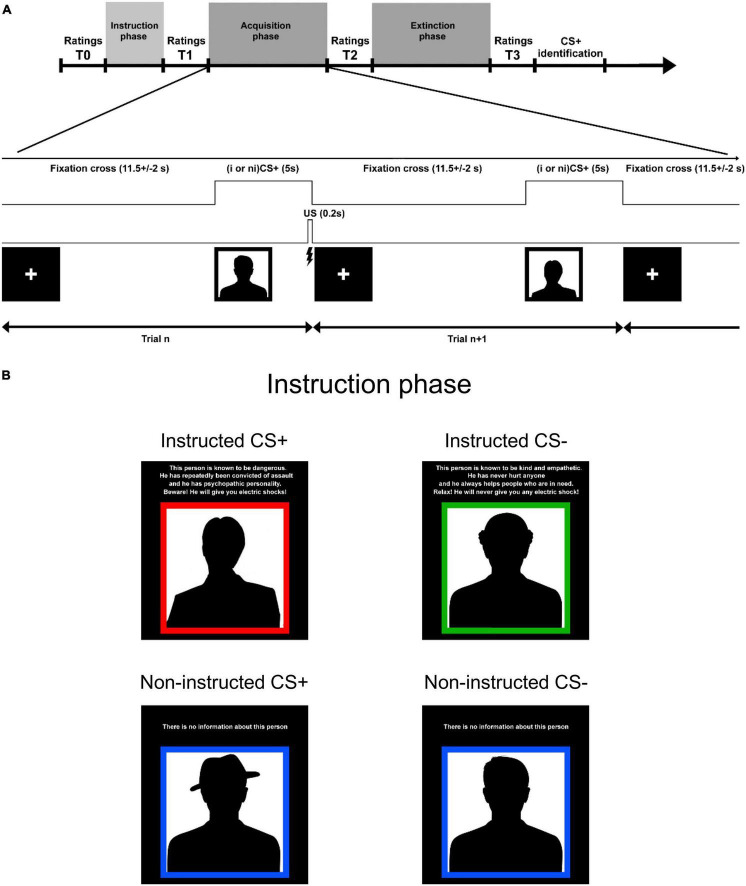
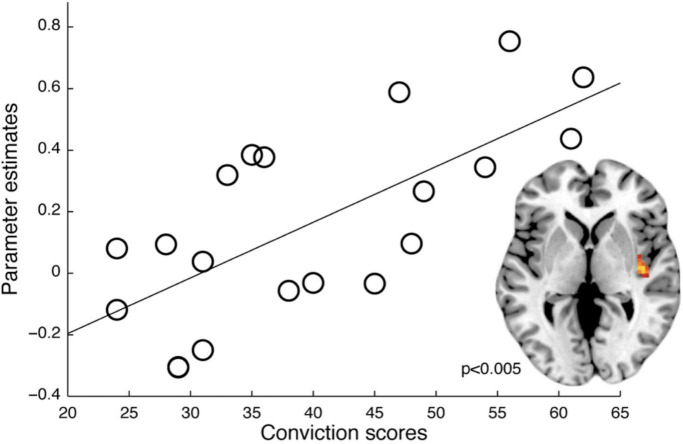
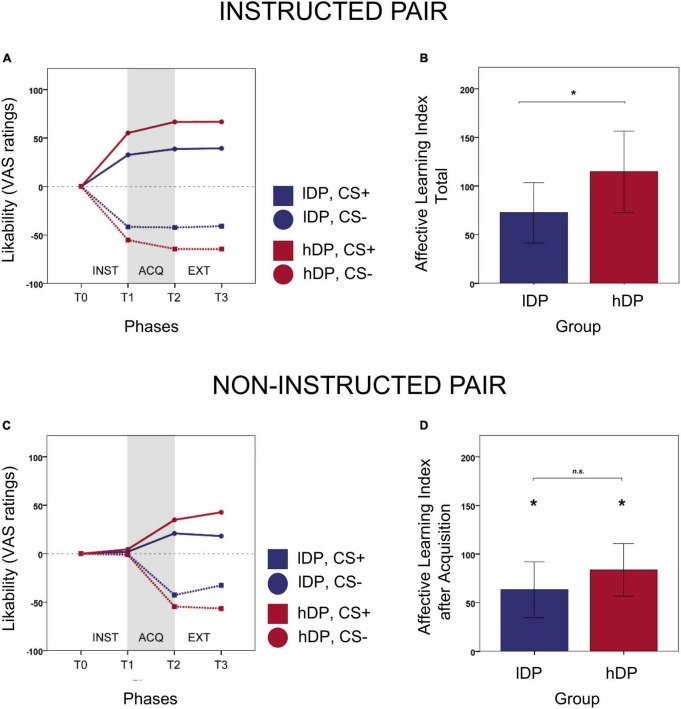
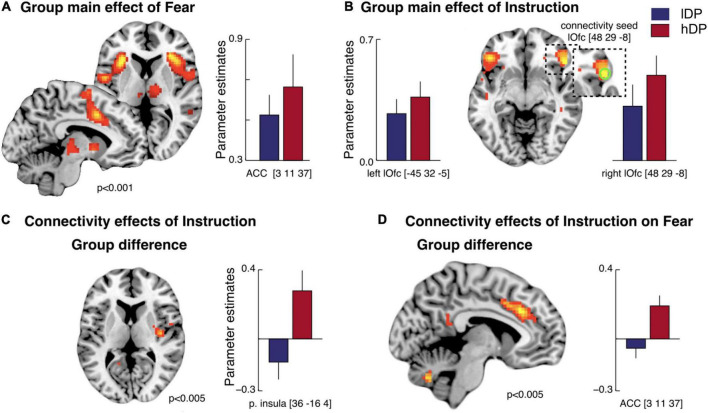
Psychosis is associated with distorted perceptions and deficient bottom-up learning such as classical fear conditioning. This has been interpreted as reflecting imprecise priors in low-level predictive coding systems. Paradoxically, overly strong beliefs, such as overvalued beliefs and delusions, are also present in psychosis-associated states. In line with this, research has suggested that patients with psychosis and associated phenotypes rely more on high-order priors to interpret perceptual input. In this behavioural and fMRI study we studied two types of , i.e., mediated by verbal suggestions about fear contingencies and mediated by low level associative learning, in delusion proneness-a trait in healthy individuals linked to psychotic disorders. Subjects were shown four faces out of which two were coupled with an aversive stimulation (CS+) while two were not (CS-) in a fear conditioning procedure. Before the conditioning, subjects were informed about the contingencies for two of the faces of each type, while no information was given for the two other faces. We could thereby study the effect of both classical fear conditioning and instructed fear learning. Our main outcome variable was evaluative rating of the faces. Simultaneously, fMRI-measurements were performed to study underlying mechanisms. We postulated that instructed fear learning, measured with evaluative ratings, is stronger in psychosis-related phenotypes, in contrast to classical fear conditioning that has repeatedly been shown to be weaker in these groups. In line with our hypothesis, we observed significantly larger instructed fear learning on a behavioural level in delusion-prone individuals ( = 20) compared to non-delusion-prone subjects ( = 23; = 20 in fMRI study). Instructed fear learning was associated with a bilateral activation of lateral orbitofrontal cortex that did not differ significantly between groups. However, delusion-prone subjects showed a stronger functional connectivity between right lateral orbitofrontal cortex and regions processing fear and pain. Our results suggest that psychosis-related states are associated with a strong instructed fear learning in addition to previously reported weak classical fear conditioning. Given the similarity between nocebo paradigms and instructed fear learning, our results also have an impact on understanding why nocebo effects differ between individuals.
精神病与感知扭曲以及自下而上的学习缺陷(如经典恐惧条件反射)有关。这被解释为反映了低层次预测编码系统中不精确的先验信息。矛盾的是,过度强烈的信念,如被高估的信念和妄想,也存在于与精神病相关的状态中。与此一致的是,研究表明患有精神病和相关表型的患者更多地依赖高阶先验信息来解释感知输入。在这项行为和功能磁共振成像研究中,我们研究了两种类型的恐惧学习,即由关于恐惧偶发事件的言语暗示介导的学习和由低水平联想学习介导的学习,针对妄想倾向——一种与精神障碍相关的健康个体的特质。在恐惧条件反射程序中,向受试者展示四张面孔,其中两张与厌恶刺激(CS+)配对,而另外两张不与厌恶刺激配对(CS-)。在条件反射之前,告知受试者每种类型的两张面孔的偶发事件,而另外两张面孔不提供任何信息。由此我们可以研究经典恐惧条件反射和指导性恐惧学习的效果。我们的主要结果变量是对面孔的评价等级。同时,进行功能磁共振成像测量以研究潜在机制。我们推测,与经典恐惧条件反射相比,用评价等级衡量的指导性恐惧学习在与精神病相关的表型中更强,而经典恐惧条件反射在这些群体中反复被证明较弱。与我们的假设一致…