Waheed Hafiz Waqas, Hassan Muhammad Waqar, Sarwar Ghulam, Jamil Moazzam
Department of Entomology, Faculty of Agriculture and Environment, Islamia University of Bahawalpur, Bahawalpur 63100, Pakistan.
Department of Botany, Faculty of Chemical and Biological Sciences, Islamia University of Bahawalpur, Bahawalpur 63100, Pakistan.
Insects. 2022 Oct 19;13(10):955. doi: 10.3390/insects13100955.
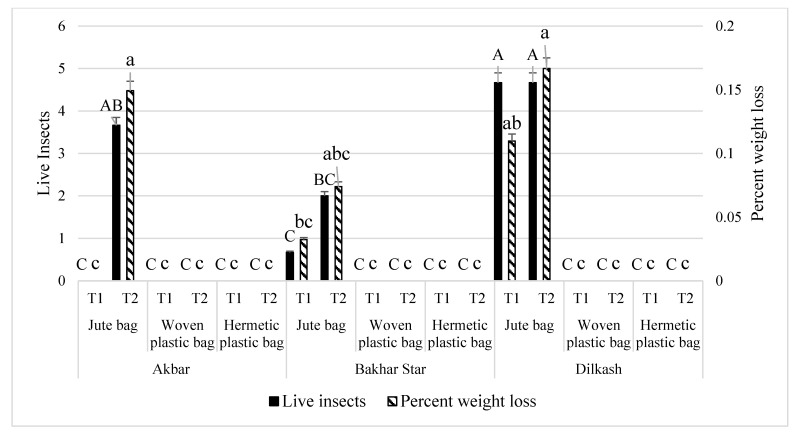
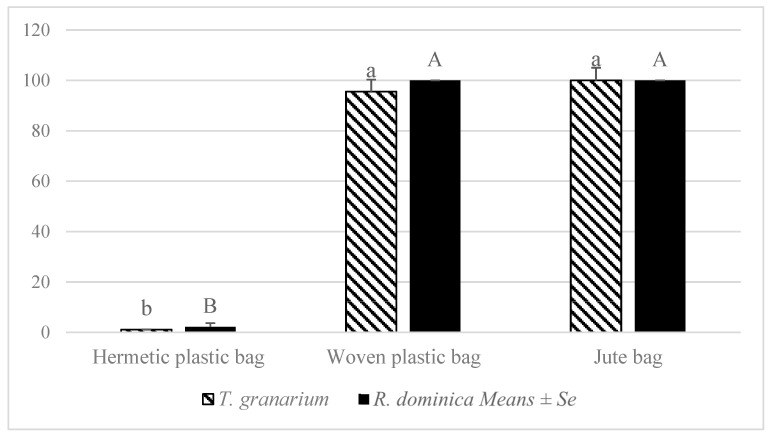
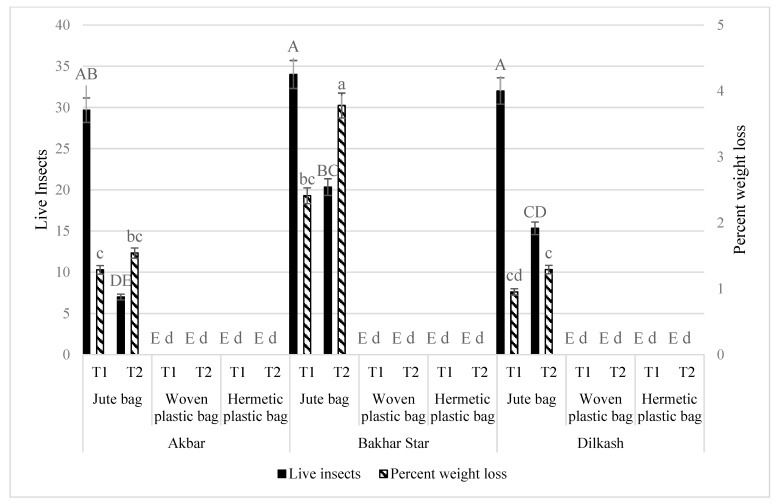
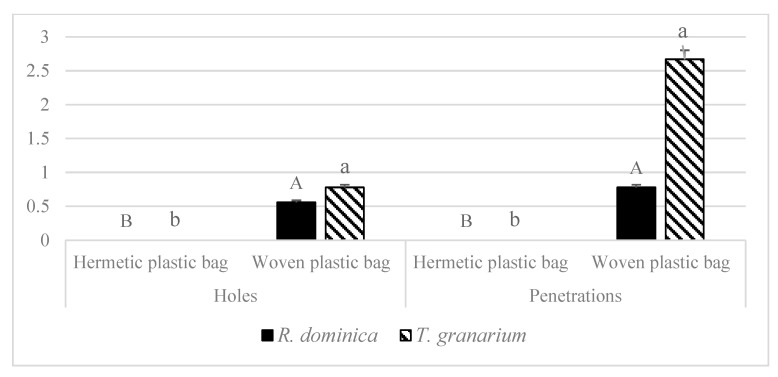
Bag storage of wheat is common in Asian countries, and common types of such bags include jute bags, woven plastic bags, and hermetic plastic bags. In order to assess infestation by two serious pests, namely Rhyzopertha dominica (Coleoptera: Bostrichidae) and Trogoderma granarium (Coleoptera: Dermestidae) in these bags, two experiments were performed. In the first experiment, three popular wheat varieties, namely Akbar, Dilkash, and Bakhar star were filled in above-mentioned miniature-size bags which were then placed in jars with three replicates per bag type and variety. Forty insects (adults for R. dominica and larvae for T. granarium) were released in the center of the jars for a period of 30 d in two different setups for both species. Data were recorded twice: after 15 d and 30 d. Results showed insects entered the jute bags only (made invasions due to its loose fibers and openings). Inside the bags, R. dominica caused more weight loss and live insects in Dilkash and Akbar varieties, while T. granarium preferred Bakhar star and Dilkash compared with their third variety. In the second experiment, only two bags, namely woven plastic bags and hermetic plastic bags filled with one variety, were tested to check damage (penetrations because no openings are present in these bags as in jute bags) to the bags. Results showed both species created holes in woven plastic bags but not in hermetic plastic bags. These results showed hermetic plastic bags remained safe from external infestation compared with the other two bags. Sometimes if insects are already present in the grains inside the bags, fumigation is needed from outside to kill the pests inside. To evaluate this, all three bags were filled with a wheat variety and were also infested with both insect species and placed in a fumigation container with nine replicates per bag type. A phosphine tablet (3.0 g) wrapped in muslin cloth was placed in a container which was then sealed, and the fumigation-induced mortality after 24 h was recorded. Results showed mortality was >95% to 100% in woven and jute bags, respectively, while mortality in hermetic plastic bags remained very low (<3%). These results revealed the least fumigant gas permeation in hermetic plastic bags compared with jute and woven plastic bags. Results of all three experiments demand immediate alteration in creation of all three bags to curtail infestation from outside (jute and woven plastic bags) as well as to generate maximum fumigation efficacy when the source of infestation is with the grains (hermetic bags).
在亚洲国家,用袋子储存小麦很常见,常见的袋子类型包括黄麻袋、编织塑料袋和密封塑料袋。为了评估这些袋子中两种严重害虫,即谷蠹(鞘翅目:长蠹科)和谷斑皮蠹(鞘翅目:皮蠹科)的侵染情况,进行了两项实验。在第一个实验中,将三种常见的小麦品种,即阿克巴、迪尔卡什和巴赫尔之星,装入上述微型袋子中,然后将每个袋子类型和品种的三个重复样本放入罐子中。在两种不同的设置下,将40只昆虫(谷蠹成虫和谷斑皮蠹幼虫)放入罐子中央30天。对两个物种的数据记录两次:15天后和30天后。结果表明,昆虫只进入了黄麻袋(由于其松散的纤维和开口而侵入)。在袋子内部,谷蠹在迪尔卡什和阿克巴品种中造成了更多的重量损失和活虫,而与第三个品种相比,谷斑皮蠹更喜欢巴赫尔之星和迪尔卡什。在第二个实验中,只测试了两个袋子,即装满一个品种的编织塑料袋和密封塑料袋,以检查袋子的损坏情况(由于这些袋子不像黄麻袋那样有开口,所以是穿透情况)。结果表明,两种害虫都在编织塑料袋上造成了孔洞,但在密封塑料袋上没有。这些结果表明,与其他两种袋子相比,密封塑料袋可免受外部侵染。有时,如果袋子里的谷物中已经有昆虫,就需要从外部进行熏蒸以杀死里面的害虫。为了评估这一点,将所有三种袋子都装满一个小麦品种,并接种两种昆虫,然后将每个袋子类型的九个重复样本放入熏蒸容器中。将一片用平纹细布包裹的磷化氢片剂(3.0克)放入容器中,然后密封,记录24小时后的熏蒸诱导死亡率。结果表明,编织袋和黄麻袋中的死亡率分别>95%和100%,而密封塑料袋中的死亡率仍然很低(<3%)。这些结果表明,与黄麻袋和编织塑料袋相比,密封塑料袋中熏蒸气体的渗透率最低。所有三个实验的结果都要求立即改变这三种袋子的制作方式,以减少外部侵染(黄麻袋和编织塑料袋),并在侵染源来自谷物时(密封袋)产生最大的熏蒸效果。