Department of Epidemiology and Health Statistics, School of Public Health, Southeast University, Nanjing 210009, China.
Department of Chronic Infectious Disease Control and Prevention, Jiangsu Provincial Center for Disease Control and Prevention, Nanjing 210009, China.
Int J Mol Sci. 2022 Oct 18;23(20):12443. doi: 10.3390/ijms232012443.
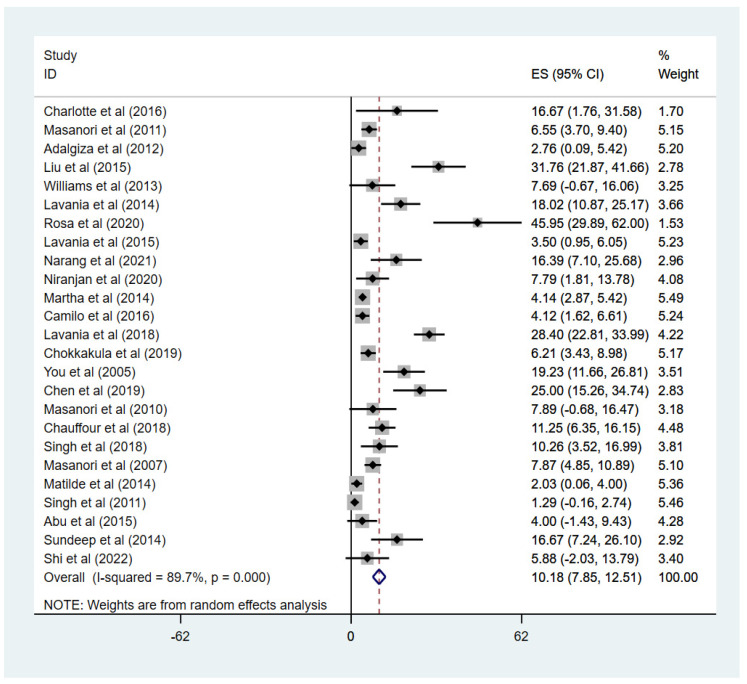
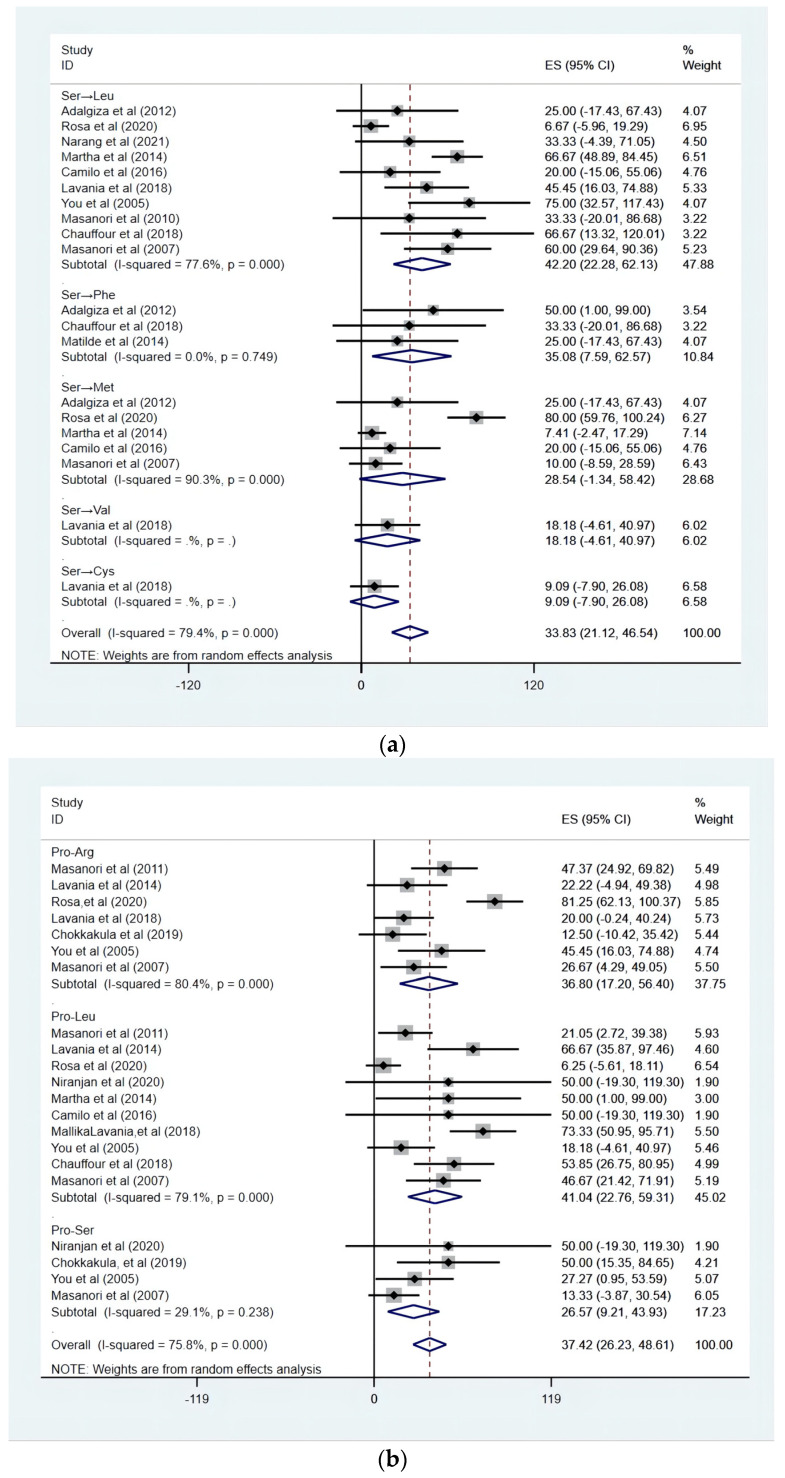
Dapsone (DDS), Rifampicin (RIF) and Ofloxacin (OFL) are drugs recommended by the World Health Organization (WHO) for the treatment of leprosy. In the context of leprosy, resistance to these drugs occurs mainly due to mutations in the target genes (Folp1, RpoB and GyrA). It is important to monitor antimicrobial resistance in patients with leprosy. Therefore, we performed a meta-analysis of drug resistance in Mycobacterium leprae and the mutational profile of the target genes. In this paper, we limited the study period to May 2022 and searched PubMed, Web of Science (WOS), Scopus, and Embase databases for identified studies. Two independent reviewers extracted the study data. Mutation and drug-resistance rates were estimated in Stata 16.0. The results demonstrated that the drug-resistance rate was 10.18% (95% CI: 7.85-12.51). Subgroup analysis showed the highest resistance rate was in the Western Pacific region (17.05%, 95% CI:1.80 to 13.78), and it was higher after 2009 than before [(11.39%, 7.46-15.33) vs. 6.59% (3.66-9.53)]. We can conclude that the rate among new cases (7.25%, 95% CI: 4.65-9.84) was lower than the relapsed (14.26%, 95 CI%: 9.82-18.71). Mutation rates of Folp1, RpoB and GyrA were 4.40% (95% CI: 3.02-5.77), 3.66% (95% CI: 2.41-4.90) and 1.28% (95% CI: 0.87-1.71) respectively, while the rate for polygenes mutation was 1.73% (0.83-2.63). For further analysis, we used 368 drug-resistant strains as research subjects and found that codons (Ser, Pro, Ala) on RpoB, Folp1 and GyrA are the most common mutation sites in the determining region (DRDR). In addition, the most common substitution patterns of Folp1, RpoB, and GyrA are Pro→Leu, Ser→Leu, and Ala→Val. This study found that a higher proportion of patients has developed resistance to these drugs, and the rate has increased since 2009, which continue to pose a challenge to clinicians. In addition, the amino acid alterations in the sequence of the DRDR regions and the substitution patterns mentioned in the study also provide new ideas for clinical treatment options.
氨苯砜(DDS)、利福平(RIF)和氧氟沙星(OFL)是世界卫生组织(WHO)推荐用于治疗麻风病的药物。在麻风病的背景下,这些药物的耐药性主要是由于靶基因(Folp1、RpoB 和 GyrA)的突变引起的。监测麻风病患者的抗菌药物耐药性非常重要。因此,我们对麻风分枝杆菌的药物耐药性和靶基因的突变谱进行了荟萃分析。在本文中,我们将研究期限限制在 2022 年 5 月,在 PubMed、Web of Science(WOS)、Scopus 和 Embase 数据库中搜索了已确定的研究。两位独立的审稿人提取了研究数据。在 Stata 16.0 中估计了突变和耐药率。结果表明,耐药率为 10.18%(95%CI:7.85-12.51)。亚组分析表明,耐药率最高的地区是西太平洋地区(17.05%,95%CI:1.80-13.78),2009 年后的耐药率高于 2009 年前[(11.39%,7.46-15.33)vs.6.59%(3.66-9.53)]。我们可以得出结论,新发病例(7.25%,95%CI:4.65-9.84)的耐药率低于复发(14.26%,95%CI%:9.82-18.71)。Folp1、RpoB 和 GyrA 的突变率分别为 4.40%(95%CI:3.02-5.77)、3.66%(95%CI:2.41-4.90)和 1.28%(95%CI:0.87-1.71),而多基因突变率为 1.73%(0.83-2.63)。为了进一步分析,我们使用了 368 株耐药菌株作为研究对象,发现 RpoB、Folp1 和 GyrA 上的密码子(Ser、Pro、Ala)是决定区(DRDR)中最常见的突变位点。此外,Folp1、RpoB 和 GyrA 最常见的取代模式是 Pro→Leu、Ser→Leu 和 Ala→Val。本研究发现,越来越多的患者对这些药物产生了耐药性,并且自 2009 年以来耐药率有所上升,这继续对临床医生构成挑战。此外,研究中提到的 DRDR 区域序列中的氨基酸改变和取代模式也为临床治疗选择提供了新的思路。