Instituto Nacional de Salud Pública, Dirección de Salud Ambiental, Universidad 655, Col. Sta. Ma. Ahucatitlán, Cuernavaca 62100, Mexico.
Unidad Iztapalapa, División de Ciencias Sociales y Humanidades, Universidad Autónoma Metropolitana, Ciudad de México 09340, Mexico.
Int J Environ Res Public Health. 2022 Oct 11;19(20):13020. doi: 10.3390/ijerph192013020.
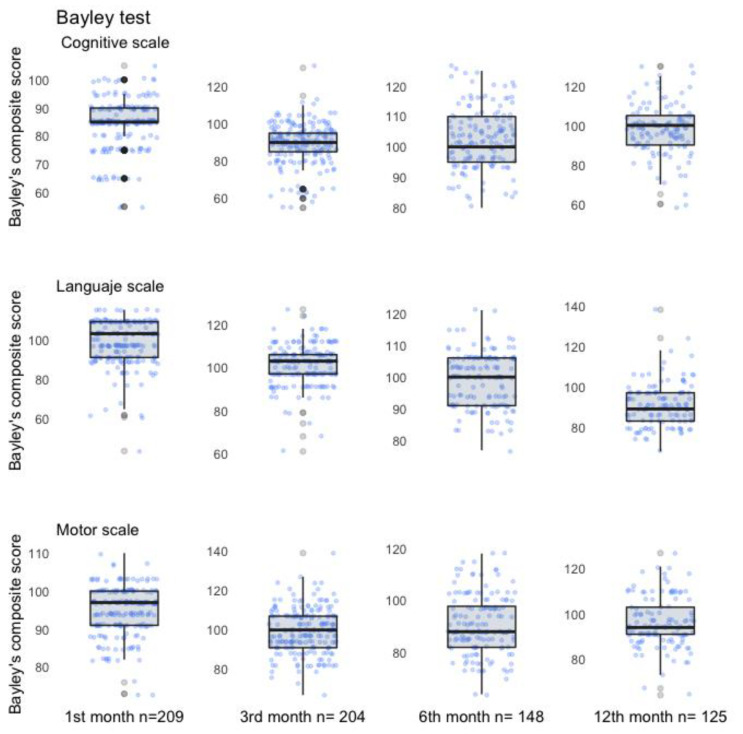
Lead (Pb), mercury (Hg), and manganese (Mn) are neurotoxic, but little is known about the neurodevelopmental effects associated with simultaneous prenatal exposure to these metals. We aimed to study the associations of Pb, Hg, and Mn prenatal levels (jointly and separately) with neurodevelopment in the first year of life. Methods: Pb, Hg, and Mn blood lead levels were measured in 253 pregnant women. Their offspring's neurodevelopment was assessed through the Bayley Scale of Infant Development III at one, three, six, and twelve months. The metals' mean blood levels (µg/L) were Pb = 11.2, Hg = 2.1, and Mn = 10.2. Mean language, cognitive, and motor development scores of the infants at each age were between low-average and average. Multilevel models' results showed that language development coefficients of the offspring decreased by 1.5 points per 1 µg/dL increase in maternal blood lead levels ( = 0.002); the magnitude of the aforementioned association increased in children with maternal blood Mn < 9.6 µg/L (ß = -1.9, = 0.003) or Hg > 1.9 µg/L (ß = -1.6, = 0.013). Cognitive and motor development had negative associations with maternal blood Pb levels; the latter was statistically significant when the interaction term between Pb, Mn, and Hg was included (ß = -0.037, = 0.03). Prenatal exposure to low Pb levels may impair infants' neurodevelopment in the first year of life, even more so if they are exposed to Hg or deficient in Mn.
铅(Pb)、汞(Hg)和锰(Mn)均具有神经毒性,但人们对同时接触这些金属对神经发育的影响知之甚少。我们旨在研究孕妇产前同时接触 Pb、Hg 和 Mn 的水平(联合或单独)与婴儿出生后第一年神经发育的关系。
检测 253 名孕妇的血 Pb、Hg 和 Mn 水平。通过贝利婴幼儿发展量表 III 在婴儿 1、3、6 和 12 个月时评估其神经发育情况。金属的平均血水平(µg/L)分别为:Pb=11.2、Hg=2.1 和 Mn=10.2。婴儿在每个年龄段的语言、认知和运动发育的平均得分处于中下等水平和中等水平之间。多水平模型的结果表明,后代的语言发育系数随母体血 Pb 水平每增加 1µg/dL 而降低 1.5 分( = 0.002);在母体血 Mn<9.6µg/L(ß=-1.9, = 0.003)或 Hg>1.9µg/L(ß=-1.6, = 0.013)的儿童中,上述关联的幅度增大。认知和运动发育与母体血 Pb 水平呈负相关;当包括 Pb、Mn 和 Hg 的交互项时,后者具有统计学意义(ß=-0.037, = 0.03)。产前接触低水平的 Pb 可能会损害婴儿出生后第一年的神经发育,如果同时接触 Hg 或缺乏 Mn 则更为严重。