
基于深度相机的基于解剖学特征引导的深度学习模型的被单下睡眠姿势分类。
Depth-Camera-Based Under-Blanket Sleep Posture Classification Using Anatomical Landmark-Guided Deep Learning Model.
机构信息
Department of Biomedical Engineering, Faculty of Engineering, The Hong Kong Polytechnic University, Hong Kong 999077, China.
Department of Bioengineering, Imperial College, London SW7 2AZ, UK.
出版信息
Int J Environ Res Public Health. 2022 Oct 18;19(20):13491. doi: 10.3390/ijerph192013491.
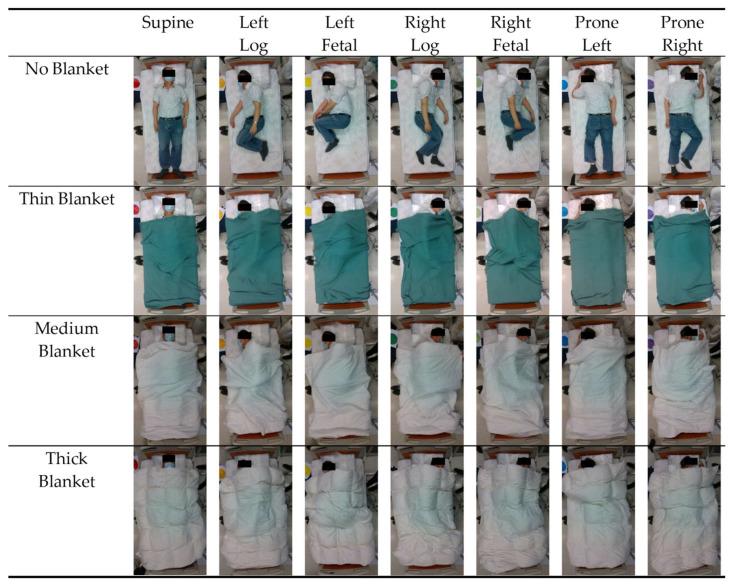
Emerging sleep health technologies will have an impact on monitoring patients with sleep disorders. This study proposes a new deep learning model architecture that improves the under-blanket sleep posture classification accuracy by leveraging the anatomical landmark feature through an attention strategy. The system used an integrated visible light and depth camera. Deep learning models (ResNet-34, EfficientNet B4, and ECA-Net50) were trained using depth images. We compared the models with and without an anatomical landmark coordinate input generated with an open-source pose estimation model using visible image data. We recruited 120 participants to perform seven major sleep postures, namely, the supine posture, prone postures with the head turned left and right, left- and right-sided log postures, and left- and right-sided fetal postures under four blanket conditions, including no blanket, thin, medium, and thick. A data augmentation technique was applied to the blanket conditions. The data were sliced at an 8:2 training-to-testing ratio. The results showed that ECA-Net50 produced the best classification results. Incorporating the anatomical landmark features increased the F1 score of ECA-Net50 from 87.4% to 92.2%. Our findings also suggested that the classification performances of deep learning models guided with features of anatomical landmarks were less affected by the interference of blanket conditions.
新兴的睡眠健康技术将对监测睡眠障碍患者产生影响。本研究提出了一种新的深度学习模型架构,通过注意力策略利用解剖学特征来提高被子下睡眠姿势分类的准确性。该系统使用了集成的可见光和深度摄像头。使用深度图像对深度学习模型(ResNet-34、EfficientNet B4 和 ECA-Net50)进行训练。我们将模型与使用可见图像数据生成的开源姿势估计模型生成的解剖学特征坐标输入进行了比较。我们招募了 120 名参与者进行了七种主要的睡眠姿势,即仰卧、左右转头、左右侧卧位和左右侧卧位在四种毯子条件下,包括没有毯子、薄毯子、中毯子和厚毯子。对毯子条件应用了数据扩充技术。数据以 8:2 的训练到测试比例进行切片。结果表明,ECA-Net50 产生了最佳的分类结果。纳入解剖学特征后,ECA-Net50 的 F1 分数从 87.4%提高到了 92.2%。我们的研究结果还表明,在有解剖学特征引导的深度学习模型的分类性能受毯子条件干扰的影响较小。



 Zotero 插件