Asma Syeda Tasmia, Imre Kálmán, Morar Adriana, Imre Mirela, Acaroz Ulas, Shah Syed Rizwan Ali, Hussain Syed Zajif, Arslan-Acaroz Damla, Istanbullugil Fatih Ramazan, Madani Khodir, Athanassiou Christos, Atanasoff Alexander, Morar Doru, Herman Viorel, Zhu Kui
Department of Food Hygiene and Technology, Faculty of Veterinary Medicine, Afyon Kocatepe University, Afyonkarahisar 03200, Turkey.
Department of Animal Production and Veterinary Public Health, Faculty of Veterinary Medicine, University of Life Sciences "King Michael I" from Timișoara, 300645 Timisoara, Romania.
Life (Basel). 2022 Oct 17;12(10):1618. doi: 10.3390/life12101618.
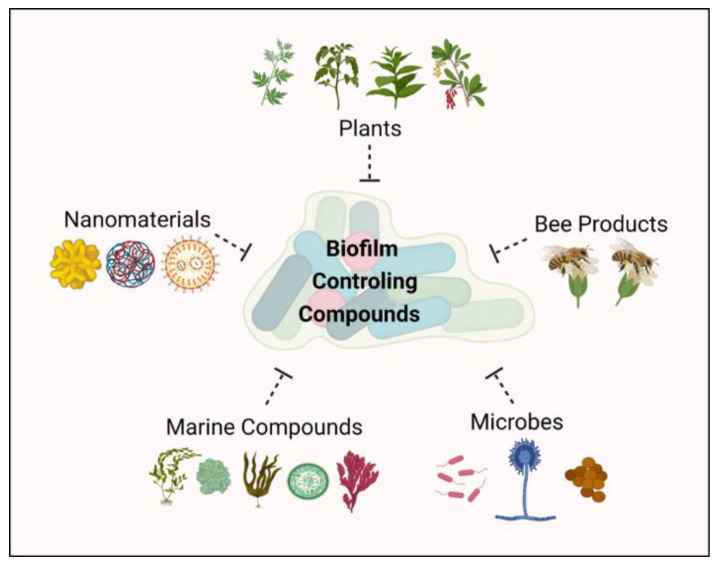
Microbial biofilm is an aggregation of microbial species that are either attached to surfaces or organized into an extracellular matrix. Microbes in the form of biofilms are highly resistant to several antimicrobials compared to planktonic microbial cells. Their resistance developing ability is one of the major root causes of antibiotic resistance in health sectors. Therefore, effective antibiofilm compounds are required to treat biofilm-associated health issues. The awareness of biofilm properties, formation, and resistance mechanisms facilitate researchers to design and develop combating strategies. This review highlights biofilm formation, composition, major stability parameters, resistance mechanisms, pathogenicity, combating strategies, and effective biofilm-controlling compounds. The naturally derived products, particularly plants, have demonstrated significant medicinal properties, producing them a practical approach for controlling biofilm-producing microbes. Despite providing effective antibiofilm activities, the plant-derived antimicrobial compounds may face the limitations of less bioavailability and low concentration of bioactive molecules. The microbes-derived and the phytonanotechnology-based antibiofilm compounds are emerging as an effective approach to inhibit and eliminate the biofilm-producing microbes.
微生物生物膜是附着于表面或组织成细胞外基质的微生物聚集体。与浮游微生物细胞相比,生物膜形式的微生物对多种抗菌剂具有高度抗性。它们的耐药性发展能力是卫生部门抗生素耐药性的主要根源之一。因此,需要有效的抗生物膜化合物来治疗与生物膜相关的健康问题。对生物膜特性、形成和耐药机制的认识有助于研究人员设计和开发对抗策略。本综述重点介绍了生物膜的形成、组成、主要稳定性参数、耐药机制、致病性、对抗策略以及有效的生物膜控制化合物。天然衍生产品,特别是植物,已显示出显著的药用特性,使其成为控制产生生物膜的微生物的实用方法。尽管植物衍生的抗菌化合物具有有效的抗生物膜活性,但可能面临生物利用度较低和生物活性分子浓度较低的局限性。微生物衍生的和基于植物纳米技术的抗生物膜化合物正在成为抑制和消除产生生物膜的微生物的有效方法。