Yang Wenjie, Liu Junjie, Yu Xiangfeng, Wang Gang, Zheng Zhigang, Guo Jianping, Chen Deyang, Qiu Zhaoguo, Zeng Dechang
School of Materials Science and Engineering, South China University of Technology, Guangzhou 510640, China.
Zhongshan R&D Center for Materials Surface and Thin Films Technology of the South China University of Technology, Gent Materials Surface Technology (Guangdong) Co., Ltd., Zhongshan 528437, China.
Materials (Basel). 2022 Oct 15;15(20):7191. doi: 10.3390/ma15207191.
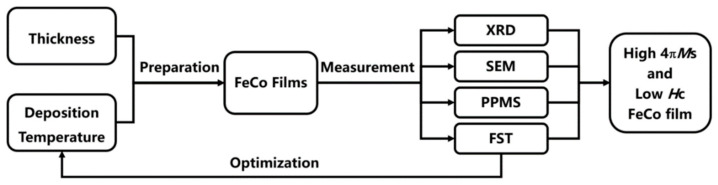
FeCo thin films with high saturation magnetization (4 π) can be applied in high-frequency electronic devices such as thin film inductors and microwave noise suppressors. However, due to its large magnetocrystalline anisotropy constant and magnetostrictive coefficient of FeCo, the coercivity () of FeCo films is generally high, which is detrimental to the soft magnetic properties. Meanwhile, the thickness and deposition temperature have significant effects on the coercivity and saturation magnetization of FeCo films. In this paper, FeCo thin films with different thicknesses were prepared by magnetron sputtering at different temperatures. The effects of thickness and deposition temperature on the microstructure and magnetic properties of FeCo thin films were systematically studied. When the film thickness increases from 50 nm to 800 nm, the coercivity would decrease from 309 Oe to 160 Oe. However, the saturation magnetization decreases from 22.1 kG to 15.3 kG. After that, we try to further increase the deposition temperature from room temperature (RT) to 475 °C. It is intriguing to find that the coercivity greatly decreased from 160 Oe to 3 Oe (decreased by 98%), and the saturation magnetization increased from 15.3 kG to 23.5 kG (increased by 53%) for the film with thickness of 800 nm. For the film with thickness of 50 nm, the coercivity also greatly decreased from 309 Oe to 10 Oe (decreased by 96%), but the saturation magnetization did not change significantly. It is contributed to the increase of deposition temperature, which will lead to the increase of grain size and the decrease of the number of grain boundaries. And the coercivity decreases as the number of grain boundaries decreases. Meanwhile, for the thicker films, when increasing the deposition temperature the thermal stress increases, which changes the appearance of (200) texture, and the saturation magnetization increases. Whereas, it has a negligible effect on the orientation of thin films with small thickness (50 nm). This indicates that high-temperature deposition is beneficial to the soft magnetic properties of FeCo thin films, particularly for the films with larger thickness. This FeCo thin film with high saturation magnetization and low coercivity could be an ideal candidate for high-frequency electronic devices.
具有高饱和磁化强度(4π)的铁钴薄膜可应用于薄膜电感器和微波噪声抑制器等高频电子器件中。然而,由于铁钴的磁晶各向异性常数和磁致伸缩系数较大,铁钴薄膜的矫顽力()通常较高,这对软磁性能不利。同时,厚度和沉积温度对铁钴薄膜的矫顽力和饱和磁化强度有显著影响。本文通过磁控溅射在不同温度下制备了不同厚度的铁钴薄膜。系统研究了厚度和沉积温度对铁钴薄膜微观结构和磁性能的影响。当薄膜厚度从50nm增加到800nm时,矫顽力将从309奥斯特降至160奥斯特。然而,饱和磁化强度从22.1千高斯降至15.3千高斯。之后,我们尝试将沉积温度从室温(RT)进一步提高到475℃。有趣的是,对于厚度为800nm的薄膜,矫顽力从160奥斯特大幅降至3奥斯特(降低了98%),饱和磁化强度从15.3千高斯增加到23.5千高斯(增加了53%)。对于厚度为50nm的薄膜,矫顽力也从309奥斯特大幅降至10奥斯特(降低了96%),但饱和磁化强度变化不显著。这归因于沉积温度的升高,这将导致晶粒尺寸增大和晶界数量减少。并且矫顽力随着晶界数量的减少而降低。同时,对于较厚的薄膜,当提高沉积温度时,热应力增加,这改变了(200)织构的形貌,饱和磁化强度增加。然而,对于小厚度(50nm)的薄膜取向影响可忽略不计。这表明高温沉积有利于铁钴薄膜的软磁性能,特别是对于较厚的薄膜。这种具有高饱和磁化强度和低矫顽力的铁钴薄膜可能是高频电子器件的理想候选材料。