Section of Veterinary Clinical Microbiology, Department of Veterinary and Animal Sciences, University of Copenhagen, 1870 Frederiksberg, Denmark.
Department of Virus & Microbiological Special Diagnostics, Statens Serum Institut, 2300 Copenhagen, Denmark.
Viruses. 2022 Sep 29;14(10):2147. doi: 10.3390/v14102147.
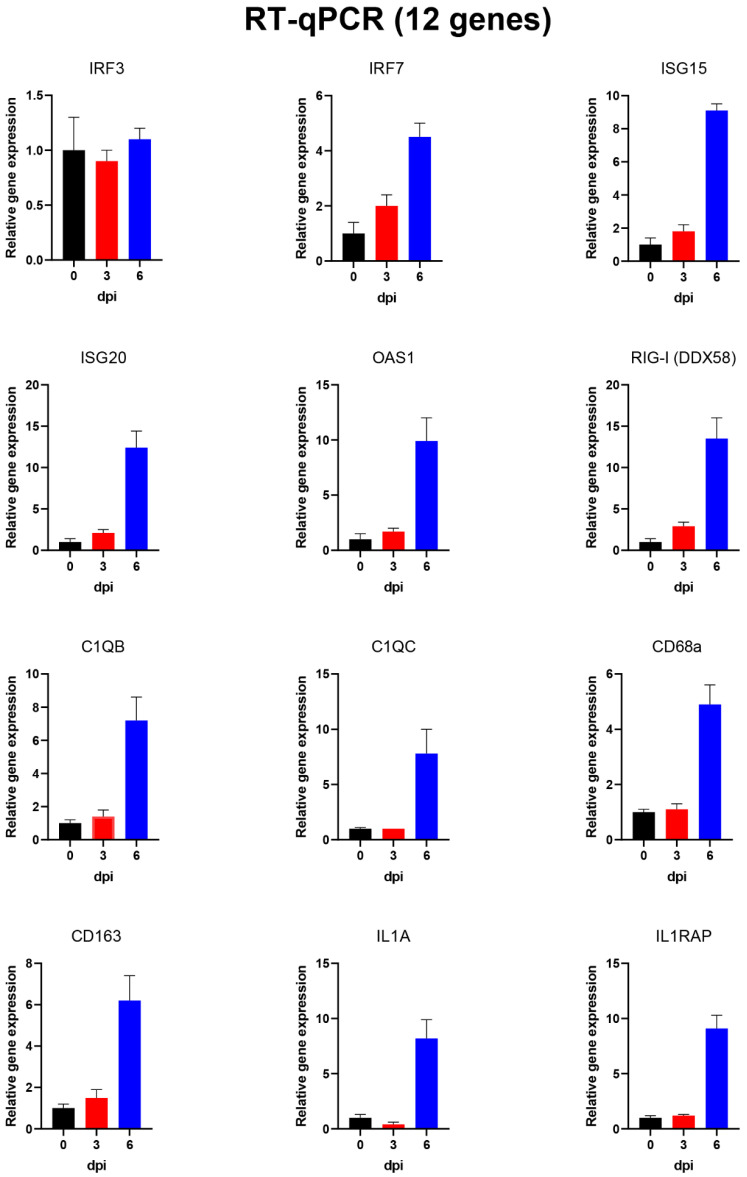
African swine fever virus (ASFV) has become a global threat to the pig production industry and has caused enormous economic losses in many countries in recent years. Peripheral blood mononuclear cells (PBMCs) from pigs infected with ASFV not only express ASFV genes (almost 200 in number) but have altered patterns of host gene expression as well. Both up- and down-regulation of host cell gene expression can be followed using RNAseq on poly(A)+ mRNAs harvested from the PBMCs of pigs collected at different times post-infection. Consistent with the time course of changes in viral gene expression, only few and limited changes in host gene expression were detected at 3 days post-infection (dpi), but by 6 dpi, marked changes in the expression of over 1300 host genes were apparent. This was co-incident with the major increase in viral gene expression. The majority of the changes in host gene expression were up-regulation, but many down-regulated genes were also identified. The patterns of changes in gene expression within the PBMCs detected by RNAseq were similar in each of the four infected pigs. Furthermore, changes in the expression of about twenty selected host genes, known to be important in host defence and inflammatory responses, were confirmed using high-throughput microfluidic qPCR assays.
非洲猪瘟病毒(ASFV)已成为全球养猪业的威胁,近年来在许多国家造成了巨大的经济损失。感染 ASFV 的猪的外周血单核细胞(PBMC)不仅表达 ASFV 基因(数量多达 200 个),而且宿主基因表达模式也发生了改变。可以使用 RNAseq 对从感染后不同时间采集的 PBMC 中分离的聚 A+ mRNA 进行研究,以观察宿主细胞基因表达的上调和下调。与病毒基因表达变化的时间进程一致,在感染后 3 天(dpi)仅检测到少数和有限的宿主基因表达变化,但到 6 dpi 时,超过 1300 个宿主基因的表达明显改变。这与病毒基因表达的大幅增加同时发生。宿主基因表达变化的大多数是上调,但也鉴定出许多下调的基因。通过 RNAseq 检测到的 PBMC 内基因表达变化的模式在 4 头感染猪中相似。此外,使用高通量微流控 qPCR 检测了大约 20 个选定的宿主基因的表达变化,这些基因已知在宿主防御和炎症反应中很重要。