Seki Keisuke, Kaneko Tadayoshi, Kamimoto Atsushi, Wada Maki, Takeuchi Yoshimasa, Furuchi Mika, Iinuma Toshimitsu
Nihon University School of Dentistry, Mishima Dental Center, Shizuoka, Japan.
Department of Comprehensive Dentistry and Clinical Education, Nihon University School of Dentistry, Tokyo, Japan.
J Dent Sci. 2022 Oct;17(4):1619-1625. doi: 10.1016/j.jds.2022.03.014. Epub 2022 Apr 13.
BACKGROUND/PURPOSE: Bone resorption inhibitors, such as bisphosphonates (BPs) and anti-receptor activator of nuclear factor kappa B ligand antibodies (denosumab; Dmab), are used to treat osteoporosis and effectively reduce the risk of fracture. However, medication-related osteonecrosis of the jaw (MRONJ) has been reported as a rare adverse effect. Invasive tooth extraction procedures are reportedly a factor in the development of MRONJ. In this study, we aimed to retrospectively observe and clinically examine the effect of medication status on MRONJ development after tooth extraction in patients receiving drug treatment for osteoporosis.
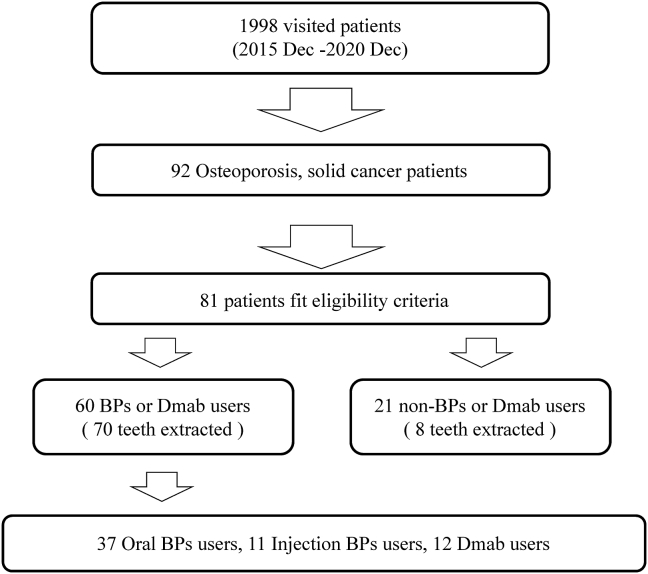
This study was conducted among patients who visited our hospital between December 2015 and December 2021. We collected and analyzed the medical information of patients who underwent dental extractions while using osteoporosis medications, including oral and injectable BPs and Dmab.
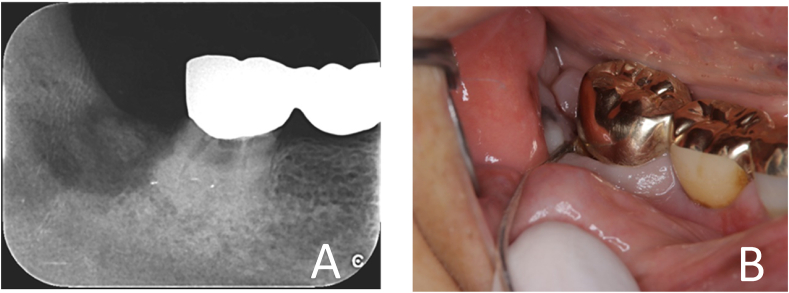
Among antiresorptive medication users, 40 patients (70 teeth) underwent extraction. The mean duration of BP/Dmab use was 40.4 months, and the mean duration of drug holiday was 6.9 months. MRONJ after tooth extraction was not seen in BP users, but we observed two cases in Dmab users. A significant difference in MRONJ development was confirmed with the use of injectable compared with oral medication administration (odds ratio=5.01).
The use of injectable bone resorption inhibitors was associated with a higher risk of developing MRONJ. The route of administration, duration of medication, and withdrawal period should be carefully considered to prevent MRONJ after tooth extraction.
背景/目的:骨吸收抑制剂,如双膦酸盐(BPs)和抗核因子κB受体活化剂配体抗体(地诺单抗;Dmab),用于治疗骨质疏松症并有效降低骨折风险。然而,药物相关性颌骨坏死(MRONJ)已被报道为一种罕见的不良反应。据报道,侵入性拔牙程序是MRONJ发生的一个因素。在本研究中,我们旨在回顾性观察并临床检查用药状况对接受骨质疏松症药物治疗的患者拔牙后MRONJ发生的影响。
本研究在2015年12月至2021年12月期间到我院就诊的患者中进行。我们收集并分析了在使用骨质疏松症药物(包括口服和注射用BPs以及Dmab)期间接受拔牙的患者的医疗信息。
在抗吸收药物使用者中,40例患者(70颗牙齿)接受了拔牙。使用BP/Dmab的平均持续时间为40.4个月,药物假期的平均持续时间为6.9个月。BP使用者拔牙后未出现MRONJ,但我们在Dmab使用者中观察到2例。与口服给药相比,注射给药在MRONJ发生方面存在显著差异(优势比=5.01)。
使用注射用骨吸收抑制剂与发生MRONJ的较高风险相关。应仔细考虑给药途径、用药持续时间和停药期,以预防拔牙后发生MRONJ。