Alonso María Fernanda, Bain Judith M, Rudkin Fiona M, Erwig Lars P, Brown Alistair J P, Gow Neil A R
The Aberdeen Fungal Group, School of Medicine, Medical Sciences & Nutrition, Institute of Medical Sciences, University of Aberdeen, Foresterhill, Aberdeen AB25 2ZD, UK.
Medical Research Council Centre for Medical Mycology, University of Exeter, Geoffrey Pope Building, Stocker Road, Exeter EX4 4QD, UK.
Cell Surf. 2022 Oct 13;8:100082. doi: 10.1016/j.tcsw.2022.100082. eCollection 2022 Dec.
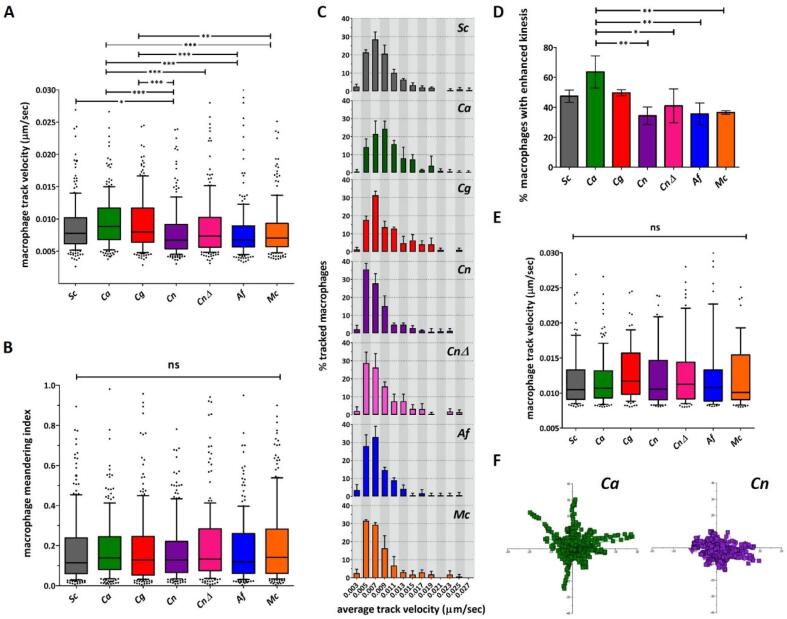
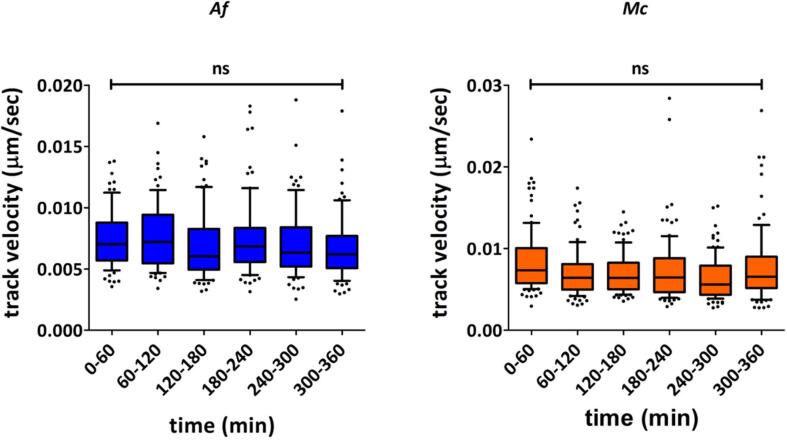
Phagocytosis is an essential component of our immune defence against fungal pathogens. Differences in the dynamics of phagocyte migration, recognition, uptake and phagolysosome maturation are dependent on the characteristics of the fungal cargo, and in particular to differences in cell wall composition and cellular morphology. However, studies that have focused on phagocyte interactions with individual fungal species have not enabled comparisons in the kinetics of these interactions to be made between these different species. We therefore used live cell video microscopy to examine the temporal dynamics of phagocytosis for a range of fungal cargoes by thioglycollate-elicited peritoneal macrophages from C57BL/6 mice. Uniform populations of macrophages were challenged at the same time with yeast cells of , and (wild-type and an acapsular mutant, 59Δ), and spores of and to enable standardized comparative interactions to be quantified from different stages of phagocytosis Differences in the rate of uptake of fungal cells varied by up to 26-fold, whilst differences in time to induce phagosome acidification varied by as much as 29-fold. Heat-killing or opsonizing the fungal targets markedly affected the kinetics of the interaction in a species-specific manner. Fungal and macrophage killing assays further revealed cargo-specific differences in phagocytosis and diversity in fungal evasion mechanisms. Therefore, simultaneous assessment of the interaction of macrophages with different fungal pathogens highlighted major differences in the kinetics and growth responses during fungus-phagocyte interactions that are likely to impact on pathogenesis and virulence.
吞噬作用是我们针对真菌病原体的免疫防御的重要组成部分。吞噬细胞迁移、识别、摄取和吞噬溶酶体成熟动力学的差异取决于真菌病原体的特性,特别是细胞壁组成和细胞形态的差异。然而,专注于吞噬细胞与单个真菌物种相互作用的研究未能对这些不同物种之间这些相互作用的动力学进行比较。因此,我们使用活细胞视频显微镜来检查来自C57BL/6小鼠的巯基乙酸盐诱导的腹腔巨噬细胞对一系列真菌病原体的吞噬作用的时间动态。将均匀的巨噬细胞群体同时用白色念珠菌、新型隐球菌和烟曲霉(野生型和无荚膜突变体59Δ)的酵母细胞以及皮炎芽生菌和荚膜组织胞浆菌的孢子进行攻击,以便从吞噬作用的不同阶段对标准化的比较相互作用进行量化。真菌细胞摄取速率的差异高达26倍,而诱导吞噬体酸化的时间差异高达29倍。热杀死或调理真菌靶标以物种特异性方式显著影响相互作用的动力学。真菌和巨噬细胞杀伤试验进一步揭示了吞噬作用中病原体特异性差异以及真菌逃避机制的多样性。因此,同时评估巨噬细胞与不同真菌病原体的相互作用突出了真菌 - 吞噬细胞相互作用期间动力学和生长反应的主要差异,这些差异可能影响发病机制和毒力。