Avelar Gabriela M, Dambuza Ivy M, Ricci Liviana, Yuecel Raif, Mackenzie Kevin, Childers Delma S, Bain Judith M, Pradhan Arnab, Larcombe Daniel E, Netea Mihai G, Erwig Lars P, Brown Gordon D, Duncan Sylvia H, Gow Neil A R, Walker Alan W, Brown Alistair J P
Aberdeen Fungal Group, University of Aberdeen, Institute of Medical Sciences, Foresterhill, Aberdeen AB25 2ZD, UK.
Medical Research Council Centre for Medical Mycology, University of Exeter, Geoffrey Pope Building, Stocker Road, Exeter EX4 4QD, UK.
Cell Surf. 2022 Oct 17;8:100084. doi: 10.1016/j.tcsw.2022.100084. eCollection 2022 Dec.
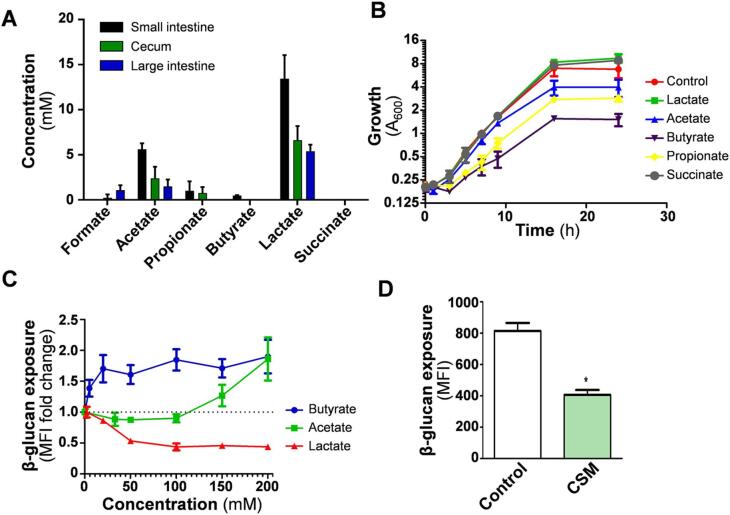
The immunogenicity of cells is influenced by changes in the exposure of microbe-associated molecular patterns (MAMPs) on the fungal cell surface. Previously, the degree of exposure on the cell surface of the immunoinflammatory MAMP β-(1,3)-glucan was shown to correlate inversely with colonisation levels in the gastrointestinal (GI) tract. This is important because life-threatening systemic candidiasis in critically ill patients often arises from translocation of strains present in the patient's GI tract. Therefore, using a murine model, we have examined the impact of gut-related factors upon β-glucan exposure and colonisation levels in the GI tract. The degree of β-glucan exposure was examined by imaging flow cytometry of cells taken directly from GI compartments, and compared with colonisation levels. Fungal β-glucan exposure was lower in the cecum than the small intestine, and fungal burdens were correspondingly higher in the cecum. This inverse correlation did not hold for the large intestine. The gut fermentation acid, lactate, triggers β-glucan masking leading to attenuated anti- immune responses. Additional fermentation acids are present in the GI tract, including acetate, propionate, and butyrate. We show that these acids also influence β-glucan exposure on cells and, like lactate, they influence β-glucan exposure via Gpr1/Gpa2-mediated signalling. Significantly, 1Δ 2Δ cells displayed elevated β-glucan exposure in the large intestine and a corresponding decrease in fungal burden, consistent with the idea that Gpr1/Gpa2-mediated β-glucan masking influences colonisation of this GI compartment. Finally, extracts from the murine gut and culture supernatants from the mannan grazing gut anaerobe promote β-glucan exposure at the cell surface. Therefore, the local microbiota influences β-glucan exposure levels directly (via mannan grazing) and indirectly (via fermentation acids), whilst β-glucan masking appears to promote colonisation of the murine large intestine.
真菌细胞的免疫原性受真菌细胞表面微生物相关分子模式(MAMPs)暴露变化的影响。此前研究表明,免疫炎性MAMPβ-(1,3)-葡聚糖在真菌细胞表面的暴露程度与胃肠道(GI)中的定植水平呈负相关。这一点很重要,因为危重症患者危及生命的系统性念珠菌病通常源于患者胃肠道中存在的菌株易位。因此,我们利用小鼠模型研究了肠道相关因素对GI中β-葡聚糖暴露和定植水平的影响。通过对直接取自GI腔室的真菌细胞进行成像流式细胞术检测β-葡聚糖暴露程度,并与定植水平进行比较。盲肠中真菌β-葡聚糖的暴露低于小肠,而盲肠中的真菌负荷相应较高。这种负相关在大肠中不成立。肠道发酵酸乳酸会引发β-葡聚糖掩盖,导致抗真菌免疫反应减弱。GI中还存在其他发酵酸,包括乙酸、丙酸和丁酸。我们发现这些酸也会影响真菌细胞上β-葡聚糖的暴露,并且与乳酸一样,它们通过Gpr1/Gpa2介导的信号传导影响β-葡聚糖暴露。值得注意的是,Gpr1ΔGpa2Δ细胞在大肠中显示出β-葡聚糖暴露增加,真菌负荷相应降低,这与Gpr1/Gpa2介导的β-葡聚糖掩盖影响该GI腔室定植的观点一致。最后,小鼠肠道提取物和甘露聚糖利用型肠道厌氧菌的培养上清液可促进真菌细胞表面β-葡聚糖的暴露。因此,局部微生物群直接(通过甘露聚糖利用)和间接(通过发酵酸)影响β-葡聚糖暴露水平,而β-葡聚糖掩盖似乎促进了真菌在小鼠大肠中的定植。