Chourak Hilda, Barateau Anaïs, Tahri Safaa, Cadin Capucine, Lafond Caroline, Nunes Jean-Claude, Boue-Rafle Adrien, Perazzi Mathias, Greer Peter B, Dowling Jason, de Crevoisier Renaud, Acosta Oscar
University of Rennes, CLCC Eugène Marquis, INSERM, LTSI - UMR 1099, Rennes, France.
The Australian eHealth Research Centre, Commonwealth Scientific and Industrial Research Organisation (CSIRO), Health and Biosecurity, Brisbane, QLD, Australia.
Front Oncol. 2022 Oct 10;12:968689. doi: 10.3389/fonc.2022.968689. eCollection 2022.
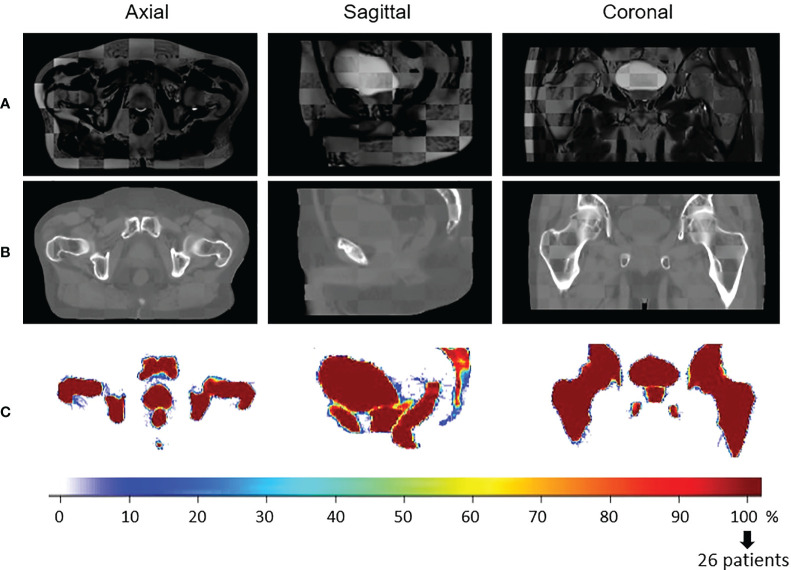
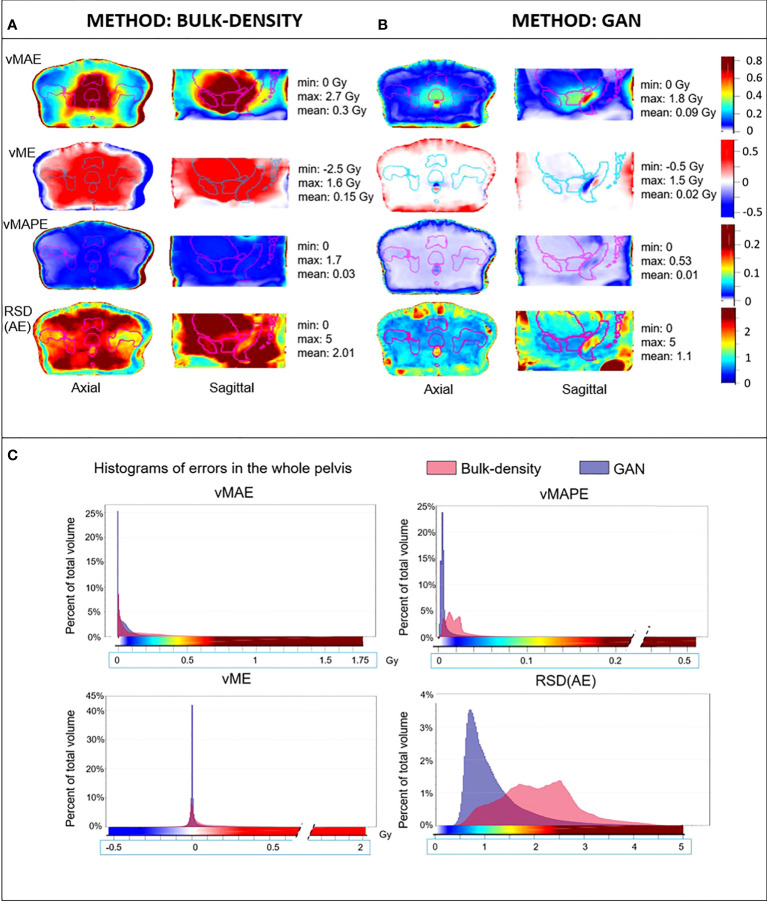
The quality assurance of synthetic CT (sCT) is crucial for safe clinical transfer to an MRI-only radiotherapy planning workflow. The aim of this work is to propose a population-based process assessing local errors in the generation of sCTs and their impact on dose distribution. For the analysis to be anatomically meaningful, a customized interpatient registration method brought the population data to the same coordinate system. Then, the voxel-based process was applied on two sCT generation methods: a bulk-density method and a generative adversarial network. The CT and MRI pairs of 39 patients treated by radiotherapy for prostate cancer were used for sCT generation, and 26 of them with delineated structures were selected for analysis. Voxel-wise errors in sCT compared to CT were assessed for image intensities and dose calculation, and a population-based statistical test was applied to identify the regions where discrepancies were significant. The cumulative histograms of the mean absolute dose error per volume of tissue were computed to give a quantitative indication of the error for each generation method. Accurate interpatient registration was achieved, with mean Dice scores higher than 0.91 for all organs. The proposed method produces three-dimensional maps that precisely show the location of the major discrepancies for both sCT generation methods, highlighting the heterogeneity of image and dose errors for sCT generation methods from MRI across the pelvic anatomy. Hence, this method provides additional information that will assist with both sCT development and quality control for MRI-based planning radiotherapy.
合成CT(sCT)的质量保证对于安全地临床转换到仅使用MRI的放射治疗计划工作流程至关重要。这项工作的目的是提出一种基于人群的过程,用于评估sCT生成中的局部误差及其对剂量分布的影响。为了使分析在解剖学上有意义,一种定制的患者间配准方法将人群数据带入相同的坐标系。然后,基于体素的过程应用于两种sCT生成方法:体密度法和生成对抗网络。使用39例接受前列腺癌放射治疗患者的CT和MRI对来生成sCT,并选择其中26例具有勾画结构的患者进行分析。针对图像强度和剂量计算,评估sCT与CT相比的体素级误差,并应用基于人群的统计测试来识别差异显著的区域。计算每体积组织的平均绝对剂量误差的累积直方图,以定量指示每种生成方法的误差。实现了准确的患者间配准,所有器官的平均骰子系数得分均高于0.91。所提出的方法生成三维图,精确显示两种sCT生成方法的主要差异位置,突出了基于MRI的骨盆解剖结构sCT生成方法的图像和剂量误差的异质性。因此,该方法提供了额外的信息,将有助于基于MRI的放射治疗计划的sCT开发和质量控制。