Ma Miao, He Wenyou, Zhao Keyu, Xue Linyuan, Xia Siyuan, Zhang Baotong
Department of Human Cell Biology and Genetics, School of Medicine, Southern University of Science and Technology, Shenzhen, China.
Front Oncol. 2022 Oct 10;12:1006340. doi: 10.3389/fonc.2022.1006340. eCollection 2022.
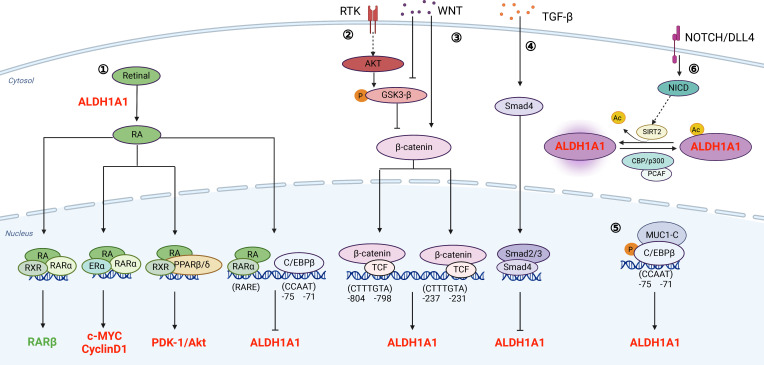
Prostate cancer (PCa) is the most common cancer in men in the United States. About 10 - 20% of PCa progress to castration-resistant PCa (CRPC), which is accompanied by metastasis and therapeutic resistance. Aldehyde dehydrogenase (ALDH) is famous as a marker of cancer stem-like cells in different cancer types, including PCa. Generally, ALDHs catalyze aldehyde oxidation into less toxic carboxylic acids and give cancers a survival advantage by reducing oxidative stress caused by aldehyde accumulation. In PCa, the expression of ALDHs is associated with a higher tumor stage and more lymph node metastasis. Functionally, increased ALDH activity makes PCa cells gain more capabilities in self-renewal and metastasis and reduces the sensitivity to castration and radiotherapy. Therefore, it is promising to target ALDH or ALDH cells to eradicate PCa. However, challenges remain in moving the ALDH inhibitors to PCa therapy, potentially due to the toxicity of pan-ALDH inhibitors, the redundancy of ALDH isoforms, and the lack of explicit understanding of the metabolic signaling transduction details. For targeting PCa stem-like cells (PCSCs), different regulators have been revealed in ALDH cells to control cell proliferation and tumorigenicity. ALDH rewires essential signaling transduction in PCa cells. It has been shown that ALDHs produce retinoic acid (RA), bind with androgen, and modulate diverse signaling. This review summarizes and discusses the pathways directly modulated by ALDHs, the crucial regulators that control the activities of ALDH PCSCs, and the recent progress of ALDH targeted therapies in PCa. These efforts will provide insight into improving ALDH-targeted treatment.
前列腺癌(PCa)是美国男性中最常见的癌症。约10%-20%的PCa会进展为去势抵抗性前列腺癌(CRPC),并伴有转移和治疗抵抗。醛脱氢酶(ALDH)作为不同癌症类型(包括PCa)中癌症干细胞样细胞的标志物而闻名。一般来说,ALDH催化醛氧化为毒性较小的羧酸,并通过减少醛积累引起的氧化应激赋予癌症生存优势。在PCa中,ALDH的表达与更高的肿瘤分期和更多的淋巴结转移相关。在功能上,ALDH活性增加使PCa细胞在自我更新和转移方面获得更多能力,并降低对去势和放疗的敏感性。因此,靶向ALDH或ALDH细胞以根除PCa具有前景。然而,将ALDH抑制剂应用于PCa治疗仍存在挑战,这可能是由于泛ALDH抑制剂的毒性、ALDH亚型的冗余性以及对代谢信号转导细节缺乏明确了解。为了靶向PCa干细胞样细胞(PCSCs),已在ALDH细胞中发现不同的调节因子来控制细胞增殖和致瘤性。ALDH重塑PCa细胞中的关键信号转导。研究表明,ALDH产生视黄酸(RA),与雄激素结合,并调节多种信号。本文综述并讨论了由ALDH直接调节的途径、控制ALDH+PCSCs活性的关键调节因子以及PCa中ALDH靶向治疗的最新进展。这些努力将为改进ALDH靶向治疗提供见解。