Immunotherapy Research Center, Korea Research Institute of Bioscience and Biotechnology, 125 Gwahak-ro, Yuseong-gu, Daejon, 34141, South Korea.
Department of Microbiology and Molecular Biology, Chungnam National University, Daejon, 34134, South Korea.
J Exp Clin Cancer Res. 2021 Nov 22;40(1):372. doi: 10.1186/s13046-021-02147-7.
Transmembrane serine protease 4 (TMPRSS4) is a cell surface-anchored serine protease. Elevated expression of TMPRSS4 correlates with poor prognosis in colorectal cancer, gastric cancer, prostate cancer, non-small cell lung cancer, and other cancers. Previously, we demonstrated that TMPRSS4 promotes invasion and proliferation of prostate cancer cells. Here, we investigated whether TMPRSS4 confers cancer stem-like properties to prostate cancer cells and characterized the underlying mechanisms.
Acquisition of cancer stem-like properties by TMPRSS4 was examined by monitoring anchorage-independent growth, tumorsphere formation, aldehyde dehydrogenase (ALDH) activation, and resistance to anoikis and drugs in vitro and in an early metastasis model in vivo. The underlying molecular mechanisms were evaluated, focusing on stemness-related factors regulated by epithelial-mesenchymal transition (EMT)-inducing transcription factors. Clinical expression and significance of TMPRSS4 and stemness-associated factors were explored by analyzing datasets from The Cancer Genome Atlas (TCGA).
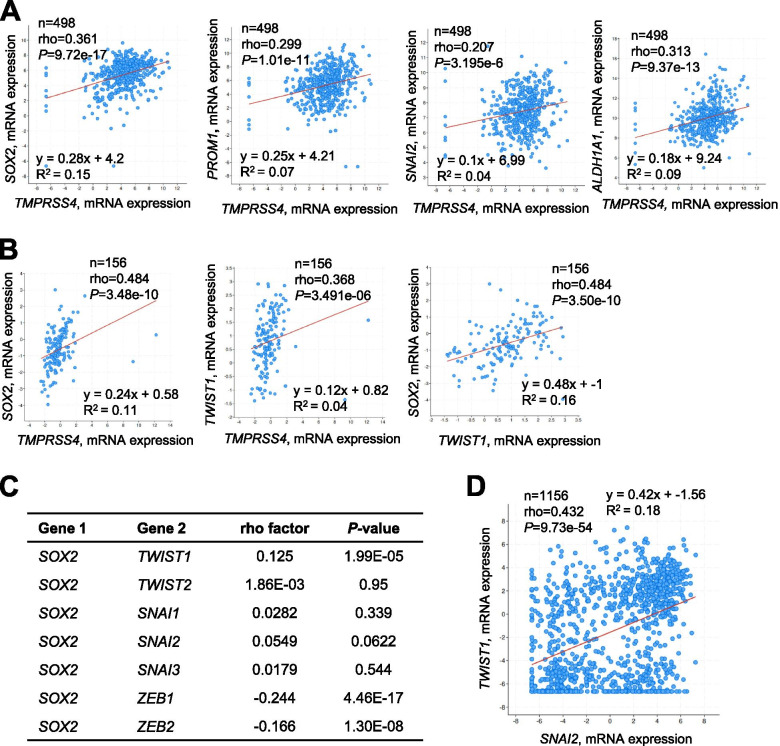
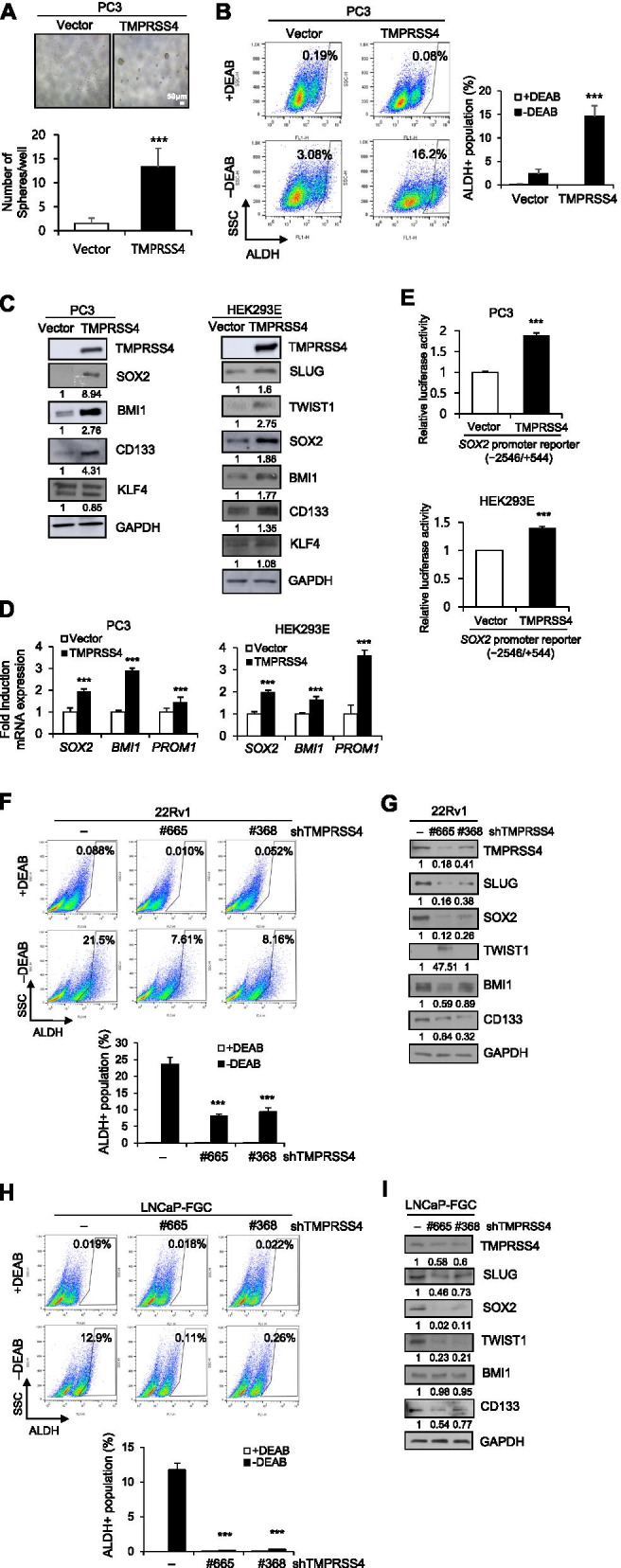
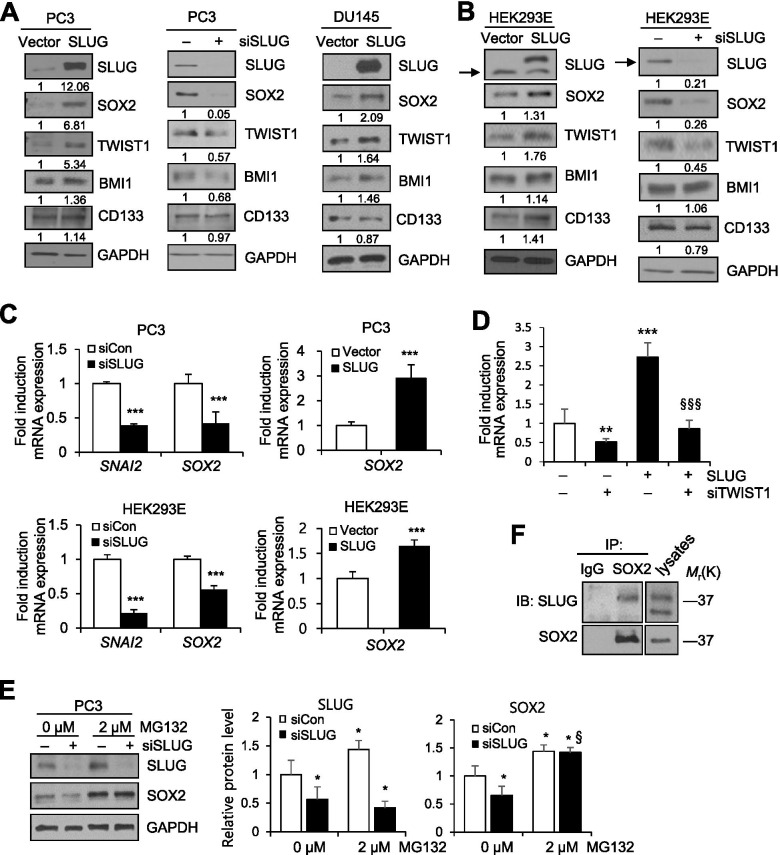
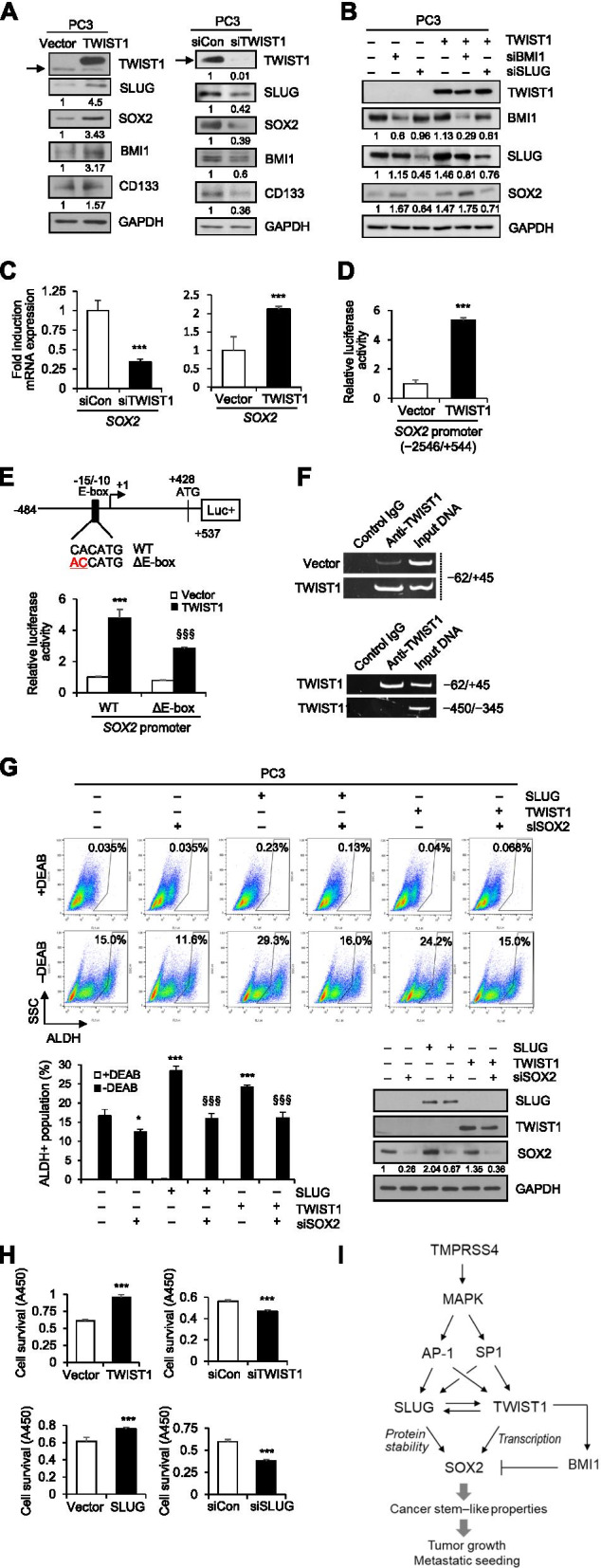
TMPRSS4 promoted anchorage-independent growth, ALDH activation, tumorsphere formation, and therapeutic resistance of prostate cancer cells. In addition, TMPRSS4 promoted resistance to anoikis, thereby increasing survival of circulating tumor cells and promoting early metastasis. These features were accompanied by upregulation of stemness-related factors such as SOX2, BMI1, and CD133. SLUG and TWIST1, master EMT-inducing transcription factors, made essential contributions to TMPRSS4-mediated cancer stem cell (CSC) features through upregulation of SOX2. SLUG stabilized SOX2 via preventing proteasomal degradation through its interaction with SOX2, while TWIST1 upregulated transcription of SOX2 by interacting with the proximal E-box element in the SOX2 promoter. Clinical data showed that TMPRSS4 expression correlated with the levels of SOX2, PROM1, SNAI2, and TWIST1. Expression of SOX2 was positively correlated with that of TWIST1, but not with other EMT-inducing transcription factors, in various cancer cell lines.
Together, these findings suggest that TMPRSS4 promotes CSC features in prostate cancer through upregulation of the SLUG- and TWIST1-induced stem cell factor SOX2 beyond EMT. Thus, TMPRSS4/SLUG-TWIST1/SOX2 axis may represent a novel mechanism involved in the control of tumor progression.
跨膜丝氨酸蛋白酶 4(TMPRSS4)是一种细胞表面锚定的丝氨酸蛋白酶。TMPRSS4 的表达升高与结直肠癌、胃癌、前列腺癌、非小细胞肺癌等癌症的预后不良相关。先前,我们证明 TMPRSS4 促进前列腺癌细胞的侵袭和增殖。在这里,我们研究了 TMPRSS4 是否赋予前列腺癌细胞癌症干细胞样特性,并对其潜在机制进行了表征。
通过监测体外无锚定生长、肿瘤球形成、醛脱氢酶(ALDH)激活以及抗失巢凋亡和药物耐药性,以及体内早期转移模型,来检测 TMPRSS4 获得癌症干细胞样特性。评估了潜在的分子机制,重点关注由上皮-间充质转化(EMT)诱导的转录因子调节的干细胞相关因子。通过分析来自癌症基因组图谱(TCGA)的数据集,研究了 TMPRSS4 和干细胞相关因子的临床表达和意义。
TMPRSS4 促进了前列腺癌细胞的无锚定生长、ALDH 激活、肿瘤球形成和治疗耐药性。此外,TMPRSS4 还促进了抗失巢凋亡的能力,从而增加了循环肿瘤细胞的存活并促进了早期转移。这些特征伴随着干细胞相关因子(如 SOX2、BMI1 和 CD133)的上调。SLUG 和 TWIST1,作为 EMT 诱导的主要转录因子,通过上调 SOX2,对 TMPRSS4 介导的癌症干细胞(CSC)特征做出了重要贡献。SLUG 通过与其相互作用来防止蛋白酶体降解,从而稳定 SOX2,而 TWIST1 通过与 SOX2 启动子近端 E 盒元件相互作用来上调 SOX2 的转录。临床数据表明,TMPRSS4 的表达与 SOX2、PROM1、SNAI2 和 TWIST1 的水平相关。在各种癌细胞系中,SOX2 的表达与 TWIST1 呈正相关,而与其他 EMT 诱导的转录因子无关。
综上所述,这些发现表明,TMPRSS4 通过上调 SLUG 和 TWIST1 诱导的干细胞因子 SOX2,促进了前列腺癌中的 CSC 特征,超出了 EMT。因此,TMPRSS4/SLUG-TWIST1/SOX2 轴可能代表一种新的机制,参与肿瘤进展的控制。