Kelly Christine, Gurung Rijan, Kamng'ona Raphael, Sheha Irene, Chammudzi Mishek, Jambo Kondwani, Mallewa Jane, Rapala Alicja, Heyderman Rob, Mallon Patrick, Mwandumba Henry, Khoo Saye, Klein Nigel
Centre for Experimental Pathogen Host Research, UCD, Dublin, Ireland.
Malawi-Liverpool-Wellcome Clinical Research Programme, Blantyre, Malawi, Malawi.
Wellcome Open Res. 2022 Oct 17;6:264. doi: 10.12688/wellcomeopenres.17044.2. eCollection 2021.
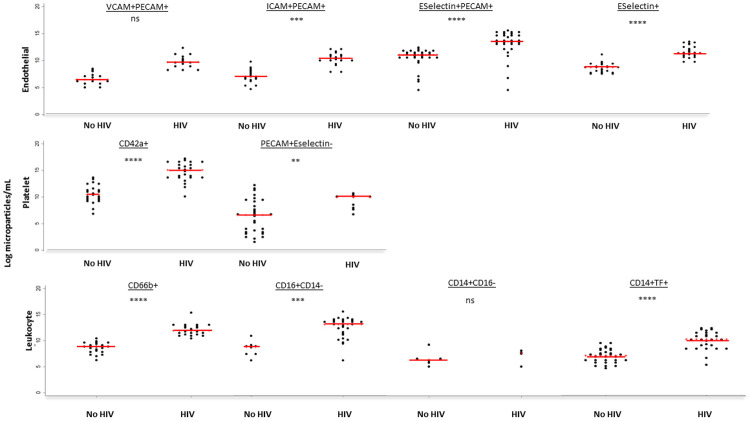
We aim to investigate whether circulating microparticle (CMPs) subsets were raised amongst people presenting with a new diagnosis of HIV and advanced immune suppression in Malawi, and whether they associated with arterial stiffness. : Microparticle characterisation and carotid femoral Pulse Wave Velocity (cfPWV) were carried out in a cohort of adults with a new HIV diagnosis and CD4 <100 cells/µL at 2 weeks post ART initiation. HIV uninfected controls were matched on age, systolic BP and diastolic BP in a 1:1 ratio. Circulating microparticles were identified from platelet poor plasma and stained for endothelial, leucocyte, monocyte and platelet markers. The median (IQ) total CMP count for 71 participants was 1 log higher in HIV compared to those without (p<0.0001) and was associated with arterial stiffness (spearman rho 0.47, p<0.001). In adjusted analysis, every log increase in circulating particles showed a 20% increase in cfPWV (95% CI 4 - 40%, p=0.02). In terms of subsets, endothelial and platelet derived microparticles were most strongly associated with HIV. Endothelial derived E-selectin+ CMPs were 1.3log-fold higher and platelet derived CD42a+ CMPs were 1.4log-fold higher (both p<0.0001). Endothelial and platelet derived CMPs also correlated most closely with arterial stiffness [spearman rho: E-selectin+ 0.57 and CD42a 0.56, both p<0.0001). Circulating microparticles associate strongly with arterial stiffness among PLWH in Malawi. Endothelial and platelet microparticles are the predominant cell origin types, indicating that platelet driven endothelial dysfunction pathways warrant further investigation in HIV associated arterial stiffness.
我们旨在调查在马拉维新诊断出感染艾滋病毒且免疫严重抑制的人群中,循环微颗粒(CMPs)亚群是否增加,以及它们是否与动脉僵硬度相关。在一组新诊断出感染艾滋病毒且在开始抗逆转录病毒治疗(ART)两周后CD4<100个细胞/微升的成年人中进行了微颗粒表征和颈股脉搏波速度(cfPWV)检测。未感染艾滋病毒的对照组按1:1的比例在年龄、收缩压和舒张压方面进行匹配。从无血小板血浆中鉴定出循环微颗粒,并对其进行内皮细胞、白细胞、单核细胞和血小板标志物染色。71名参与者的CMP总数中位数(四分位数间距)在艾滋病毒感染者中比未感染者高1个对数(p<0.0001),且与动脉僵硬度相关(斯皮尔曼相关系数0.47,p<0.001)。在调整分析中,循环颗粒每增加1个对数,cfPWV增加20%(95%置信区间4%-40%,p=0.02)。就亚群而言,内皮细胞和血小板衍生的微颗粒与艾滋病毒的关联最为密切。内皮细胞衍生的E-选择素+CMPs高1.3对数倍,血小板衍生的CD42a+CMPs高1.4对数倍(均p<0.0001)。内皮细胞和血小板衍生的CMPs也与动脉僵硬度的相关性最为密切[斯皮尔曼相关系数:E-选择素+为0.57,CD42a为0.56,均p<0.0001]。在马拉维艾滋病毒感染者中,循环微颗粒与动脉僵硬度密切相关。内皮细胞和血小板微颗粒是主要的细胞来源类型,表明血小板驱动的内皮功能障碍途径在艾滋病毒相关动脉僵硬度方面值得进一步研究。