Division of Neonatology, Careggi University Hospital of Florence, Largo Brambilla 3, 50134, Florence, Italy.
Department of Neurosciences, Psychology, Drug Research and Child Health, University of Florence, Florence, Italy.
Paediatr Drugs. 2023 Jan;25(1):79-86. doi: 10.1007/s40272-022-00541-y. Epub 2022 Oct 27.
Early treatment with caffeine in the delivery room (DR) has been proposed to decrease the need for mechanical ventilation (MV) by limiting episodes of apnoea and improving respiratory mechanics in preterm infants. Our aim was to verify the hypothesis that intravenous or enteral administration of caffeine can be performed in the preterm infant in the DR.
Infants with 25-29 weeks of gestational age were enrolled and randomised to receive 20 mg/kg of caffeine citrate intravenously, via the umbilical vein, or enterally, through an orogastric tube, within 10 min of birth. Caffeine blood level was measured at 60 ± 15 min after administration and 60 ± 15 min before the next dose (5 mg/kg). The primary endpoint was evaluation of the success rate of intravenous and enteral administration of caffeine in the DR.
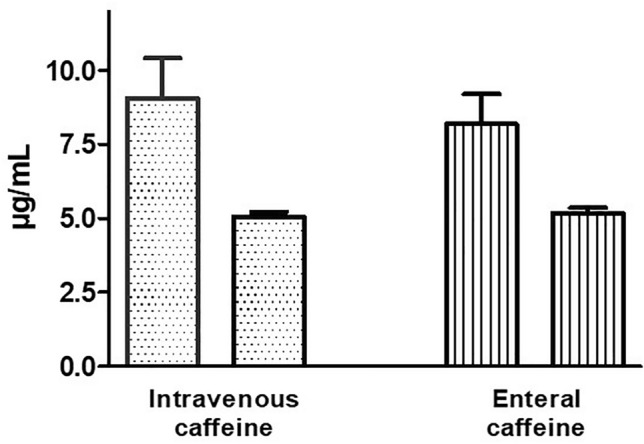
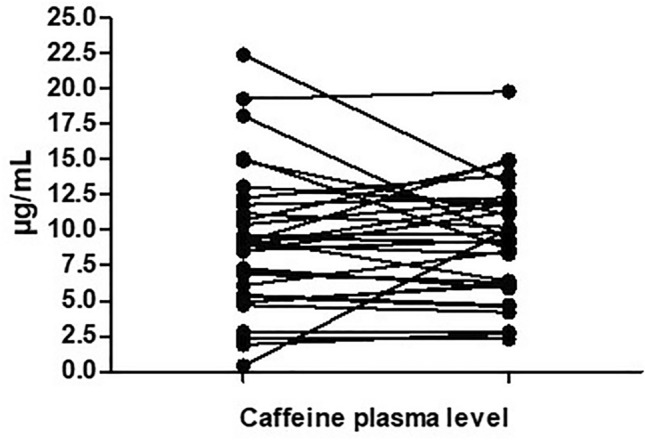
Nineteen patients were treated with intravenous caffeine and 19 with enteral caffeine. In all patients the procedure was successfully performed. Peak blood level of caffeine 60 ± 15 min after administration in the DR was found to be below the therapeutic range (5 µg/mL) in 25 % of samples and above the therapeutic range in 3%. Blood level of caffeine 60 ± 15 min before administration of the second dose was found to be below the therapeutic range in 18% of samples.
Intravenous and enteral administration of caffeine can be performed in the DR without interfering with infants' postnatal assistance. Some patients did not reach the therapeutic range, raising the question of which dose is the most effective to prevent MV.
ClinicalTrials.gov identifier NCT04044976; EudraCT number 2018-003626-91.
在分娩室(DR)中早期给予咖啡因治疗,可通过限制呼吸暂停发作和改善早产儿的呼吸力学来减少机械通气(MV)的需求。我们的目的是验证在 DR 中对早产儿进行静脉或肠内给予咖啡因的假设。
纳入 25-29 周胎龄的婴儿,并随机分为两组,分别在出生后 10 分钟内通过脐静脉静脉内给予 20mg/kg 枸橼酸咖啡因,或通过经口胃管肠内给予,咖啡因血药浓度在给药后 60±15 分钟和下一次剂量(5mg/kg)前 60±15 分钟进行测量。主要终点是评估 DR 中静脉和肠内给予咖啡因的成功率。
19 例患者接受静脉内咖啡因治疗,19 例患者接受肠内咖啡因治疗。所有患者的操作均成功完成。DR 中给药后 60±15 分钟时,咖啡因的峰值血药浓度在 25%的样本中低于治疗范围(5μg/mL),在 3%的样本中高于治疗范围。第二次剂量前 60±15 分钟的咖啡因血药浓度在 18%的样本中低于治疗范围。
DR 中可以进行静脉内和肠内给予咖啡因,而不会干扰婴儿的产后护理。一些患者未达到治疗范围,这引发了一个问题,即哪种剂量最有效以预防 MV。
ClinicalTrials.gov 标识符 NCT04044976;EudraCT 编号 2018-003626-91。