• 文献检索
  • 文档翻译
  • 深度研究
  • 学术资讯
  • Suppr Zotero 插件Zotero 插件
  • 邀请有礼
  • 套餐&价格
  • 历史记录
应用&插件
Suppr Zotero 插件Zotero 插件浏览器插件Mac 客户端Windows 客户端微信小程序
定价
高级版会员购买积分包购买API积分包
服务
文献检索文档翻译深度研究API 文档MCP 服务
关于我们
关于 Suppr公司介绍联系我们用户协议隐私条款
关注我们

Suppr 超能文献

核心技术专利:CN118964589B侵权必究
粤ICP备2023148730 号-1Suppr @ 2026

文献检索

告别复杂PubMed语法,用中文像聊天一样搜索,搜遍4000万医学文献。AI智能推荐,让科研检索更轻松。

立即免费搜索

文件翻译

保留排版,准确专业,支持PDF/Word/PPT等文件格式,支持 12+语言互译。

免费翻译文档

深度研究

AI帮你快速写综述,25分钟生成高质量综述,智能提取关键信息,辅助科研写作。

立即免费体验

利用电子健康支持妊娠糖尿病自我管理的障碍和促进因素:医疗保健专业人员和妊娠糖尿病患者感知的系统文献综述。

Barriers to and Facilitators of Using eHealth to Support Gestational Diabetes Mellitus Self-management: Systematic Literature Review of Perceptions of Health Care Professionals and Women With Gestational Diabetes Mellitus.

机构信息

School of Science and Engineering, University of Dundee, Dundee, United Kingdom.

School of Health Sciences, University of Dundee, Dundee, United Kingdom.

出版信息

J Med Internet Res. 2022 Oct 27;24(10):e39689. doi: 10.2196/39689.

DOI:10.2196/39689
PMID:36301613
原文链接:https://pmc.ncbi.nlm.nih.gov/articles/PMC9650580/
Abstract

BACKGROUND

Gestational diabetes mellitus (GDM) is one of the most common medical complications during pregnancy. eHealth technologies are proving to be successful in supporting the self-management of medical conditions. Digital technologies have the potential to improve GDM self-management.

OBJECTIVE

The primary objective of this systematic literature review was to identify the views of health professionals (HPs) and women with GDM regarding the use of eHealth for GDM self-management. The secondary objective was to investigate the usability and user satisfaction levels when using these technologies.

METHODS

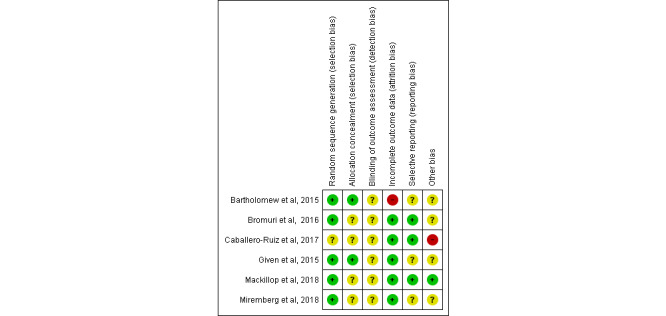
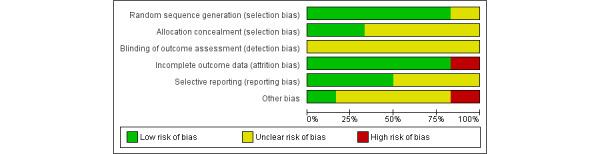
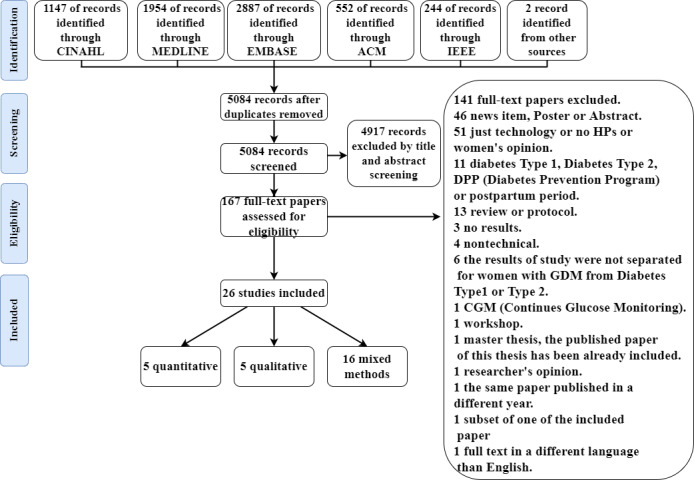
Following the PRISMA (Preferred Reporting Items for Systematic Reviews and Meta-Analyses) approach, the search included primary papers in English on the evaluation of technology to support self-management of GDM from January 2008 to September 2021 using MEDLINE, CINAHL, Embase, ACM, and IEEE databases. The lists of references from previous systematic literature reviews, which were related to technology and GDM, were also examined for primary studies. Papers with qualitative, quantitative, and mixed methodologies were included and evaluated. The selected papers were assessed for quality using the Cochrane Collaboration tool, National Institute for Health and Care Excellence clinical guidelines, Critical Appraisal Skills Programme Qualitative Checklist, and McGill University Mixed Methods Appraisal Tool. NVivo (QSR International) was used to extract qualitative data, which were subjected to thematic analysis. Narrative synthesis was used to analyze the quantitative data.

RESULTS

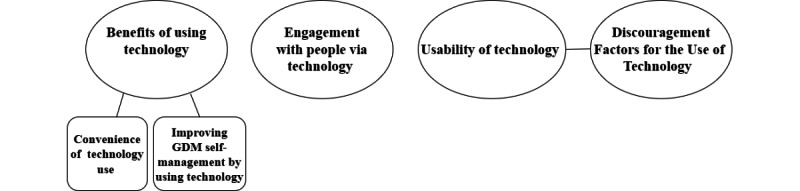
A total of 26 papers were included in the review. Of these, 19% (5/26) of studies used quantitative research methodologies, 19% (5/26) used qualitative methods, and 62% (16/26) used mixed methods. In all, 4 themes were identified from the qualitative data: the benefits of using technology, engagement with people via technology, the usability of technology, and discouragement factors for the use of technology. The thematic analysis revealed a vast scope of challenges and facilitators in the use of GDM self-management systems. The challenges included usability aspects of the system, technical problems, data privacy, lack of emotional support, the accuracy of reported data, and adoption of the system by HPs. Convenience, improved GDM self-management, peer support, increased motivation, increased independence, and consistent monitoring were facilitators to use these technologies. Quantitative data showed that there is potential for improving the usability of the GDM self-management systems. It also showed that convenience, usefulness, increasing motivation for GDM self-management, helping with GDM self-management, and being monitored by HPs were facilitators to use the GDM self-management systems.

CONCLUSIONS

This novel systematic literature review shows that HPs and women with GDM encountered some challenges in using GDM self-management systems. The usability of GDM systems was the primary challenge derived from qualitative and quantitative results, with convenience, consistent monitoring, and optimization of GDM self-management emerging as important facilitators.
https://cdn.ncbi.nlm.nih.gov/pmc/blobs/32d7/9650580/6be717187db7/jmir_v24i10e39689_fig4.jpg
https://cdn.ncbi.nlm.nih.gov/pmc/blobs/32d7/9650580/9b116ec7530f/jmir_v24i10e39689_fig1.jpg
https://cdn.ncbi.nlm.nih.gov/pmc/blobs/32d7/9650580/b6a5ef502c95/jmir_v24i10e39689_fig2.jpg
https://cdn.ncbi.nlm.nih.gov/pmc/blobs/32d7/9650580/7cf11fcde578/jmir_v24i10e39689_fig3.jpg
https://cdn.ncbi.nlm.nih.gov/pmc/blobs/32d7/9650580/6be717187db7/jmir_v24i10e39689_fig4.jpg
https://cdn.ncbi.nlm.nih.gov/pmc/blobs/32d7/9650580/9b116ec7530f/jmir_v24i10e39689_fig1.jpg
https://cdn.ncbi.nlm.nih.gov/pmc/blobs/32d7/9650580/b6a5ef502c95/jmir_v24i10e39689_fig2.jpg
https://cdn.ncbi.nlm.nih.gov/pmc/blobs/32d7/9650580/7cf11fcde578/jmir_v24i10e39689_fig3.jpg
https://cdn.ncbi.nlm.nih.gov/pmc/blobs/32d7/9650580/6be717187db7/jmir_v24i10e39689_fig4.jpg
摘要

背景

妊娠糖尿病(GDM)是孕妇最常见的医学并发症之一。电子健康技术在支持医疗条件的自我管理方面已被证明是成功的。数字技术有可能改善 GDM 的自我管理。

目的

本系统文献综述的主要目的是确定卫生专业人员(HPs)和 GDM 女性对使用电子健康技术进行 GDM 自我管理的看法。次要目的是调查使用这些技术时的可用性和用户满意度水平。

方法

根据 PRISMA(系统评价和荟萃分析的首选报告项目)方法,从 2008 年 1 月至 2021 年 9 月,使用 MEDLINE、CINAHL、Embase、ACM 和 IEEE 数据库,对评估支持 GDM 自我管理的技术的英语原始论文进行了搜索。还检查了与技术和 GDM 相关的先前系统文献综述的参考文献列表,以寻找原始研究。纳入了具有定性、定量和混合方法的论文,并对其进行了评估。使用 Cochrane 协作工具、英国国家卫生与保健优化研究所临床指南、批判性评估技能计划定性清单和麦吉尔大学混合方法评估工具对选定的论文进行了质量评估。使用 NVivo(QSR International)提取定性数据,并对其进行主题分析。使用叙述性综合分析定量数据。

结果

综述共纳入 26 篇论文。其中,19%(5/26)的研究使用定量研究方法,19%(5/26)使用定性方法,62%(16/26)使用混合方法。总的来说,从定性数据中确定了 4 个主题:使用技术的好处、通过技术与他人互动、技术的可用性以及使用技术的阻碍因素。主题分析揭示了 GDM 自我管理系统使用中广泛存在的挑战和促进因素。挑战包括系统的可用性方面、技术问题、数据隐私、缺乏情感支持、报告数据的准确性以及 HPs 对系统的采用。便利性、改善 GDM 自我管理、同伴支持、提高动机、增加独立性和持续监测是使用这些技术的促进因素。定量数据表明,有可能提高 GDM 自我管理系统的可用性。它还表明,便利性、有用性、提高 GDM 自我管理的动机、帮助 GDM 自我管理以及接受 HPs 的监测是使用 GDM 自我管理系统的促进因素。

结论

本新型系统文献综述表明,HPs 和 GDM 女性在使用 GDM 自我管理系统时遇到了一些挑战。GDM 系统的可用性是定性和定量结果得出的主要挑战,便利性、持续监测和 GDM 自我管理的优化是重要的促进因素。

相似文献

1
Barriers to and Facilitators of Using eHealth to Support Gestational Diabetes Mellitus Self-management: Systematic Literature Review of Perceptions of Health Care Professionals and Women With Gestational Diabetes Mellitus.利用电子健康支持妊娠糖尿病自我管理的障碍和促进因素:医疗保健专业人员和妊娠糖尿病患者感知的系统文献综述。
J Med Internet Res. 2022 Oct 27;24(10):e39689. doi: 10.2196/39689.
2
Cost-effectiveness of using prognostic information to select women with breast cancer for adjuvant systemic therapy.利用预后信息为乳腺癌患者选择辅助性全身治疗的成本效益
Health Technol Assess. 2006 Sep;10(34):iii-iv, ix-xi, 1-204. doi: 10.3310/hta10340.
3
Survivor, family and professional experiences of psychosocial interventions for sexual abuse and violence: a qualitative evidence synthesis.性虐待和暴力的心理社会干预的幸存者、家庭和专业人员的经验:定性证据综合。
Cochrane Database Syst Rev. 2022 Oct 4;10(10):CD013648. doi: 10.1002/14651858.CD013648.pub2.
4
Eliciting adverse effects data from participants in clinical trials.从临床试验参与者中获取不良反应数据。
Cochrane Database Syst Rev. 2018 Jan 16;1(1):MR000039. doi: 10.1002/14651858.MR000039.pub2.
5
Rapid molecular tests for tuberculosis and tuberculosis drug resistance: a qualitative evidence synthesis of recipient and provider views.快速分子检测结核分枝杆菌和结核分枝杆菌耐药性:受检者和提供者观点的定性证据综合评价。
Cochrane Database Syst Rev. 2022 Apr 26;4(4):CD014877. doi: 10.1002/14651858.CD014877.pub2.
6
Self-management and self-efficacy of women with gestational diabetes mellitus: a systematic review.妊娠期糖尿病妇女的自我管理和自我效能:系统评价。
Glob Health Action. 2022 Dec 31;15(1):2087298. doi: 10.1080/16549716.2022.2087298.
7
Interventions for promoting habitual exercise in people living with and beyond cancer.促进癌症患者及康复者进行习惯性锻炼的干预措施。
Cochrane Database Syst Rev. 2018 Sep 19;9(9):CD010192. doi: 10.1002/14651858.CD010192.pub3.
8
The Effect of a Mobile App (eMOM) on Self-Discovery and Psychological Factors in Persons With Gestational Diabetes: Mixed Methods Study.一款移动应用程序(eMOM)对妊娠期糖尿病患者自我发现及心理因素的影响:混合方法研究
JMIR Mhealth Uhealth. 2025 Jun 4;13:e60855. doi: 10.2196/60855.
9
Community views on mass drug administration for soil-transmitted helminths: a qualitative evidence synthesis.社区对土壤传播蠕虫群体药物给药的看法:定性证据综合分析
Cochrane Database Syst Rev. 2025 Jun 20;6:CD015794. doi: 10.1002/14651858.CD015794.pub2.
10
Home treatment for mental health problems: a systematic review.心理健康问题的居家治疗:一项系统综述
Health Technol Assess. 2001;5(15):1-139. doi: 10.3310/hta5150.

引用本文的文献

1
Development of a Smartphone App for Women Living With Gestational Diabetes Mellitus: Qualitative Study.一款针对妊娠期糖尿病女性的智能手机应用程序的开发:定性研究。
JMIR Diabetes. 2025 Aug 11;10:e65328. doi: 10.2196/65328.
2
The Effect of a Mobile App (eMOM) on Self-Discovery and Psychological Factors in Persons With Gestational Diabetes: Mixed Methods Study.一款移动应用程序(eMOM)对妊娠期糖尿病患者自我发现及心理因素的影响:混合方法研究
JMIR Mhealth Uhealth. 2025 Jun 4;13:e60855. doi: 10.2196/60855.
3
Systematic development and refinement of a user-centered evidence-based digital toolkit for supporting self-care in gestational diabetes mellitus.

本文引用的文献

1
Effectivness of specific mobile health applications (mHealth-apps) in gestational diabtetes mellitus: a systematic review.特定移动医疗应用(mHealth-apps)在妊娠期糖尿病中的有效性:系统评价。
BMC Pregnancy Childbirth. 2021 Dec 5;21(1):808. doi: 10.1186/s12884-021-04274-7.
2
Women's Usage Behavior and Perceived Usefulness with Using a Mobile Health Application for Gestational Diabetes Mellitus: Mixed-Methods Study.女性使用移动健康应用程序进行妊娠期糖尿病管理的行为和感知有用性:混合方法研究。
Int J Environ Res Public Health. 2021 Jun 21;18(12):6670. doi: 10.3390/ijerph18126670.
3
How do women with a history of gestational diabetes mellitus use mHealth during and after pregnancy? Qualitative exploration of women's views and experiences.
系统开发和完善以用户为中心的循证数字工具包,用于支持妊娠期糖尿病的自我护理。
Sci Rep. 2025 Apr 8;15(1):12009. doi: 10.1038/s41598-025-96318-7.
4
Readiness of adults with type 1 diabetes and diabetes caregivers for diabetes distress monitoring using a voice-based digital health solution: insights from the PsyVoice mixed methods study.1型糖尿病成人患者及糖尿病照护者使用基于语音的数字健康解决方案进行糖尿病困扰监测的意愿:来自PsyVoice混合方法研究的见解
BMJ Open. 2025 Jan 2;15(1):e088424. doi: 10.1136/bmjopen-2024-088424.
5
The User-Centered Design of a Clinical Dashboard and Patient-Facing App for Gestational Diabetes.妊娠期糖尿病临床仪表板和患者端应用程序的以用户为中心的设计
J Diabetes Sci Technol. 2024 Nov 29:19322968241301792. doi: 10.1177/19322968241301792.
6
Demand and Requirements for a Digital Healthcare System to Manage Gestational Diabetes in Patients and Healthcare Professionals: A Cross-sectional Survey.患者和医疗保健专业人员的妊娠期糖尿病管理数字化医疗系统的需求和要求:一项横断面调查。
Inquiry. 2024 Jan-Dec;61:469580241252569. doi: 10.1177/00469580241252569.
7
Baseline Perceptions of Women With Gestational Diabetes Mellitus and Health Care Professionals About Digital Gestational Diabetes Mellitus Self-Management Health Care Technologies: Interview Study Among Patients and Health Care Professionals.基线:妊娠期糖尿病患者和医护人员对数字化妊娠期糖尿病自我管理医疗技术的看法:一项针对患者和医护人员的访谈研究
JMIR Hum Factors. 2023 Dec 19;10:e51691. doi: 10.2196/51691.
8
Barriers and facilitators of using health information technologies by women: a scoping review.利用健康信息技术的障碍和促进因素:范围综述。
BMC Med Inform Decis Mak. 2023 Sep 5;23(1):176. doi: 10.1186/s12911-023-02280-7.
9
The effect of personalized intelligent digital systems for self-care training on type II diabetes: a systematic review and meta-analysis of clinical trials.个性化智能数字系统对自我护理训练对 2 型糖尿病的影响:临床试验的系统评价和荟萃分析。
Acta Diabetol. 2023 Dec;60(12):1599-1631. doi: 10.1007/s00592-023-02133-9. Epub 2023 Aug 4.
患有妊娠糖尿病病史的女性在怀孕期间和产后如何使用移动医疗?对女性观点和经验的定性探讨。
Midwifery. 2021 Jul;98:102995. doi: 10.1016/j.midw.2021.102995. Epub 2021 Mar 21.
4
Identifying Mobile Health Technology Experiences and Preferences of Low-Income Pregnant Women with Diabetes.识别低收入糖尿病孕妇的移动医疗技术体验和偏好。
J Diabetes Sci Technol. 2021 Sep;15(5):1018-1026. doi: 10.1177/1932296821993175. Epub 2021 Feb 19.
5
Midwives' views towards women using mHealth and eHealth to self-monitor their pregnancy: A systematic review of the literature.助产士对女性使用移动健康和电子健康技术自我监测孕期的看法:文献系统综述
Eur J Midwifery. 2020 Sep 17;4:36. doi: 10.18332/ejm/126625. eCollection 2020.
6
Women, clinician and IT staff perspectives on telehealth for enhanced gestational diabetes mellitus management in an Australian rural/regional setting.澳大利亚农村/地区以远程医疗加强妊娠糖尿病管理:女性、临床医生和 IT 员工的观点。
Rural Remote Health. 2021 Jan;21(1):5983. doi: 10.22605/RRH5983. Epub 2021 Jan 22.
7
M♡THer, an mHealth System to Support Women with Gestational Diabetes Mellitus: Feasibility and Acceptability Study.M♡THer,一种支持妊娠期糖尿病女性的移动健康系统:可行性与可接受性研究。
Diabetes Technol Ther. 2021 May;23(5):358-366. doi: 10.1089/dia.2020.0509. Epub 2020 Dec 15.
8
A Randomized Controlled Trial to Evaluate the Effects of a Smartphone Application-Based Lifestyle Coaching Program on Gestational Weight Gain, Glycemic Control, and Maternal and Neonatal Outcomes in Women With Gestational Diabetes Mellitus: The SMART-GDM Study.一项随机对照试验,旨在评估基于智能手机应用的生活方式指导方案对妊娠期糖尿病女性的体重增长、血糖控制以及母婴结局的影响:SMART-GDM 研究。
Diabetes Care. 2021 Feb;44(2):456-463. doi: 10.2337/dc20-1216. Epub 2020 Nov 12.
9
Systematic Evaluation of Canadian Diabetes Smartphone Applications for People With Type 1, Type 2 and Gestational Diabetes.1 型、2 型和妊娠糖尿病患者用加拿大糖尿病智能手机应用程序的系统评价。
Can J Diabetes. 2021 Mar;45(2):174-178.e1. doi: 10.1016/j.jcjd.2020.07.005. Epub 2020 Aug 11.
10
Application of Mobile Technology for Disease and Treatment Monitoring of Gestational Diabetes Mellitus Among Pregnant Women: A Systematic Review.移动技术在妊娠期糖尿病孕妇疾病和治疗监测中的应用:系统评价。
J Diabetes Sci Technol. 2022 Mar;16(2):491-497. doi: 10.1177/1932296820965577. Epub 2020 Oct 29.