Department of Orthopaedics, University Orthopaedic Center, University of Utah, Salt Lake City, UT, USA.
Department of Orthopaedics, Dartmouth-Hitchcock Medical Center, Lebanon, NH, USA.
BMC Musculoskelet Disord. 2022 Oct 27;23(1):934. doi: 10.1186/s12891-022-05899-1.
Existing studies of patient-reported outcomes (PRO) following total knee arthroplasty (TKA) based on fixation methods (cemented vs cementless) are limited to single centers with small sample sizes. Using multicentered data,, we compared baseline and early post-operative global and condition-specific PROs between patients undergoing cemented versus cementless TKA.
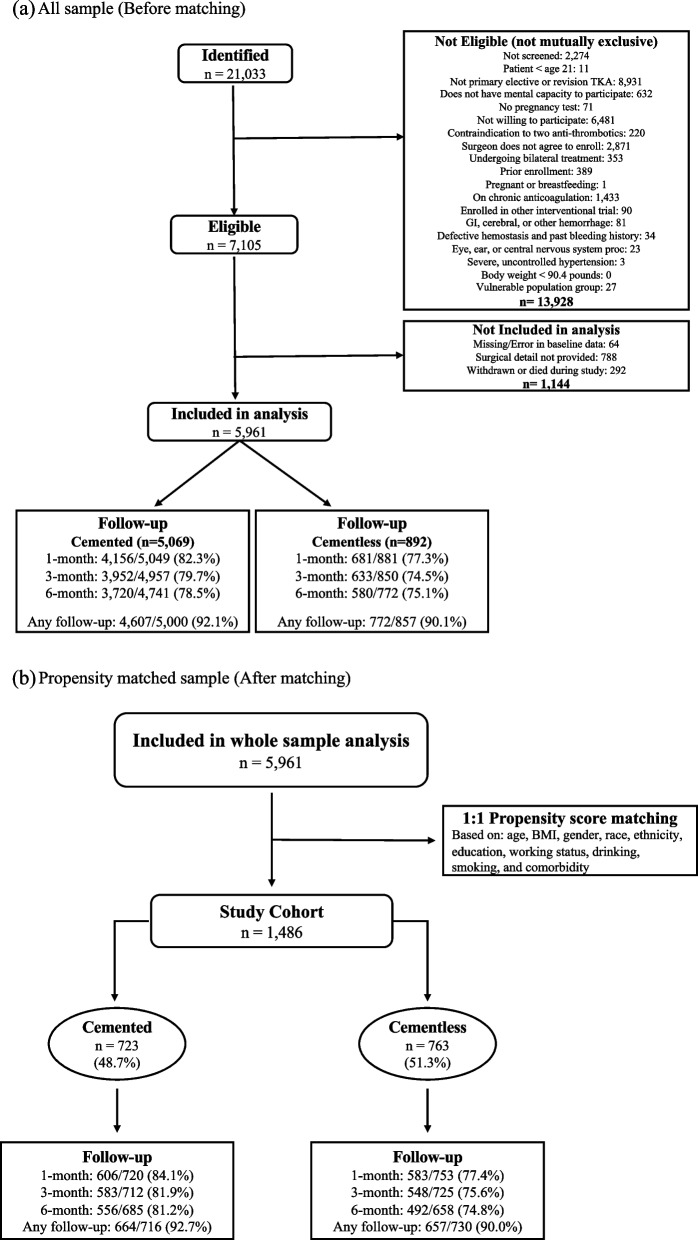
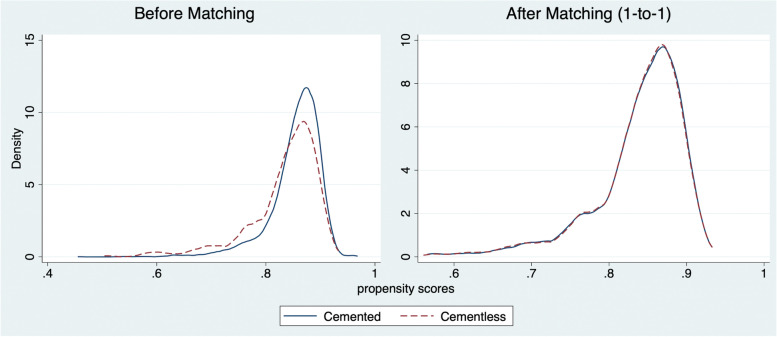
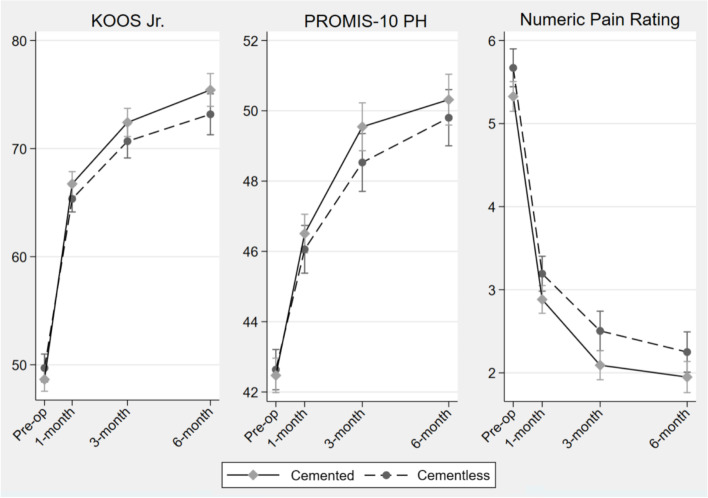
With PROs prospectively collected through Comparative Effectiveness Pulmonary Embolism Prevention After Hip and Knee Replacement (PEPPER) trial (ClinicalTrials.gov: NCT02810704), we examined pre- and post-operative (1, 3, and 6-months) outcomes in 5,961 patients undergoing primary TKA enrolled by 28 medical centers between December 2016 and August 2021. Outcomes included the short-form of the Knee Injury and Osteoarthritis Outcome Score (KOOS-Jr.), the Patient-Reported Outcomes Measurement Information System Physical Health (PROMIS-PH), and the Numeric Pain Rating Scale (NPRS). To minimize selection bias, we performed a 1-to-1 propensity score matched analysis to assess relative pre- to post-operative change in outcomes within and between cemented and cementless TKA groups.
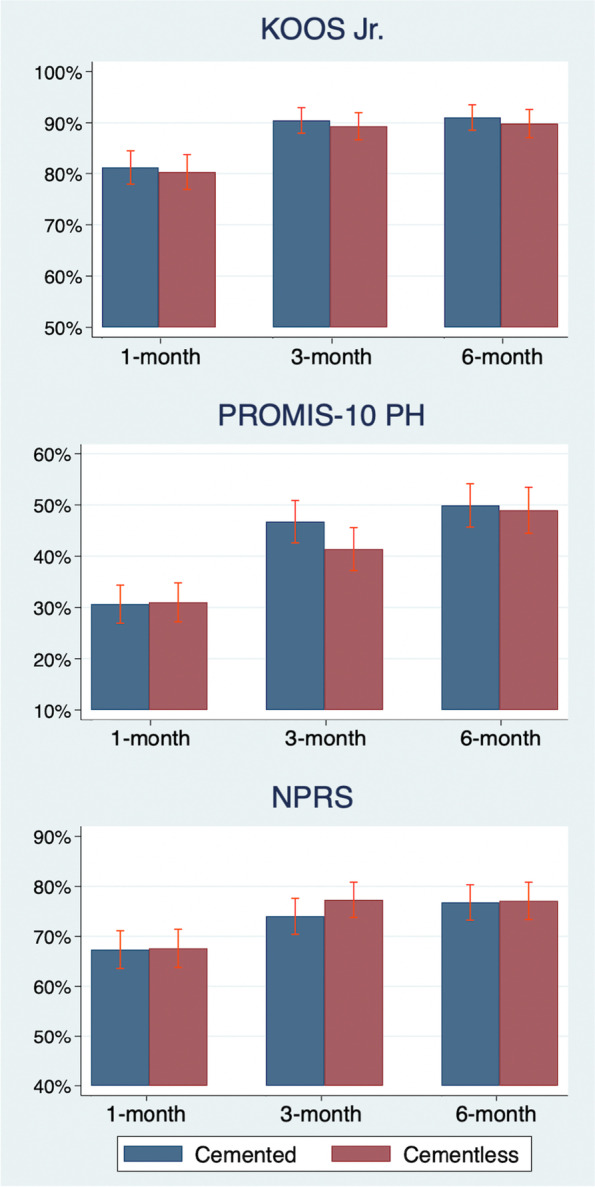
With greater than 90% follow-up, significant pre to- post-operative improvements were observed in both groups. At 6 months, the cemented TKA group achieved a 3.3 point (55% of the Minimum Clinically Important Difference) greater improvement in the mean KOOS-Jr. (95%CI: 0.36, 6.30; P = 0.028) than did the cementless group with no significant between-group differences in PROMIS-PH and NPRS.
In a large cohort of primary TKAs, patients with cemented fixation reported early incremental benefit in KOOS-Jr. over those with cementless TKA. Future studies are warranted to capture longer follow-up of PROs.
基于固定方法(骨水泥固定与非骨水泥固定)的全膝关节置换术后患者报告结局(PRO)的现有研究仅限于小样本量的单中心研究。本研究利用多中心数据,比较了行骨水泥固定与非骨水泥固定全膝关节置换术患者的基线和术后早期的总体及特定疾病 PRO。
通过比较有效性预防髋膝关节置换术后肺栓塞(PEPPER)试验(ClinicalTrials.gov:NCT02810704)前瞻性收集 PRO 数据,本研究纳入了 28 个医学中心在 2016 年 12 月至 2021 年 8 月期间招募的 5961 例初次行全膝关节置换术的患者,评估了患者术前(1、3 和 6 个月)和术后(1、3 和 6 个月)的结局。结局包括膝关节损伤和骨关节炎结果评分简表(KOOS-Jr.)、患者报告的测量信息系统生理健康(PROMIS-PH)和数字疼痛评分量表(NPRS)。为了尽量减少选择偏倚,我们进行了 1:1 倾向评分匹配分析,以评估骨水泥固定与非骨水泥固定 TKA 组内和组间手术前后结局的相对变化。
在超过 90%的患者获得随访的情况下,两组患者均表现出显著的术前到术后改善。在 6 个月时,骨水泥固定 TKA 组在 KOOS-Jr.平均评分的改善上比非骨水泥固定组多 3.3 分(最小临床重要差异的 55%)(95%CI:0.36,6.30;P=0.028),而两组在 PROMIS-PH 和 NPRS 上无显著差异。
在初次 TKA 的大样本队列中,骨水泥固定患者在 KOOS-Jr.上报告了早期增量获益,优于非骨水泥固定 TKA 患者。需要进一步研究来捕捉 PRO 的更长随访结果。