Duan Weiwei, Zhou Hao, Dong Xiaohua, Li Bijuan, Li Yi, Cai Haobing, Zhou Qian, Ouyang Song, Yin Weifan, Yang Huan
Department of Neurology, Xiangya Hospital, Central South University, Changsha, China.
Department of Blood Transfusion, Xiangya Hospital, Central South University, Changsha, China.
Front Neurol. 2022 Oct 11;13:1018509. doi: 10.3389/fneur.2022.1018509. eCollection 2022.
Lymphoplasmapheresis (LPE) is a treatment that combines traditional plasma exchange and lymphocyte removal technique. It has been applied to treat a variety of autoimmune diseases, but its application value in the treatment of severe myasthenia gravis (MG) is not yet clear. Therefore, the aim of this study was to investigate the efficacy and safety of LPE in severe MG.
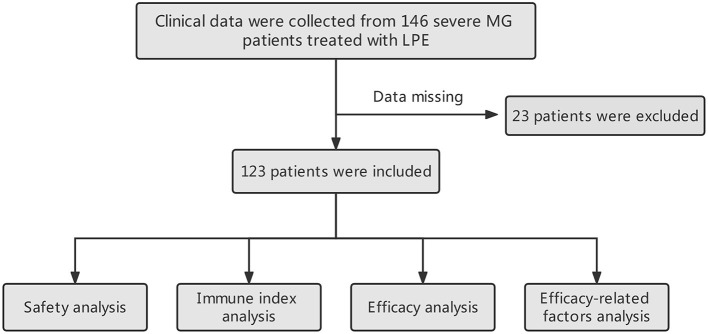
Clinical data of 123 severe patients with MG (Myasthenia Gravis Foundation of America Clinical Classification, Class IV) who received LPE treatment were included in a retrospective analysis. Efficacy was evaluated by the change of Quantitative Myasthenia Gravis score (QMGS) before and after treatment. Univariate and multivariate logistic regression analysis was used to explore clinical factors affecting efficacy.
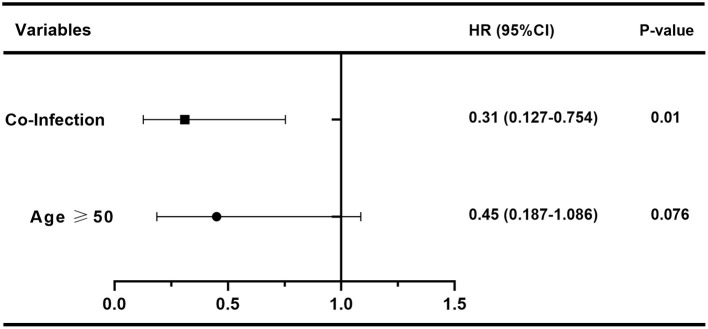
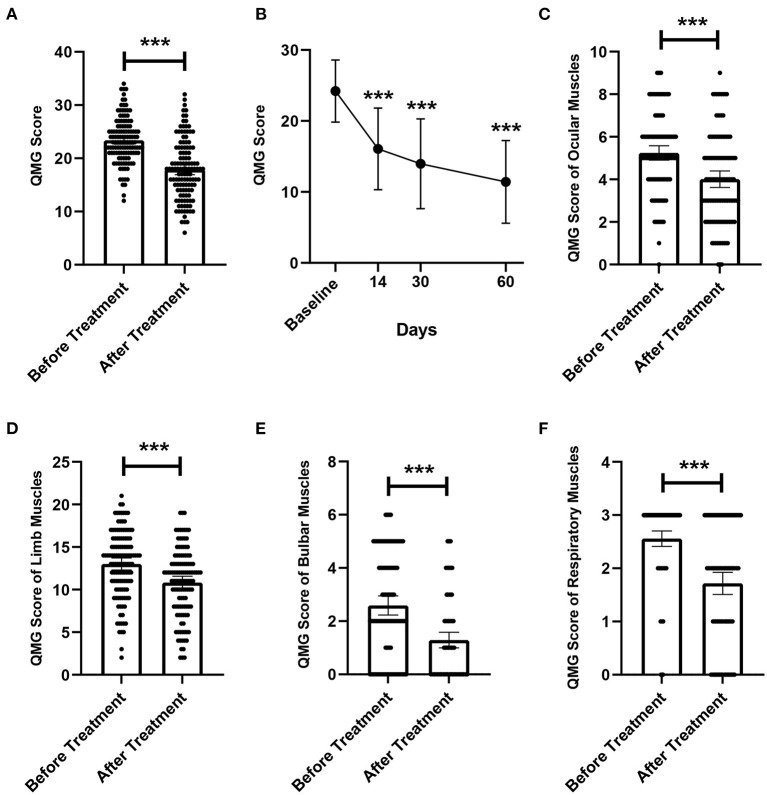
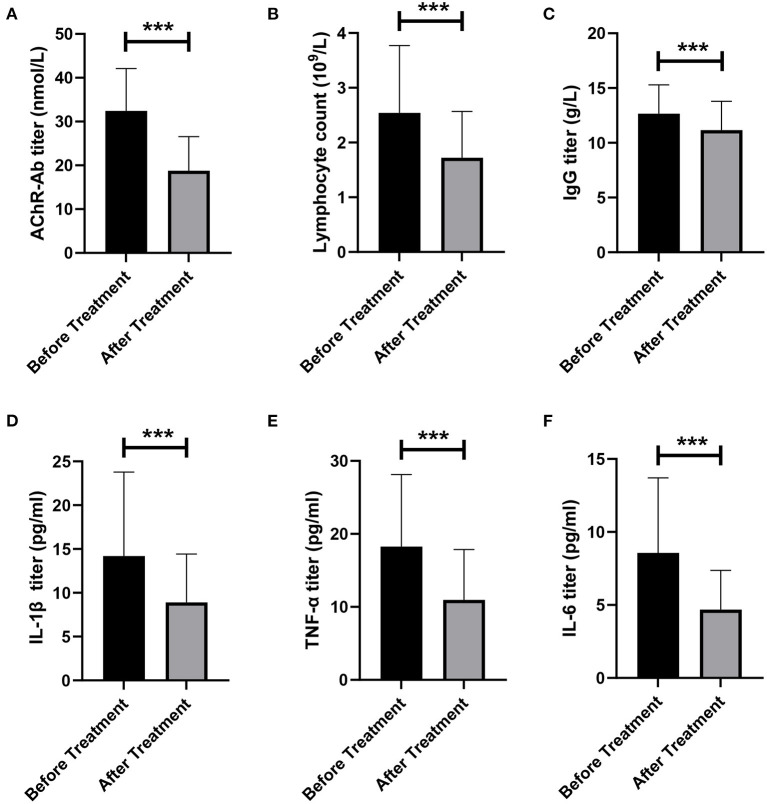
A total of 220 replacements were performed in 123 patients, with an average of 1.79 replacements per patient. The overall safety of LPE was good, and no serious adverse reactions occurred. After treatment, the mean QMGS of patients decreased significantly, from 23.40 ± 4.25 points before treatment to 17.93 ± 5.61 points after treatment, a decrease of 5.47 ± 4.16 points. 75.6% of patients experienced remission of clinical symptoms. During a 2-month follow-up of 64 patients, a progressive improvement in QMGS was found. Each muscle group involved in MG responded well to LPE treatment. In addition, LPE significantly reduced the levels of AChR-Ab and inflammatory cytokines in patients. Age ≥ 50 years and co-infection were unfavorable factors affecting the efficacy.
In this study cohort, LPE is safe for the treatment of severe MG and achieves good treatment outcome with fewer replacements. In patients with MG, the avoidance and timely control of infection are necessary. Our study provides a potential new treatment option for severe MG.
淋巴细胞血浆置换术(LPE)是一种将传统血浆置换与淋巴细胞去除技术相结合的治疗方法。它已被应用于治疗多种自身免疫性疾病,但其在治疗重症肌无力(MG)中的应用价值尚不清楚。因此,本研究的目的是探讨LPE治疗重症MG的疗效和安全性。
回顾性分析123例接受LPE治疗的重症MG患者(美国重症肌无力基金会临床分类,IV级)的临床资料。通过治疗前后重症肌无力定量评分(QMGS)的变化评估疗效。采用单因素和多因素逻辑回归分析探讨影响疗效的临床因素。
123例患者共进行了220次置换,平均每位患者1.79次置换。LPE的总体安全性良好,未发生严重不良反应。治疗后,患者的平均QMGS显著下降,从治疗前的23.40±4.25分降至治疗后的17.93±5.61分,下降了5.47±4.16分。75.6%的患者临床症状缓解。在对64例患者进行的2个月随访中,发现QMGS有逐步改善。MG累及的每个肌肉组对LPE治疗反应良好。此外,LPE显著降低了患者体内乙酰胆碱受体抗体(AChR-Ab)和炎性细胞因子的水平。年龄≥50岁和合并感染是影响疗效的不利因素。
在本研究队列中,LPE治疗重症MG安全,置换次数较少即可取得良好的治疗效果。对于MG患者,避免和及时控制感染是必要的。我们的研究为重症MG提供了一种潜在的新治疗选择。