Du Yantao, Wu Tao
Ningbo Institute of Medical Science, The Affiliated Hospital of Medical School of Ningbo University, Ningbo, Zhejiang, China.
Department of Cardiovascular Center, The Affiliated Hospital of Medical School of Ningbo University, Ningbo, Zhejiang, China.
Front Cardiovasc Med. 2022 Oct 11;9:992011. doi: 10.3389/fcvm.2022.992011. eCollection 2022.
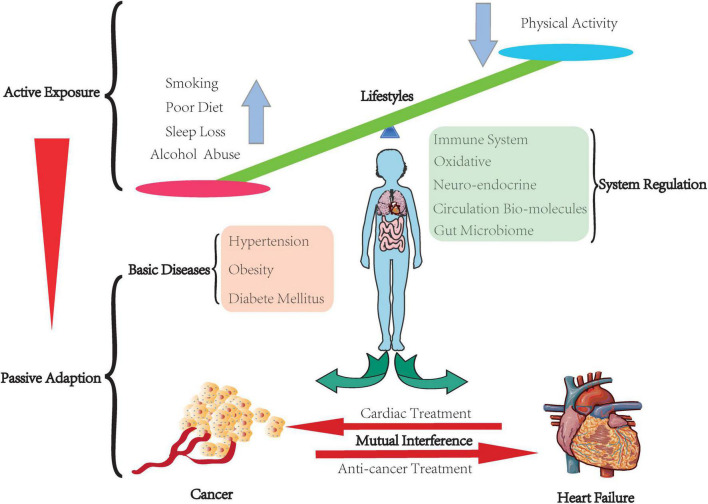
The human body seems like a "balance integrator." On the one hand, the body constantly actively receives various outside stimuli and signals to induce changes. On the other hand, several internal regulations would be initiated to adapt to these changes. In most cases, the body could keep the balance and to reach a healthy body. However, in some cases, the body can only get to a pathological balance. Actively exposed to unhealthy lifestyles and passively adapting to individual primary diseases lead to a similarly inner environment for both heart failure and cancer. To cope with these stimuli, the body must activate the system regulation mechanism and face the mutual interference. This review summarized the association between heart failure and cancer from active exposure to passive adaption. Moreover, we hope to inspire researchers to contemplate these two diseases from the angle of overall body consideration.
人体似乎是一个“平衡整合器”。一方面,身体不断主动接收各种外部刺激和信号以引发变化。另一方面,会启动一些内部调节机制来适应这些变化。在大多数情况下,身体能够保持平衡并达到健康状态。然而,在某些情况下,身体只能达到病理平衡。主动暴露于不健康的生活方式以及被动适应个体原发性疾病会导致心力衰竭和癌症具有相似的内环境。为了应对这些刺激,身体必须激活系统调节机制并面对相互干扰。本综述总结了从主动暴露到被动适应过程中心力衰竭与癌症之间的关联。此外,我们希望激发研究人员从整体身体考量的角度对这两种疾病进行思考。