Department of Epidemiology and Biostatistics, Schulich School of Medicine and Dentistry, University of Western Ontario, London, Ontario, Canada; Radiation Medicine Program, Princess Margaret Cancer Centre, University Health Network, Toronto, Ontario, Canada; Department of Radiation Oncology, University of Toronto, Toronto, Ontario, Canada.
Radiation Medicine Program, Princess Margaret Cancer Centre, University Health Network, Toronto, Ontario, Canada; Department of Radiation Oncology, University of Toronto, Toronto, Ontario, Canada.
Int J Radiat Oncol Biol Phys. 2023 Jan 1;115(1):39-47. doi: 10.1016/j.ijrobp.2022.04.054. Epub 2022 Oct 26.
During the COVID-19 pandemic, many radiation oncology departments worldwide adopted the use of shorter and more intense hypofractionated regimens. Hospital foot traffic was reduced through virtual care. This study's primary objective was to assess the collective environmental effect of these strategic changes by identifying sources of carbon dioxide equivalents (COe). The rate of radiation-related adverse events from the increased use of hypofractionated treatments was assessed.
All patients treated with external beam radiation therapy from April 1, 2019, to March 31, 2021, at our single institution were identified (n = 10,175) along with their radiation therapy visits (176,423 fractions) and unplanned visits to the radiation nursing clinic or emergency department. Out-patient hospital and virtual visits (n = 75,853) during this same period were also analyzed. Environmental effect measures, including linear accelerator power usage, patient travel distances, and personal protection equipment consumption were all converted into COe.
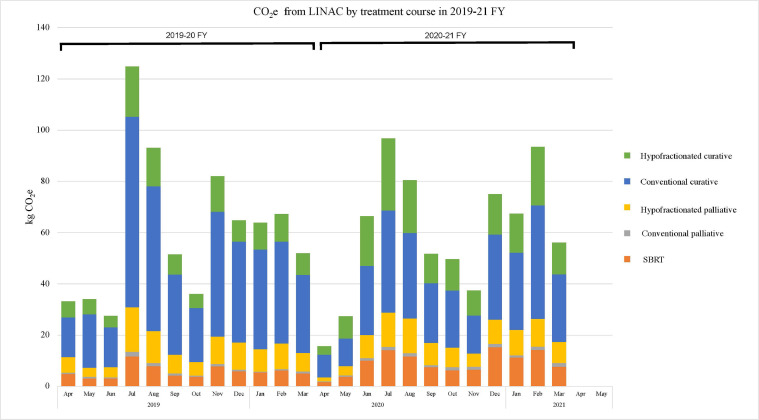
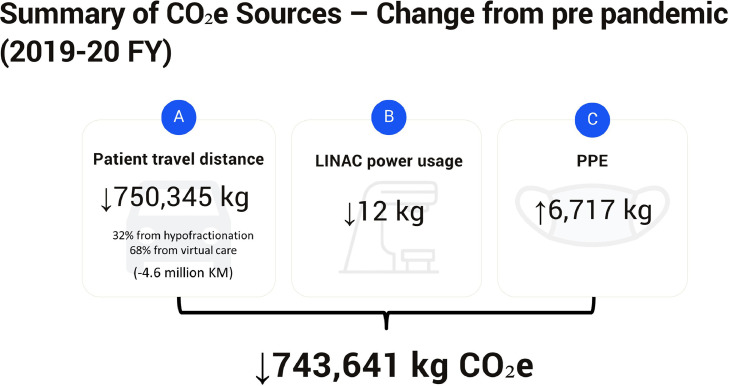
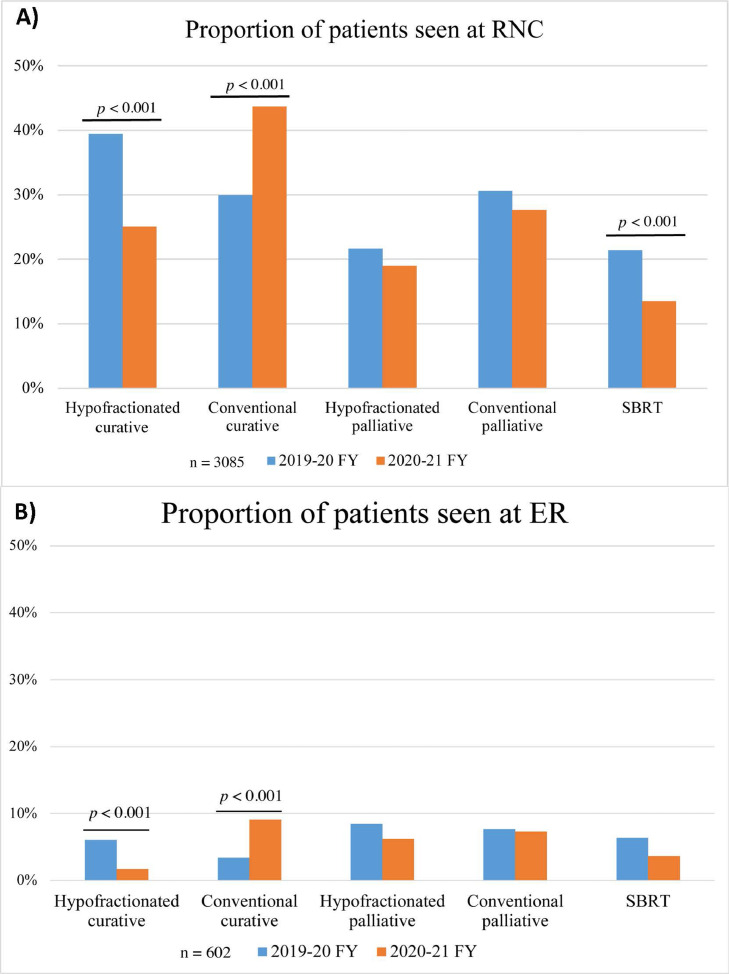
The use of curative hypofractionated regimens increased from 17% to 27% during the pandemic year. Carbon footprint was reduced by 39% during the pandemic year (1,332,388 kg COe) compared with the prepandemic year (2,024,823 kg COe). Comparing patients in the prepandemic versus pandemic year, there was a significant reduction in the proportion of hypofractionated patients who needed a visit to either the radiation nursing clinic (39% vs 25%; P < .001) or emergency department (6% vs 2%; P < .001) during and within 90 days of radiation therapy.
This is the first study to demonstrate the environmental benefits of increased use of hypofractionated regimens and virtual care, while assuring that there was no added acute radiation-related adverse event. Our findings support their continued use as one of many long-term strategies to reduce the environmental footprint of health care delivery.
在 COVID-19 大流行期间,全球许多放射肿瘤学部门采用了更短、更集中的分次治疗方案。通过虚拟护理减少了医院的人流量。本研究的主要目的是通过确定二氧化碳当量(COe)的来源,来评估这些战略变化的集体环境影响。评估了因增加使用分次治疗而导致的与放射治疗相关的不良事件发生率。
我们确定了 2019 年 4 月 1 日至 2021 年 3 月 31 日期间在我们单一机构接受外照射放射治疗的所有患者(n=10175),以及他们的放射治疗次数(176423 次)和放射护理诊所或急诊部门的非计划就诊次数。在此期间,还分析了门诊医院和虚拟就诊(n=75853)。将线性加速器功率使用、患者旅行距离和个人防护设备消耗等环境影响措施全部转换为 COe。
在大流行期间,根治性分次治疗方案的使用率从 17%增加到 27%。与大流行前一年(2024823kg COe)相比,大流行期间的碳足迹减少了 39%(1332388kg COe)。与大流行前一年相比,大流行期间需要到放射护理诊所或急诊部门就诊的分次治疗患者比例显著降低(39% vs 25%;P<.001),且在放射治疗期间和 90 天内也显著降低(6% vs 2%;P<.001)。
这是第一项证明增加使用分次治疗方案和虚拟护理带来环境效益的研究,同时确保没有增加急性放射治疗相关的不良事件。我们的研究结果支持继续使用这些方案,作为减少医疗保健提供的环境足迹的众多长期策略之一。