Department of Epidemiology, School of Public Health, Sun Yat-sen University, Guangzhou, 510080, China.
College for Public Health & Social Justice, Saint Louis University, Saint Louis, MO, 63104, USA.
BMC Med. 2022 Oct 31;20(1):375. doi: 10.1186/s12916-022-02573-0.
Though the association between air pollution and incident type 2 diabetes (T2D) has been well documented, evidence on the association with development of subsequent diabetes complications and post-diabetes mortality is scarce. We investigate whether air pollution is associated with different progressions and outcomes of T2D.
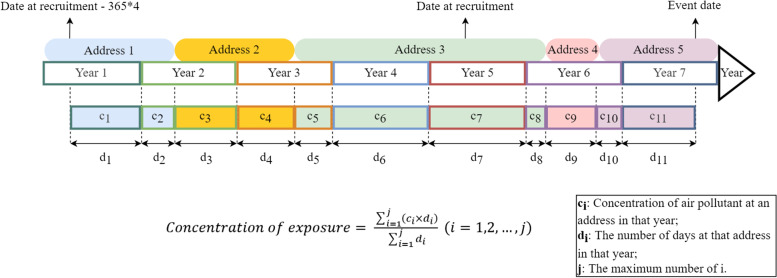
Based on the UK Biobank, 398,993 participants free of diabetes and diabetes-related events at recruitment were included in this analysis. Exposures to particulate matter with a diameter ≤ 10 μm (PM), PM, nitrogen oxides (NO), and NO for each transition stage were estimated at each participant's residential addresses using data from the UK's Department for Environment, Food and Rural Affairs. The outcomes were incident T2D, diabetes complications (diabetic kidney disease, diabetic eye disease, diabetic neuropathy disease, peripheral vascular disease, cardiovascular events, and metabolic events), all-cause mortality, and cause-specific mortality. Multi-state model was used to analyze the impact of air pollution on different progressions of T2D. Cumulative transition probabilities of different stages of T2D under different air pollution levels were estimated.
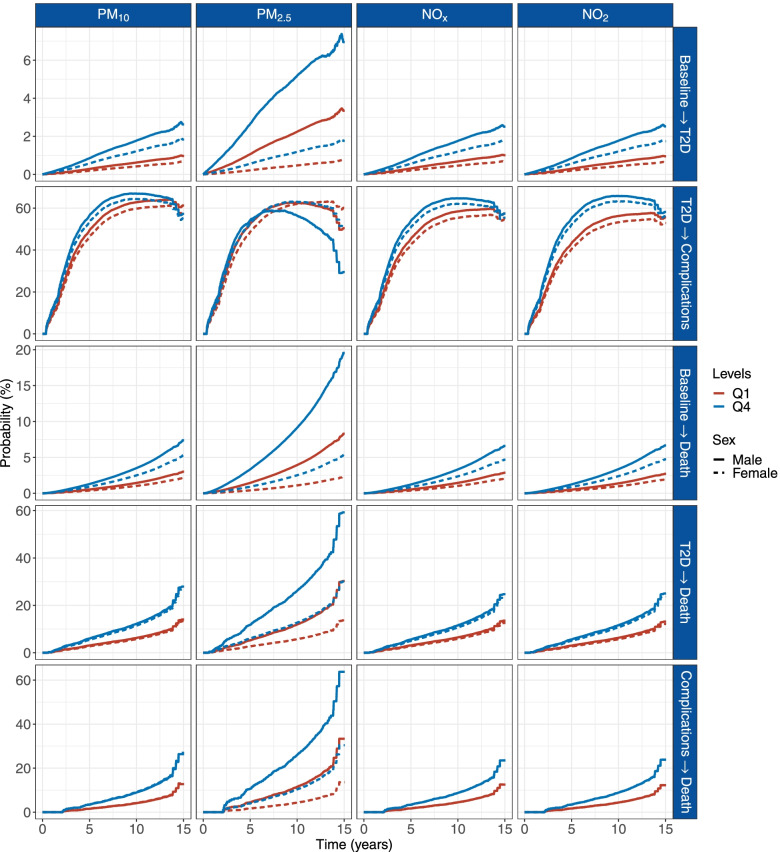
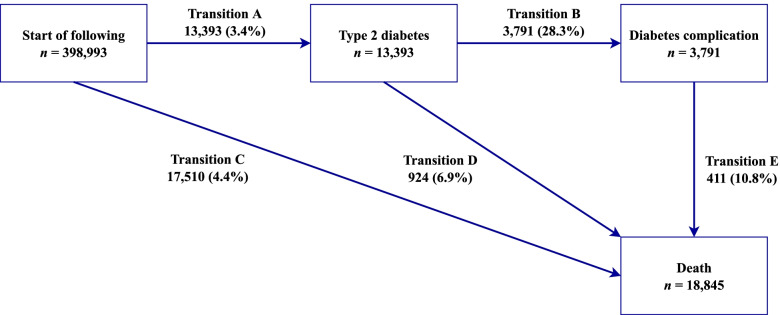
During the 12-year follow-up, 13,393 incident T2D patients were identified, of whom, 3791 developed diabetes complications and 1335 died. We observed that air pollution was associated with different progression stages of T2D with different magnitudes. In a multivariate model, the hazard ratios [95% confidence interval (CI)] per interquartile range elevation in PM were 1.63 (1.59, 1.67) and 1.08 (1.03, 1.13) for transitions from healthy to T2D and from T2D to complications, and 1.50 (1.47, 1.53), 1.49 (1.36, 1.64), and 1.54 (1.35, 1.76) for mortality risk from baseline, T2D, and diabetes complications, respectively. Generally, we observed stronger estimates of four air pollutants on transition from baseline to incident T2D than those on other transitions. Moreover, we found significant associations between four air pollutants and mortality risk due to cancer and cardiovascular diseases from T2D or diabetes complications. The cumulative transition probability was generally higher among those with higher levels of air pollution exposure.
This study indicates that ambient air pollution exposure may contribute to increased risk of incidence and progressions of T2D, but to diverse extents for different progressions.
尽管空气污染与 2 型糖尿病(T2D)发病之间的关联已得到充分证实,但有关其与随后发生的糖尿病并发症和糖尿病后死亡风险之间关联的证据却很少。我们调查了空气污染是否与 T2D 的不同进展和结局有关。
本研究基于英国生物银行(UK Biobank),共纳入了 398993 名在招募时无糖尿病和糖尿病相关事件的参与者。在每个参与者的居住地址处,使用英国环境、食品和农村事务部的数据,估算了每个过渡期的直径≤10μm(PM)、PM、氮氧化物(NO)和 NO 的暴露量。结局为新发 T2D、糖尿病并发症(糖尿病肾病、糖尿病眼病、糖尿病神经病变、外周血管疾病、心血管事件和代谢事件)、全因死亡率和死因特异性死亡率。采用多状态模型分析空气污染对 T2D 不同进展的影响。估计不同空气污染水平下 T2D 不同阶段的累积转移概率。
在 12 年的随访期间,共确定了 13393 例新发 T2D 患者,其中 3791 例患者发生了糖尿病并发症,1335 例患者死亡。我们观察到,空气污染与 T2D 的不同进展阶段有关,且关联程度不同。在多变量模型中,PM 每升高一个四分位距的危害比(95%置信区间)分别为 1.63(1.59,1.67)和 1.08(1.03,1.13),与从健康到 T2D 和从 T2D 到并发症的进展有关,与全因死亡率、T2D 和糖尿病并发症的风险分别为 1.50(1.47,1.53)、1.49(1.36,1.64)和 1.54(1.35,1.76)。一般来说,我们发现与从基线到新发 T2D 的转变相比,四个空气污染物对从基线到 T2D 的转变的估计值更强。此外,我们发现四个空气污染物与 T2D 或糖尿病并发症引起的癌症和心血管疾病死亡风险之间存在显著关联。在较高的空气污染暴露水平下,累积转移概率通常更高。
本研究表明,环境空气污染暴露可能会增加 T2D 的发病和进展风险,但不同进展的程度不同。