Necknig U, Leyh H, Waidelich R, Gernhold L, Kiesewetter J, Weidenbusch M
Urologische Praxis Lindenberg, Lindenberg, Germany.
Deutsche Gesellschaft für Urologie, Junior Akademie, Düsseldorf, Germany.
Front Surg. 2022 Oct 14;9:1009391. doi: 10.3389/fsurg.2022.1009391. eCollection 2022.
Mentoring is an effective method for human resource development. Monitoring the process is important for individual mentee/mentor pairs as well as for program directors. Due to individual personality differences of both mentees and mentors and their respective interactions, it is challenging to monitor the individual development process of mentees in a structured manner. This study investigates to what extent a novel instrument, the mentee-based assessment tool for role development of interpersonal competencies in surgical professions (MatricS) can adequately monitor the professional role development process of residents during an established mentoring program.
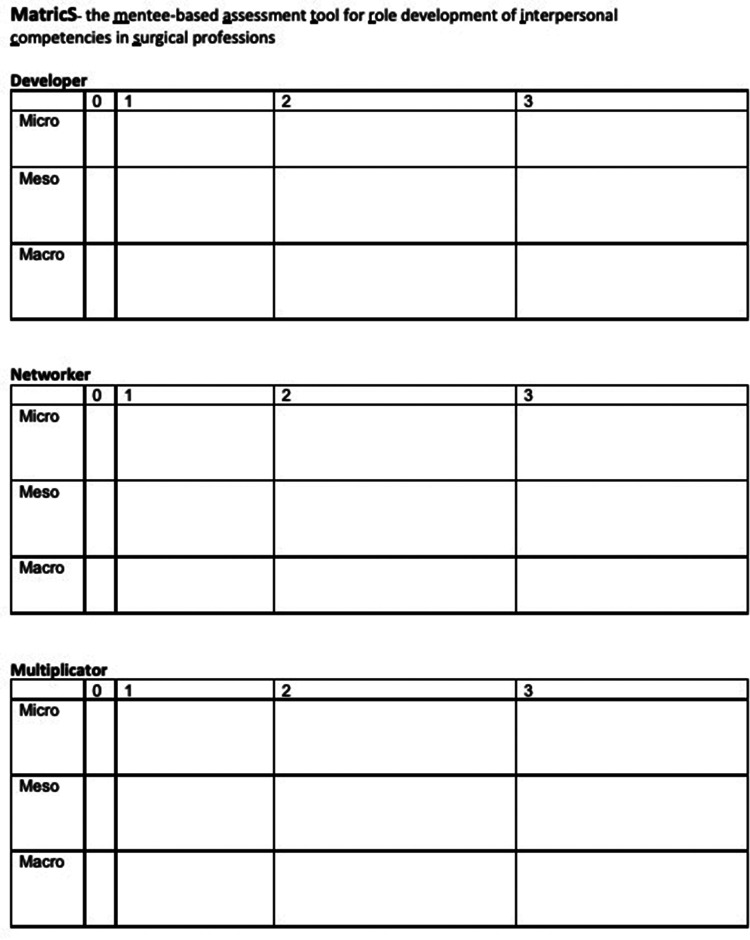
In a prospective longitudinal study, the competence development of 31 mentees in two subsequent cohorts was assessed by a modified role matrix based on Canadian Medical Education Directives for Specialists. The evaluation focused on three defined roles (D, developer; N, networker; M, multiplicator) at three levels (private, employer-related, national/international) with four stages of development. For validation of mentee self-assessments, the assessments of the respective mentors were recorded alongside. For correlation analyses, Pearson coefficients were calculated, pre-post-comparisons were done by paired t-tests; significance was assumed at < 0.05, respectively.
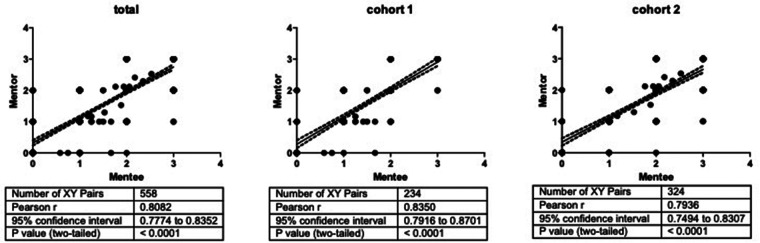
Mentee self-assessments overall correlated well with the objective mentor assessments (Pearson's 0.8, < 0.001). Significant correlations of this magnitude were found for both individual cohorts as well as for all individual roles. The mentees acquired competencies in all roles indicated by significant increases of corresponding MatricS scores. The largest competency gains (mean ± SD) were found in the role D (start: 1.30 ± 0.77, end: 2.13 ± 0.83, < 0.001). The majority of mentees achieved the prespecified target competency level in >75% of all roles and levels.
The role development process during mentoring can be reliably monitored by using MatricS. MatricS scores highly correlate between mentees and mentors, indicating that mentee self-assessments are suitable and sufficient for monitoring. These findings help to lessen the work burden on senior surgeons and thus can help to increase the acceptance of mentoring programs in surgical disciplines.
指导是人力资源开发的一种有效方法。对指导过程进行监测,对受指导者/指导者个体以及项目负责人而言都很重要。由于受指导者和指导者的个性差异以及他们之间各自的互动,以结构化方式监测受指导者的个人发展过程具有挑战性。本研究调查了一种新型工具——外科职业人际能力角色发展的受指导者评估工具(MatricS)在既定指导计划中能够在多大程度上充分监测住院医师的专业角色发展过程。
在一项前瞻性纵向研究中,基于加拿大专家医学教育指令,通过修改后的角色矩阵对两个连续队列中的31名受指导者的能力发展进行评估。评估聚焦于三个定义角色(D,开发者;N,网络构建者;M,传播者),分三个层面(个人层面、雇主相关层面、国家/国际层面)以及四个发展阶段。为验证受指导者的自我评估,同时记录各自指导者的评估。进行相关性分析时,计算皮尔逊系数,前后比较采用配对t检验;显著性水平设定为<0.05。
受指导者的自我评估总体上与指导者的客观评估相关性良好(皮尔逊系数为0.8,<0.001)。在各个队列以及所有个体角色中均发现了这种程度的显著相关性。受指导者在所有角色中都获得了能力,相应的MatricS分数显著提高。在角色D中发现了最大的能力提升(均值±标准差)(开始:1.30±0.77,结束:2.13±0.83,<0.001)。大多数受指导者在所有角色和层面中超过75%达到了预先设定的目标能力水平。
使用MatricS能够可靠地监测指导过程中的角色发展过程。MatricS分数在受指导者和指导者之间高度相关,表明受指导者的自我评估适合且足以用于监测。这些发现有助于减轻资深外科医生的工作负担,从而有助于提高外科领域对指导计划的接受度。