Yu Qichao, Jiang Miaomiao, Wu Liang
Beijing Genomics Institute (BGI)-Shenzhen, Shenzhen, China.
College of Life Sciences, University of Chinese Academy of Sciences, Beijing, China.
Front Oncol. 2022 Oct 13;12:1019111. doi: 10.3389/fonc.2022.1019111. eCollection 2022.
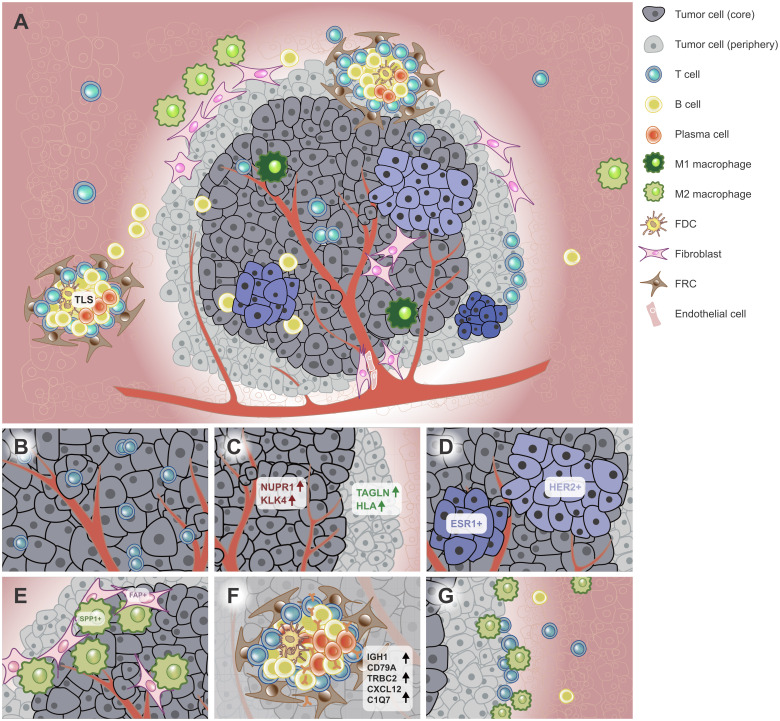
In recent years, spatial transcriptomics (ST) technologies have developed rapidly and have been widely used in constructing spatial tissue atlases and characterizing spatiotemporal heterogeneity of cancers. Currently, ST has been used to profile spatial heterogeneity in multiple cancer types. Besides, ST is a benefit for identifying and comprehensively understanding special spatial areas such as tumor interface and tertiary lymphoid structures (TLSs), which exhibit unique tumor microenvironments (TMEs). Therefore, ST has also shown great potential to improve pathological diagnosis and identify novel prognostic factors in cancer. This review presents recent advances and prospects of applications on cancer research based on ST technologies as well as the challenges.
近年来,空间转录组学(ST)技术发展迅速,已广泛应用于构建空间组织图谱和表征癌症的时空异质性。目前,ST已被用于分析多种癌症类型的空间异质性。此外,ST有助于识别和全面了解特殊的空间区域,如肿瘤界面和三级淋巴结构(TLSs),这些区域呈现出独特的肿瘤微环境(TMEs)。因此,ST在改善癌症病理诊断和识别新的预后因素方面也显示出巨大潜力。本文综述了基于ST技术在癌症研究中的应用进展、前景以及面临的挑战。