Department of Neurology, First Affiliated Hospital of Soochow University, Suzhou, China.
Department of Biostatistics, School of Public Health, Fudan University, China and National Clinical Research Center for Aging and Medicine, Huashan Hospital, Fudan University, Shanghai, China.
Front Endocrinol (Lausanne). 2022 Oct 12;13:1023867. doi: 10.3389/fendo.2022.1023867. eCollection 2022.
Cervical arterial atherosclerosis (CAA) is an important risk factor of stroke in China. The triglyceride-glucose (TyG) index is a simple and low-cost marker for ischemic stroke. Whether the TyG index predicts cervical arterial atherosclerosis remains uncertain. This study aimed to investigate the relationship between the TyG index and cervical arterial atherosclerosis.
This cross-sectional study was conducted in residents aged ≥40 years in the general population of southeast China. All participants completed a detailed questionnaire and provided blood samples. The high-stroke-risk groups further completed cervical artery ultrasonography. The TyG index was calculated using a well-established formula and analyzed in quartiles (Q1-Q4). Multivariate logistic regression was used to investigate the relationship between the TyG index and cervical arterial atherosclerosis.
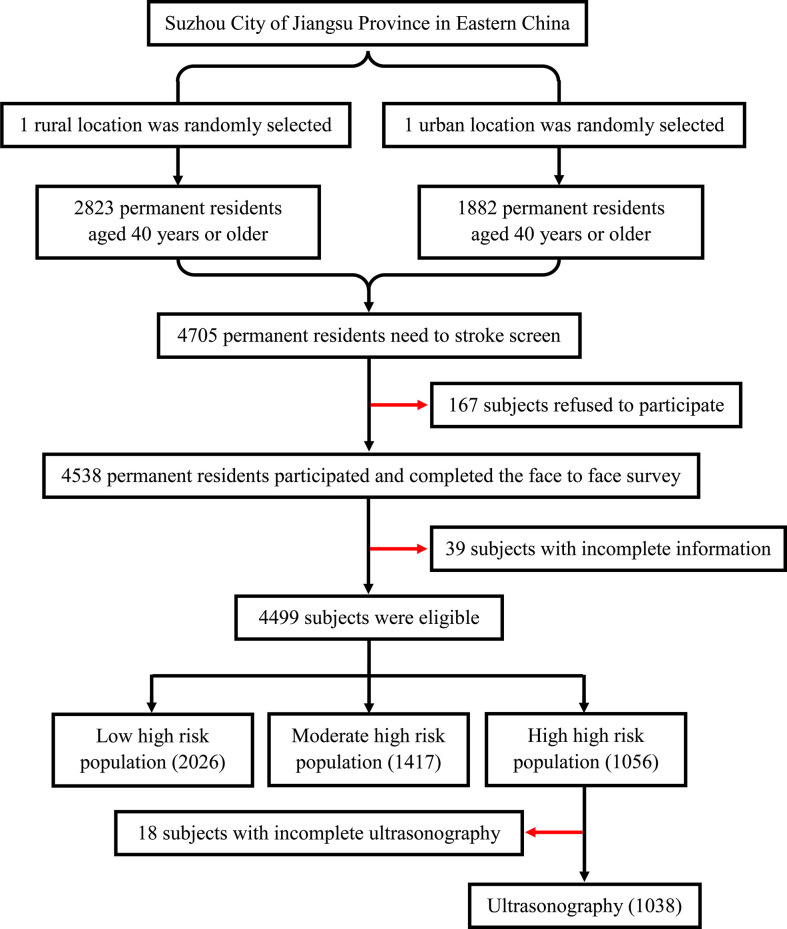
A total of 4,499 participants aged ≥40 years were finally included, with 23.47% comprising the high-stroke-risk population. The prevalence rates of increased intima-media thickness (IMT), carotid plaque, and cervical artery stenosis (CAS) in the high-stroke-risk population were 21.97%, 39.3%, and 6.1%, respectively. Subjects with higher TyG were still more likely to have carotid plaque. After adjusting for several established risk factors, compared with the TyG-Q1 group, the TyG-Q2, TyG-Q3, and TyG-Q4 groups were more likely to have carotid plaque (OR = 1.85, 95%CI = 1.28-2.67; OR = 1.51, 95%CI = 1.05-2.18; and OR = 1.29, 95%CI = 0.90-1.84). TyG was an independent predictor of the presence of plaque in the carotid artery of the high-stroke-risk population.
An elevated TyG index is a potential predictor of carotid plaques in the high-stroke-risk population older than 40 years.
颈动脉硬化(CAA)是中国脑卒中的重要危险因素。甘油三酯-葡萄糖(TyG)指数是缺血性脑卒中的一种简单且低成本的标志物。TyG 指数是否预测颈动脉硬化尚不确定。本研究旨在探讨 TyG 指数与颈动脉硬化的关系。
本横断面研究在中国东南部的一般人群中进行,纳入年龄≥40 岁的居民。所有参与者完成详细的问卷并提供血液样本。高卒中风险组进一步进行颈动脉超声检查。TyG 指数通过一个成熟的公式计算,并按四分位(Q1-Q4)进行分析。采用多变量 logistic 回归分析 TyG 指数与颈动脉硬化的关系。
共纳入 4499 名年龄≥40 岁的参与者,其中 23.47%为高卒中风险人群。高卒中风险人群中,内膜中层厚度(IMT)增加、颈动脉斑块和颈动脉硬化(CAS)的患病率分别为 21.97%、39.3%和 6.1%。TyG 较高的患者颈动脉斑块的发生率仍然更高。在校正了几个已确立的危险因素后,与 TyG-Q1 组相比,TyG-Q2、TyG-Q3 和 TyG-Q4 组发生颈动脉斑块的可能性更高(OR=1.85,95%CI=1.28-2.67;OR=1.51,95%CI=1.05-2.18;OR=1.29,95%CI=0.90-1.84)。TyG 是 40 岁以上高卒中风险人群颈动脉斑块存在的独立预测因子。
升高的 TyG 指数是 40 岁以上高卒中风险人群颈动脉斑块的潜在预测因子。