Center for Food Science and Nutrition, Addis Ababa University, Addis Ababa, Ethiopia.
Research Center for Inclusive Development in Africa (RIDA), Addis Ababa, Ethiopia.
Matern Child Nutr. 2024 Jul;20 Suppl 5(Suppl 5):e13452. doi: 10.1111/mcn.13452. Epub 2022 Nov 1.
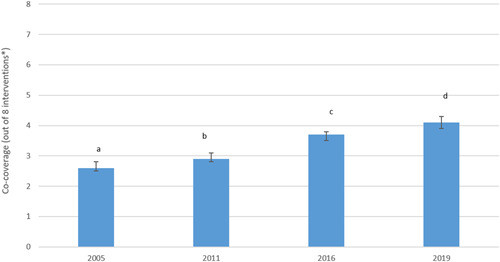
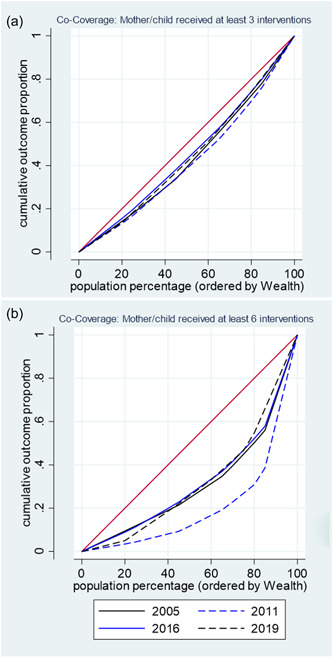
The health system is the primary vehicle for the delivery of nutrition-specific interventions that aim to reduce maternal and child malnutrition. The integration of nutrition interventions into existing health interventions is promising, but to ensure that no one is left behind requires that access to essential health services is equitably distributed. This study aims to assess trends and socioeconomic inequalities in coverage of reproductive, maternal, newborn and child health (RMNCH) and assess its association with child nutritional outcomes in Ethiopia. Using the Ethiopian Demographic and Health Survey (2005, 2011, 2016, and 2019), we estimated the coverage of RMNCH interventions in Ethiopia using the co-coverage index, which is a count of the number of interventions accessed. We assessed the trend and inequalities in co-coverage and evaluated its association with child nutritional outcomes like stunting, wasting, and minimum dietary diversity (MDD). The national co-coverage index has shown a significant increase over the 2005-2019 period. However, all of the RMNCH interventions constituting the co-coverage index showed a pro-rich and pro-urban distribution (p < 0.05). The highest inequality, based on the slope index of inequality (SII), was observed for skilled assistance during delivery (SII: 80.4%), followed by access to an improved source of drinking water (SII: 62.6%), and antenatal care visits (SII: 55.5%). The low coverage in RMNCH and the observed inequality were associated with stunting, wasting, and MDD. Reducing socioeconomic inequality in RMNCH is key to achieve the health, nutrition and equity-related goals of the Sustainable Development Goals.
卫生系统是提供旨在减少孕产妇和儿童营养不良的营养专项干预措施的主要手段。将营养干预措施纳入现有卫生干预措施具有广阔前景,但要确保不遗漏任何人,就需要公平分配获取基本卫生服务的机会。本研究旨在评估埃塞俄比亚生殖、孕产妇、新生儿和儿童健康(RMNCH)覆盖范围的趋势和社会经济不平等,并评估其与儿童营养结果的关系。本研究使用埃塞俄比亚人口与健康调查(2005、2011、2016 和 2019 年),使用共覆盖指数评估了埃塞俄比亚 RMNCH 干预措施的覆盖情况,该指数是指所获得的干预措施数量的计数。我们评估了共覆盖指数的趋势和不平等,并评估了其与儿童营养结果(如发育迟缓、消瘦和最低饮食多样性)的关系。全国共覆盖指数在 2005-2019 年间呈显著上升趋势。然而,构成共覆盖指数的所有 RMNCH 干预措施均表现出有利于富裕阶层和城市的分布(p<0.05)。基于不平等斜率指数(SII),最高的不平等是在分娩时获得熟练帮助方面(SII:80.4%),其次是获得改善的饮用水源(SII:62.6%)和产前护理次数(SII:55.5%)。RMNCH 的低覆盖和观察到的不平等与发育迟缓、消瘦和最低饮食多样性有关。缩小 RMNCH 方面的社会经济不平等对于实现可持续发展目标的健康、营养和公平相关目标至关重要。