Department of Humanities and Social Sciences (DoHSS), Indian Institute of Technology (IIT), Madras, India.
Institute of Rural Management Anand, Anand, Gujarat, India.
BMC Public Health. 2024 Jun 17;24(1):1605. doi: 10.1186/s12889-024-18857-4.
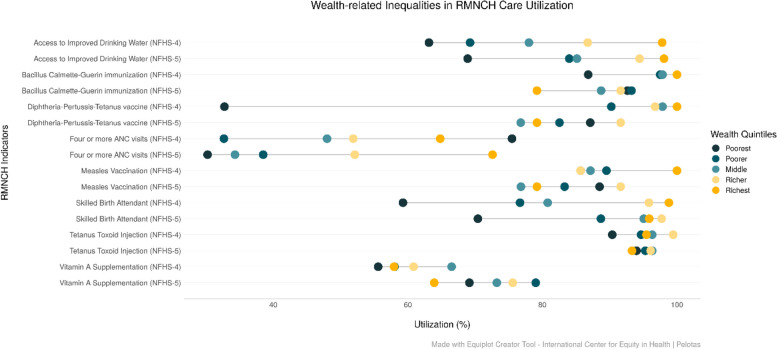
The utilisation of Reproductive, Maternal, Newborn and Child Health (RMNCH) services remains lower among the Scheduled Tribes (ST) in India than among the rest of the country's population. The tribal population's poorest and least-educated households are further denied access to RMNCH care due to the intersection of their social status, wealth, and education levels. The study analyses the wealth- and education-related inequalities in the utilisation of RMNCH services within the ST population in Odisha and Jharkhand.
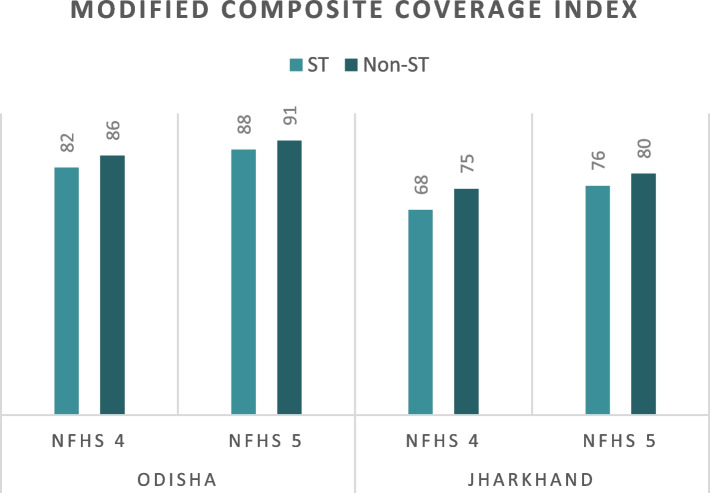
We have constructed two summary measures, namely, the Co-coverage indicator and a modified Composite Coverage Index (CC), to determine wealth- and education-related inequalities in the utilisation of RMNCH indicators within the ST population in Odisha and Jharkhand. The absolute and relative inequalities with respect to wealth and education within the ST population are estimated by employing the Slope Index of Inequality (SII) and the Relative Index of Inequality (RII).
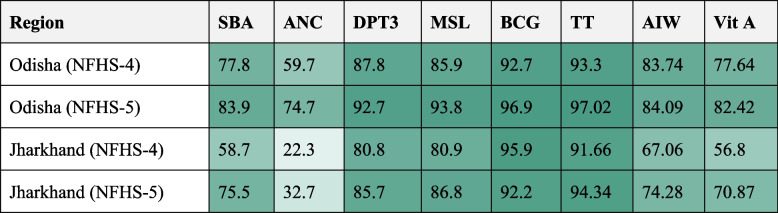
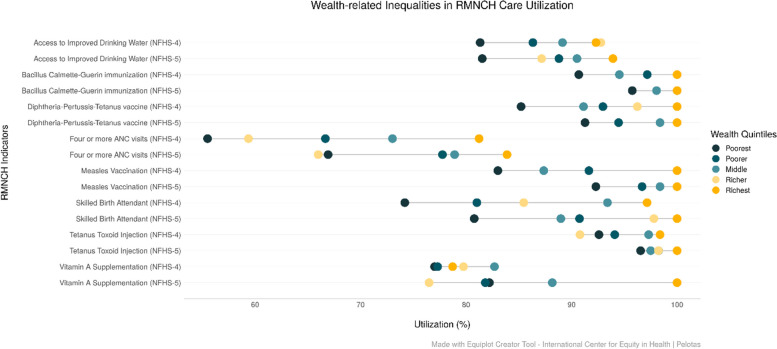
The results of the study highlight that access to RMNCH services is easier for women who are better educated and belong to wealthier households. The SII and RII values in the co-coverage indicator and modified CCI exhibit an increase in wealth-related inequalities in Odisha between NFHS-4 (2015-16) and NFHS-5 (2019-21) whereas in Jharkhand, the wealth- and education-related absolute and relative inequalities present a reduction between 2016 and 2021. Among the indicators, utilisation of vaccination was high, while the uptake of Antenatal Care Centre Visits and Vitamin A supplementation should be improved.
The study results underscore the urgent need of targeted policies and interventions to address the inequalities in accessing RMNCH services among ST communities. A multi-dimensional approach that considers the socioeconomic, cultural and geographical factors affecting healthcare should be adopted while formulating health policies to reduce inequalities in access to healthcare.
在印度,与全国其他地区相比,生殖、孕产妇、新生儿和儿童健康(RMNCH)服务在在册部落(ST)中的利用率仍然较低。由于社会地位、财富和教育水平的交叉,部落人口中最贫困和受教育程度最低的家庭进一步被剥夺了获得 RMNCH 护理的机会。本研究分析了奥里萨邦和恰尔康得邦在册部落人口中 RMNCH 服务利用方面的与财富和教育相关的不平等现象。
我们构建了两个综合指标,即共同覆盖指标和修正综合覆盖指数(CCI),以确定奥里萨邦和恰尔康得邦在册部落人口中 RMNCH 指标利用方面与财富和教育相关的不平等现象。通过使用不平等斜率指数(SII)和相对不平等指数(RII),估计了在册部落人口中财富和教育方面的绝对和相对不平等。
研究结果表明,受教育程度较高、家庭较富裕的妇女更容易获得 RMNCH 服务。在奥里萨邦,共同覆盖指标和修正 CCI 的 SII 和 RII 值在 NFHS-4(2015-16 年)和 NFHS-5(2019-21 年)之间表现出与财富相关的不平等现象增加,而在恰尔康得邦,2016 年至 2021 年期间,财富和教育相关的绝对和相对不平等现象减少。在各项指标中,疫苗接种利用率较高,而产前保健中心就诊和维生素 A 补充的利用率有待提高。
研究结果强调,迫切需要针对在册部落社区获取 RMNCH 服务方面的不平等现象制定有针对性的政策和干预措施。在制定卫生政策以减少医疗保健获取方面的不平等时,应采取考虑影响医疗保健的社会经济、文化和地理因素的多维方法。