DeCandia Carmela J, Volk Katherine T, Unick George J
Artemis Associates, LLC, 15 Main St. Suite 224, Watertown, MA 02472 USA.
C4 Innovations, Needham, MA USA.
Advers Resil Sci. 2022;3(4):365-380. doi: 10.1007/s42844-022-00080-y. Epub 2022 Oct 26.
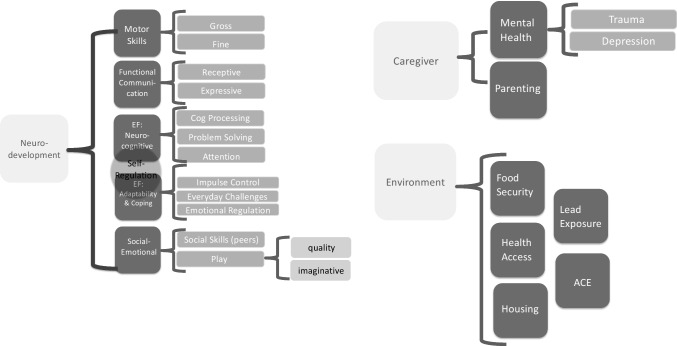
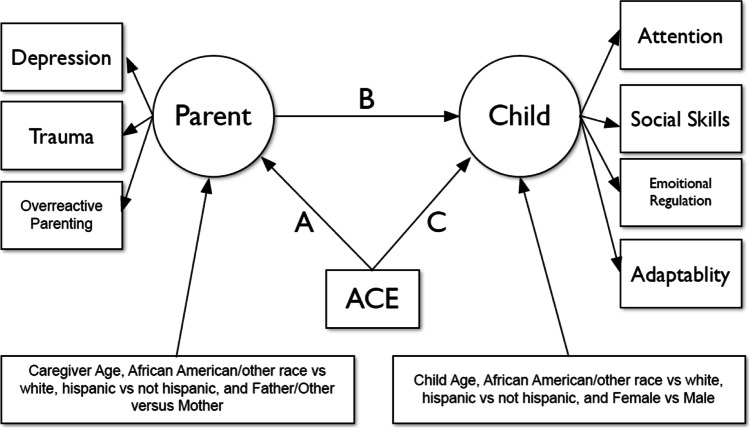
We investigated the conceptualization and impact of adverse childhood experiences (ACEs) in a sample of 231 children ages 3-5 living in poverty and experiencing homelessness, focusing specifically on caregiver well-being and housing instability. Data was collected using the Neurodevelopmental Ecological Screening Tool (NEST), which screens for developmental risk and resilience across three domains (neurodevelopmental, caregiver, and environment). We used structural equation modelling (SEM) to test the association between domains and ACE scores and assessed the impact on neurodevelopmental constructs. Fifty-five percent of the sample had high ACE scores (> 3), which were associated with lower attention, social skills, and emotional regulation. ACEs were strongly associated with 0.17 standard deviation units of higher levels of caregiver distress ( < .001), which was also associated with 0.26 standard deviation units of lower levels of child neurodevelopmental functioning ( = .001). For each unit increase in housing instability, there was a three-fourths increase in ACE (0.78 ACE at = .004); four or more moves were associated with the worst neurodevelopmental outcomes (53% of the sample). We must use an ecological, developmental lens to understand how early adversity impacts children, at what age, and in what context. Housing stability plays a critical role in developmental well-being and should be accounted for in conceptualizations of child ACE scales. Caregiver and child relationships are reciprocal, and so the impacts of ACEs are also bidirectional. Our policies and practices at individual, community, and systemic levels should account for these dynamics to improve child well-being.
我们对231名年龄在3至5岁、生活贫困且无家可归的儿童样本进行了研究,探讨童年不良经历(ACEs)的概念化及其影响,特别关注照顾者的幸福感和住房不稳定情况。数据通过神经发育生态筛查工具(NEST)收集,该工具在三个领域(神经发育、照顾者和环境)筛查发育风险和复原力。我们使用结构方程模型(SEM)来测试各领域与ACE分数之间的关联,并评估对神经发育结构的影响。55%的样本ACE分数较高(>3),这与注意力、社交技能和情绪调节能力较低有关。ACEs与照顾者更高水平的痛苦程度的0.17个标准差单位密切相关(<0.001),而这也与儿童神经发育功能较低水平的0.26个标准差单位相关(=0.001)。住房不稳定程度每增加一个单位,ACE增加四分之三(在=0.004时为0.78个ACE);四次或更多次搬家与最差的神经发育结果相关(占样本的53%)。我们必须从生态、发展的角度来理解早期逆境如何影响儿童、在什么年龄以及在什么背景下产生影响。住房稳定性在发展幸福感中起着关键作用,应在儿童ACE量表的概念化中予以考虑。照顾者与儿童的关系是相互的,因此ACEs的影响也是双向的。我们在个人、社区和系统层面的政策和做法应考虑到这些动态因素,以改善儿童的幸福感。