Xiang Guo-Xing, Gan Xiong, Jin Xin, Zhang Yan-Hong
Department of Psychology, College of Education and Sports Sciences, Yangtze University, Jingzhou, China.
Yangtze University College of Technology and Engineering, Jingzhou, China.
Curr Psychol. 2022 Oct 26:1-12. doi: 10.1007/s12144-022-03790-9.
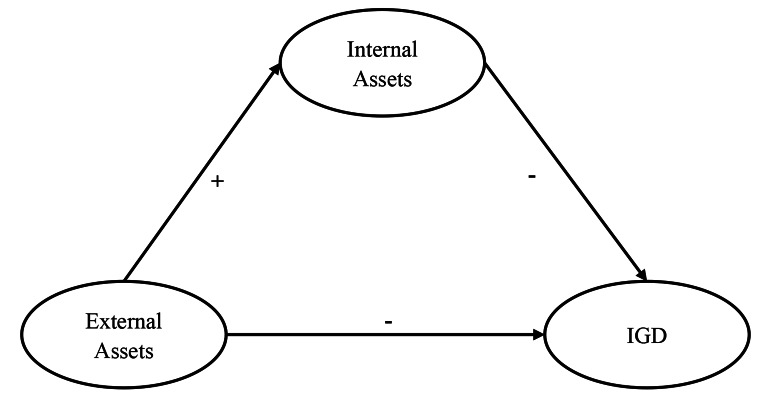
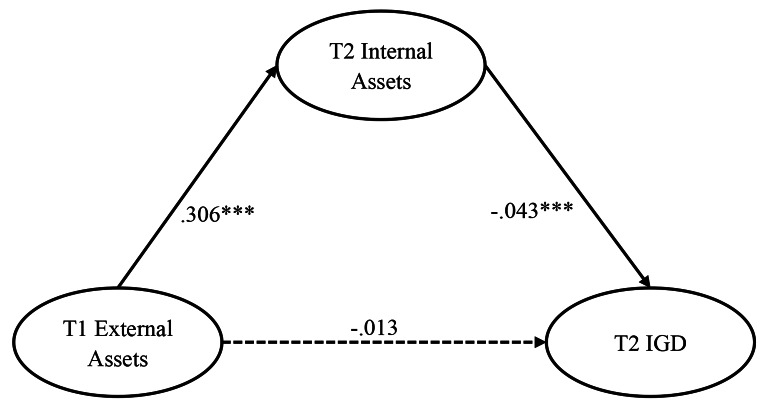
The COVID-19 pandemic has triggered the dramatical development and prosperity of online games, while worldwide people are suffering from it. Considering the high prevalence, serious impacts, and huge development potential of internet gaming disorder (IGD), it is extremely necessary to develop a protective model to prevent and intervene with it among young people. Based on the developmental assets theory, the present study adopted a two-wave longitudinal design to evaluate the cumulative effects of developmental assets on IGD, as well as the underlying mechanisms during this specific period. Data were collected from a sample of 1023 adolescents in Hubei province, Central China through self-report questionnaires. The results indicated that (1) developmental assets were negatively associated with adolescents' IGD concurrently and longitudinally; (2) the overall developmental assets had cumulative effects in linear patterns on adolescents' IGD, concurrently and longitudinally; and (3) internal developmental assets mediated the relationship between external developmental assets and adolescents' IGD longitudinally. Theoretically, the present study supports the developmental assets theory and expands the literature about developmental assets and IGD in younger generations. Practically, the present study provides guidance for prevention and intervention of IGD among adolescents during and after the COVID-19 pandemic. Comprehensive measures should be taken to assist in developing positive internal and external resources to promote youth thriving.
新冠疫情在全球人民饱受其苦的同时,引发了网络游戏的急剧发展与繁荣。鉴于网络游戏障碍(IGD)的高患病率、严重影响及巨大发展潜力,开发一种保护模型以在青少年中预防和干预IGD极为必要。基于发展资产理论,本研究采用两波纵向设计来评估发展资产对IGD的累积效应以及这一特定时期的潜在机制。通过自填问卷从中国中部湖北省的1023名青少年样本中收集数据。结果表明:(1)发展资产在横断和纵向层面均与青少年的IGD呈负相关;(2)总体发展资产在横断和纵向层面均以线性模式对青少年的IGD产生累积效应;(3)内部发展资产在纵向层面中介了外部发展资产与青少年IGD之间的关系。理论上,本研究支持发展资产理论,并拓展了关于年轻一代发展资产与IGD的文献。实践上,本研究为新冠疫情期间及之后青少年IGD的预防和干预提供了指导。应采取综合措施协助培养积极的内部和外部资源,以促进青少年茁壮成长。